Tuesday, July 12, 2016

What My Black Student Taught Me, His White Teacher, About Black Lives

By Steven Singer, Director BATs Research and Blogging

Originally published on his blog https://gadflyonthewallblog.wordpress.com/2016/07/12/what-my-black-student-taught-me-his-white-teacher-about-black-lives/

student_081910-thumb-640xauto-704
I can’t tell you how many times Darnell was in detention.
After a while, it didn’t feel right if he wasn’t staying at least an hour after school.
Darnell was late to class.
Darnell swore at another student.
Darnell copied someone’s paper.
Darnell did just about everything and anything that came to his mind. And it earned him time after school with me, his newly-minted 8th grade language arts teacher.
In a class full of mostly brown and black students, many living in an impoverished high crime Pittsburgh suburb, Darnell was the standout. Or at least his misbehavior was.
At first, he complained, but I had his mom on speed dial, and she fully supported my holding him accountable.
He wanted to do his homework during this time, but I made him do busy work instead. The way I looked at it as a young teacher just starting out, if I gave him time to do his school work, it would be a reward, not a punishment.
So I made him copy down dictionary definitions, clean the tables or put up the chairs.
And once he realized there was no way out, he did it all uncomplainingly.
But an hour is a long time, so after a while I let him work on his homework, too.
I had an awful lot of work to do, myself, during these times – piles of papers to grade and lessons to plan – so whatever would keep him quiet would be okay with me.
Unfortunately, Darnell didn’t work that way. He had questions. So many questions.
I had no time, but what else was I gonna’ do?
I answered him. With frustration at first while sitting at my desk.
Then I found myself walking over to him and standing at his table. Then I sat down next to him. And pretty soon we were doing the homework together.
But an hour is a long time, so sometimes he’d finish early. I offered to let him go.
He didn’t want to.
He’d stay and talk: “Did you see the football game, Mr. Singer?”
Or “Did you hear the new Beyoncé album, Mr. Singer?”
Or “How many kids do you have at home, Mr. Singer?”
One day I remember the last bell ringing and looking up to see Darnell at his desk doing homework. I looked back at my stack of papers before I realized – Darnell didn’t have detention today.
I laughed. “You can go home, Buddy,” I said.
“I know,” he replied. “Is it okay if I stay and get this done?”
I shouldn’t have been so surprised. But I was.
I nodded, and he stayed.
I won’t say Darnell ever became a perfect student. He just didn’t have the patience for detailed work. He was more of a big picture guy.
But after months of never turning in homework – years, really – he began to turn all of it in. And I mean all of it!
He wasn’t a great speller, but he started ending all of his sentences with punctuation. And he started all of his sentences with a capitalized word.
He wasn’t a great reader, but he did crack open a few books. Nothing too difficult or complex, but it was more than any teacher I talked to had ever seen him read previously.
At the end of the year, I remember pausing by his desk and praising him.
“Darnell, that’s some mighty fine work you did in here this year,” I said.
And he got this big ol’ grin on his face like he used to get before he was about to engage in some random act of mischief.
“Thanks, Mr. Singer. You’re a really good teacher.”
I smiled and said, “No, Darnell. You’re a good student.”
I remember looking him in the eye to emphasize it. This was a kid with a reputation. I’ll bet few teachers had ever commended him on his school work before.
Then the year ended, and he was gone.
He went on to 9th grade and did even better than in my class. The same in 10th, 11th and 12th.
Oh, sure. He was still a handful and got himself in trouble lots of times. But he did his work and didn’t fail his classes.
I kept an eye on him like I do all my students when they leave me. I try to keep tabs, but there’s always a new bunch just waiting for you at the beginning of the year.
You remember anytime you think about it, which isn’t much.
So it was years later when I heard the news.
Teachers were shaking their heads in the faculty room. The principal held a meeting to tell us about it in case any of our current students were upset, in case any of us had Darnell’s cousins, brothers, sisters, or friends.
He was only 18 when he was murdered.
Shot down in the streets from a passing car.
Police still don’t know whether he was the shooter’s target or if he was just at the wrong place at the wrong time.
The high school teachers, who knew Darnell best, said he had really straightened up his act. He had gotten into community college, wanted to be an engineer.
And they shook their heads. What else was there to say?
I walked back to my classroom and opened a file cabinet.
Inside was a bunch of dusty manila folders – one for each child I had ever made serve a detention.
It didn’t take long to spot Darnell’s. It was one of the thickest.
I opened it up and took out the stack of papers inside.
There were doodles of monsters and basketball players. There were lists of badly spelled vocabulary words in his adolescent handwriting. And there were these halting paragraphs about what he’d done to get detention and how he’d never do it again.
“I’m sorry I wuz late 2 class. I will ask to use bathrom before going.”
“i will not copy LaRonns paper. i will do it myself.”
I read through them all. Every one. I read them again and again until long after everyone else but the janitors had left the building.
I had spent so much time with Darnell.
I had poured my soul into that kid.
But what had it truly accomplished?
He is dead. A victim of his environment. Nothing but a number, a statistic, a footnote.
Just not to me.
By all accounts he had been trying to do good, trying to make something of himself. But it wasn’t enough. Bullets don’t discriminate between the hardworking and the lazy. They just do what they do.
In my mind I tried to see him walking home, a stack of books weighing him down, making him slow. I saw him walking past those ramshackle apartments and slums, that shady park with the broken benches, the street corners where you could buy heroin or pills or weed.
If he was white, would it have been different? If he was white and didn’t live in the “bad neighborhood,” would it have mattered?
If his mom didn’t have to work two or three jobs, would it have helped? If he had someone at home to watch him instead of a bunch of younger siblings and cousins to watch, would things be different?
I don’t know.
But I DO know that there is a list of dead children in my community – some of them my former students – and almost all of them are black.
Darnell wasn’t killed by a policeman, but I’m sure they knew his name. He used to tell me how the cops would often follow him and his friends into the grocery store. “Why they always be doin’ that?” he’d ask me. And I’d just shrug thinking about all the times he’d wait until I wasn’t looking before slapping another child on the neck.
But if Darnell had been white, would we have had different expectations of him? Would we have given him the benefit of the doubt to begin with – like we do white kids?
I wasn’t a very good teacher to Darnell. Every scrap of respect I gave him he had to earn. Why didn’t I give him that respect at the start? Why didn’t I expect the best and then change my expectations as the situation dictated? Why did I instead expect the worst and alter my expectations from there?
I never questioned if or why Darnell was seeking my attention. I just thought of his bad behavior. It was something I wanted to change, so here’s a punishment.
I never offered Darnell my help. I offered help to the class as a whole but not to Darnell individually. Not until he wore me down. Not until helping him was easier than arguing with him.
I never thought about Darnell’s needs. I thought about MY needs of Darnell. I need him to behave so I can teach. Never Darnell’s needs to behave so he can learn.
And there are so many other kids out there like him. I’ve taught so many other little Darnells.
I approach them differently now. It’s a lesson he taught me.
I may have bestowed upon him some spelling and grammar. He taught me humanity. Who is the better teacher?
He taught me to look at black children in a different way.
He taught me to come to them on their terms. To begin anew with an expectation that they will do well no matter what they’ve done in the past. He taught me to look beyond their behaviors and see them as little people. It’s a lesson I’ve never forgotten, and it informs my teaching to this day.
As I sat there with that stack of dusty folders, I realized it doesn’t end at the classroom door.
I used to think being a parent, myself, I had an interest in the future. But that’s not entirely true. Being a parent is one of the most rewarding things you can do, but it isn’t selfless. It only means you care about your child. Not all children.
And that’s where being a teacher is different. After a while, you can’t be selfish anymore. You can’t care for only some people’s futures. You are essentially invested in a future for all, for everyone.
You can try to draw a line in the sand and say “I only care about THESE kids,” but it doesn’t work. You find yourself caring about all of them, all of the children who will become our world when we crumble to dust.
That’s how it should be for everyone.
As a human being, it is my responsibility to fight to make this world a better place for people like Darnell. It’s my responsibility to make sure they all have a future.
But it goes beyond even that. I’m not just any person. I’m a white person.
All the things stacked against a kid like Darnell were stacked in my favor. I lived in a good neighborhood. Police never followed me anywhere. No matter how much I misbehaved, it was always expected I wouldn’t cause any trouble – unless I did.
So it’s my responsibility as a white person to fight my privileged place in society. It’s my responsibility to ensure that black people aren’t held back by entitlements I have not earned and handicaps they do not deserve.
As a white teacher, it is my responsibility to see the best in my children – in ALL of my children. It is my responsibility to meet them where they are and give them support and nurturing and love.
To do so I must see beyond the walls of invisible prejudice. I must see the hurdles, the traps, the maze so I can help them overcome it.
Because Darnell never got to go to college. He never got to become an engineer.
But his life mattered.
The Image from DC
By Jesse "The Walking Man" Turner


The image from DC that reminds why I march. 
How do we tell her that 49 states spend more money on their wealthy schools than their poor schools?
How do we tell her spending on prisons grew three times faster than spending on our public schools?
How do we tell the data from the past 15 years proves that every Market-based education reform policy has failed our children?
How do we tell her that 15 years of more testing has resulted in lower test scores, but our nation's leaders can't let testing go?
How do tell her legislators are slashing school budgets again? everywhere?
How do we tell her that her that her legislators are cutting Librarians in our public schools?
How do we tell her that her that her legislators are cutting school nurses in our public schools?
How do we tell her that her that her legislators are cutting music teachers in our public schools?
How do we tell her that her that her legislators are cutting art teachers in our public schools?
How do we say to her your future doesn't matter enough to:
America's wealthy,
America's powerful, and
America's connected to give her the public education she deserves?
How do we live with ourselves, if we don't fight for her future?
Still marching,
Jesse The Walking Man Turner


Racism is Just One of Two Things Shown in Alton Sterling Killing

By Steven Singer - Director of BATs Research and Blogging

Originally published on his blog https://gadflyonthewallblog.wordpress.com/2016/07/07/racism-is-just-one-of-two-things-shown-in-alton-sterling-killing/

-1dd3afa605e6bc1d
Americans are notoriously bad at holding two thoughts in our heads at the same time.
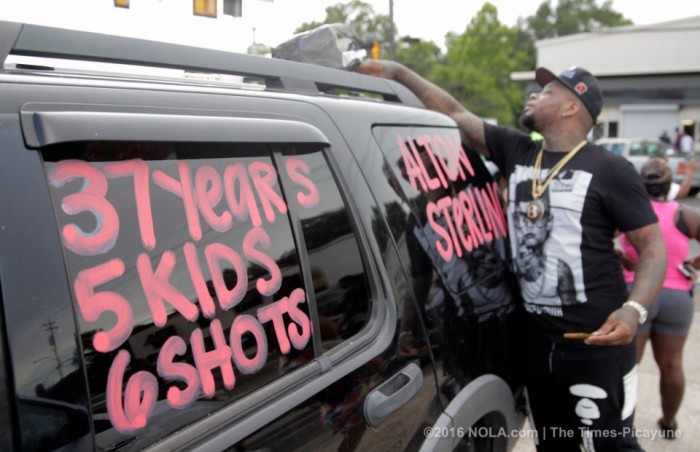
We look at the police shooting of Alton Sterling and can’t decide whether it was racist or if the 37-year-old black man just had it coming.
But we’re missing the point. Sometimes twice.
Baton Rouge Police shot and killed the father of five on July 5th.
The 37-year-old man was killed outside a convenience store in Louisiana because police allegedly got a tip someone was selling CDs and was armed. In the resulting scuffle, Sterling was shot and killed.
If the whole thing weren’t caught on a cell phone video, it probably wouldn’t be more than a sad headline. Just another black dude killed by police.
But the resulting attention has made his name a hashtag and his death a source of outrage – for good reason.
On the video, police tackle Sterling to the ground before gunshots are heard.
One of the officers shouts “gun” before shooting, but store owner Abdullah Mulfahi told the media that Sterling’s hand was not near any weapon and the alleged gun later recovered from his pocket was not visible.
People watch the video (or not) and immediately take sides.
Who is to blame – the police or Sterling?
Was the black man armed? Maybe – though Louisiana is an open carry state so he would be within his rights to do so.
What should he have done when confronted by police? What actions of his might have resulted in police not shooting him dead?
Did he have a record? Is that even relevant since police had no access to that information at the time?
Typically people come to conclusions based on their convictions and not based on the evidence. If you think black people are being victimized by police, then you’re probably on Sterling’s side. If you think black people are naturally violent and police rarely do any wrong, you’re probably on the side of law enforcement.
But what both sides are ignoring is a sense of context.
This was the 15th American killed by police so far in July alone.
Not the 15th black person. The 15th person. Period.
There’s some dispute over exactly how many people have been killed by police so far this year, but the number is surprisingly high. You’d think that would be something the federal government would keep track of, but no. The FBI’s Uniform Crime Reporting Program tabulates every criminal statistic imaginable – except homicide by law enforcement. Alarmingly, it leaves this to the private sector – almost as if it had something to hide.
Much of this is done by the news media, both in and out of the country. The Washington Post puts the number of Americans killed by police this year at 505 people. The Guardian puts it at 560. An open sourced database called Killed by Policeputs the number at 580.
Any way you look at it, no matter which tally you go with, 2016 is turning out to be one of the deadliest years for police shootings since people have been counting.
It’s a problem for everyone. Police should not be killing such high numbers of civilians. In fact, in other countries, they don’t. Police kill more people in the U.S. in days than they do in other countries in years.
For instance, U.S. police killed 59 people in 24 days last year. In England and Wales, 55 people were killed by police in 24 YEARS!
And the numbers aren’t that high solely because the United States has a larger population. The entire nation of Canada has about as many people as the entire state of California, yet Canadian police killed 25 people last year to 72 by California law enforcement.
That may be due in part to a lack of accountability.
Despite such high body counts in this country, not a single police officer has served jail time for it in the last few years. Several officers went to trial in 2016, but none were convicted, according to the Wall Street Journal.
Last year had the highest number of officers being charged for shooting civilians in a decade. That number? 12. And none of them – not one – was convicted of murder or manslaughter.
We have a real problem here. American police kill far too many people.
However, this doesn’t mean that racism isn’t a motive in many of these police shootings. In fact, the numbers back that up.
Though more white people are killed by law enforcement in this country, it is black people who are killed at a disproportionately high rate. They only make up 13.2% of the population, yet they are twice as likely to be killed by police as whites. Nearly a quarter of all police homicides this year resulted in dead black folks.
What’s going on here?
First, we live in a police state. Officers often kill suspects with impunity and face little to no consequences. Not all police, certainly, but far too many.
Second, black folks are killed more regularly by police than whites. In fact, if all things were equal, you’d expect MORE white people to be killed than already are.Whites make up 77.7% of the population, yet they account for only half of the victims of police shootings.
This isn’t because black people are so much more violent than whites. According tothe Center on Disease Control’s annual Youth Risk Behavior Surveythey engage in violent behavior at similar rates to whites.
For instance, they carry a weapon (whites 17.9% to African Americans 15.2%) and carry guns (whites 5.5% to African Americans 6.5%) at about the same rates. However, blacks are twice as likely to be arrested for weapons possession.
The same holds for assaults. African Americans report being in physical fights at similar rates (36.5% versus 32.5% for whites) but are three times more likely to be arrested for aggravated assault.
It should come as no surprise then that black people are more likely to be killed by police. This holds with everything else we know. When it comes to the criminal justice system, black people are penalized more often and that includes being shot and killed by law enforcement.
Why? Because they’re black. Because of societal attitudes, fears, phobias and prejudices.
For many of us, when we see Sterling’s last moments enacted on that cell phone video, we’re confronted with that fact. We put ourselves in his position. What could he have done differently? Whether he was guilty of a crime or not, what action on his part would have assured that he got out of this situation alive?
Eric Garner was choked to death by police while repeatedly saying, “I can’t breathe!”Tamir Rice was shot by police in two seconds. What exactly could a black person do to avoid being shot if law enforcement already perceives him or her to be a threat?
These are important questions. But they aren’t the only ones.
America has a problem with police violence. In fact, it has two problems. And we can’t solve one without solving the other.
We have to come to terms with this. It is not a case of racism or a police state. It is a case of BOTH.

Saturday, July 2, 2016

Big Money Fails to Oust In-Coming Pittsburgh Schools Superintendent

By:  Steven Singer, Director BATs Research and Blogging
Originally published on his blog https://gadflyonthewallblog.wordpress.com/2016/06/30/big-money-fails-to-oust-in-coming-pittsburgh-schools-superintendent/
DSC-4973-1
Democracy 1, Oligarchy 0.
That might be the score in the latest contest between corporate education reformers and the Pittsburgh Public School Board.
Special interest groups and the media had stirred up controversy for months over one line in newly hired superintendent Anthony Hamlet’s resume.
The board voted 7-2 not to cancel his contract. He will be sworn in tomorrow to start a 5-year commitment in the city.
He had been unanimously hired May 18 from the Palm Beach County district in Florida where he had distinguished himself with an excellent record of leadership and enacting authentic reforms.
Though critics cited one line in his resume as too similar to a statement in a Washington Post article, the real reasons for the dispute are ideological.
Put simply, Hamlet favors reforms that have nothing to do with teaching to the test, charter school expansion, closing schools and other market driven policies.
This put him at odds with the usual gang of corporate sycophants:
1) The Campaign for Quality Schools Pittsburgh – a PAC recently formed to Make City Schools Great Again by promoting charter schools and other failed neoliberal reforms.
2) A+ Schools, an advocacy organization that used to champion the same kinds of authentic reforms school directors are trying to enact with Dr. Hamlet’s help. However, after getting a fat check from the Gates Foundation, the group has became a cheerleader for privatization and disaster capitalism.
3) Various foundations who immediately offered to pay for a new superintendent search if the district dismissed Dr. Hamlet – a measure that probably would have meant paying him at least a year’s salary to sit at home.
Why?
In short, they want a superintendent who thinks like them who they can control. They want to undermine our elected school board and community input process. They want to further THEIR agenda – not the education of our children.
Pittsburgh school directors are to be congratulated for not giving in to the monied interests.
Even the two directors who voted to remove Hamlet did so for good reasons. Though I thoroughly disagree with them, I think Terry Kennedy and Lynda Wrenn truly have the best interests of students at heart. They have always voted that way before.
It’s easy to write a blog about a district where you don’t live, as I do. They, however, are accountable to their constituents. I’m just a doofus with a WordPress account. They had a lot of information to process and made a tough decision. Thankfully, the other seven board members didn’t see it their way.
But that’s the beauty of it. This was democracy at work! At so many other urban districts throughout the country – even in similarly troubled Philadelphia – decision making “by and for the people” has become disbarred.
Many schools like Pittsburgh’s with a shrinking tax base, large pockets of crippling poverty and a history of state disinvestment are taken over by the state. Bureaucrats and flunkies make these decisions not members of a duly elected school board held accountable by the voters.
In fact, many calling for Hamlet’s dismissal were surely cheerleading just such a move in Pittsburgh. They were hoping to show that democracy doesn’t work in the Three Rivers community and must be replaced with … THEMSELVES.
The defeat of that position is the biggest victory here.
Now Hamlet and the board will get a chance to enact authentic reforms to help the children of Pittsburgh get the best possible education.
Now Hamlet will get to strengthen the restorative justice project already under way at 20 city schools. Instead of simply assigning detention or suspension for student misbehavior, administrators are encouraged to make students set things right after doing wrong.
In Florida Hamlet made a name for himself partnering with the criminology department at Florida Atlantic University on this same project.
It’s widely acknowledged in education circles that suspensions can have lasting impacts especially on black students making them more likely to enter the school-to-prison pipeline. Finding an approach to increase discipline without adversely affecting students’ prospects is imperative. This is especially true since Pittsburgh Public Schools have been known to suspend black students at a rate four times higher than white students.
Hamlet also will get to enact measures to transform Pittsburgh’s schools into a central part of the community and not apart from it. Like many on the board, he is an advocate for community schools. That means pushing for social services to help students and the community to make the schools the center of the neighborhood.
Hamlet has received support from all over the city including from the Pittsburgh Federation of Teachers.
However, in an unexpected move, some educators came out individually in favor of Dr. Hamlet even though doing so might mean putting targets of their backs from corporate forces.
High School teacher Jon Parker even wrote a blog about the issue where he pulled no punches:
“While the [Pittsburgh] Post-Gazette is complicit in this scheme to defame and destroy Dr. Hamlet, the real enemy here, as always, is A+ Schools. They simply cannot pursue their Gatesian agenda with a superintendent who believes in community schools. They need one who believes in firing teachers. They can’t pursue their agenda if the superintendent believes in collaboration rather than stacked ranking. And they can’t pursue their agenda of closing schools and turning them into charter profit factories if the narrative in our schools shifts away from “achievement” being measured by high stakes tests. Simply put, Anthony Hamlet is not their style, and they can’t stand that Pittsburgh’s community, through real grassroots activism and real community empowerment, elected a school board which genuinely engaged its community in a selection process that produced a once-in-a-lifetime superintendent selection.”

Erin P. Breault, a district teacher with three children who graduated from Pittsburgh Public, wrote to the Post Gazette to praise Dr. Hamlet:
“First, he will be a fine superintendent who will work to foster community schools, increase student learning outcomes and graduation rates. He will be an especially welcome breath of fresh air, not beholden to corporate “reformers” agenda. Second, I am especially alarmed about growing calls for his contract to be dissolved and if it is not, that our democratically elected school board be replaced by an appointed system.
This is outrageous. These attacks on Mr. Hamlet and on the process of the search need to be viewed in context. There are powerful interests including the Pittsburgh foundations, A+ Schools and Students First who are upset that their vision of privatization of our public schools has been challenged by our school district.
They have leapt into action, using their money, and political clout to engage into what amounts to character assassination.”

Kathy M. Newman, an associate professor of English at Carnegie Mellon University, wrote to the Post Gazette to school them on the definition of plagiarism:
“Mr. Hamlet’s resume is not a copyrighted work of art or nonfiction, such as a novel or a work of history. Nor is it a work of journalism. He was not trying to “pass off” (a legal term) the work of another artist or historian or journalist as his own.
…the outrage over Mr. Hamlet’s resume doesn’t acknowledge why it is that we demand citations from students and historians, or why artists might sue those who have appropriated their work. As the scholar Steven Dutch has argued, in an article called “Sense and Nonsense about Plagiarism,” citations “allow readers to check the accuracy of facts, gauge the credibility of the ideas being presented, know whether an idea is solidly established, controversial or hypothetical, and find further information.” When Mr. Hamlet borrowed a sentence from a Washington Post editorial to express his educational philosophy he did not, to use another phrase from Mr. Dutch, diminish the “credibility of the ideas being presented.”
Finally, the furor over Mr. Hamlet’s resume has had a tone of moral outrage so hysterical that I have been concerned about the toxic mixture of sanctimony and glee expressed by many people I otherwise like and respect. Again, according to Mr. Dutch, “the institutional hysteria over plagiarism [can become] a ‘witch-hunt.’ … Charges of plagiarism are fast becoming the blood sport of choice among academic bottom-feeders.”
Ouch. But perhaps the most incendiary remarks came from Churchill residentLorraine Turner. In the Post Gazette, she accused the paper of outright racism in its criticism of Dr. Hamlet:
“As an African-American, we are taught this particular lesson many moons ago (along with the talk about police) growing up in, “Pittsburgh, Mississippi.” That lesson is: Black people must run twice as fast and jump twice as high as their white competitors. Black people must be exceptional with every “i” dotted and every “t” crossed. The comparison of President Barack Obama and Donald Trump will highlight this lesson…
…The editorial goes on using language to highlight nearly every antiquated, racist stereotype referencing black men: Mr. Hamlet made a “perfunctory apology” (he didn’t bow his head and say, “I’se so sorry), Mr. Hamlet “sounded like a nervous student” (just call him boy), then “a bad superintendent” (black is bad), “a good superintendent” (one approved by someone white), Mr. Hamlet “prefers recalcitrance to transparency’ (recalcitrance is when one is stubbornly resistant to authority or guidance — he thinks he’s actually going to have the power of the superintendent!)…
… I hope the board quotes a line from “The Wizard of Oz,” and tells your good ol’ boy editorial staff what the Good Witch of the East told the Bad Witch of West: “Go away, you have no power here!”
In the end, the power of the monied elites evaporated against the power of good ol’ fashioned democracy.
Because the fight against corporate education reform is a fight for representative government.
And the winners of today’s battle are as always our children, our grandchildren, our posterity.

Without Black Culture There Would Be No American Culture

By:  Steven Singer, Director BATs Research and Blogging
Originally published on his blog - https://gadflyonthewallblog.wordpress.com/2016/06/28/without-black-culture-there-would-be-no-american-culture/
Screen shot 2016-06-28 at 12.10.37 AM
“We’ve been floating this country on credit for centuries, and we’re done watching and waiting while this invention called whiteness uses and abuses us, burying black people out of sight and out of mind while extracting our culture, our dollars, our entertainment like oil – black gold, ghettoizing and demeaning our creations then stealing them, gentrifying our genius and then trying us on like costumes before discarding our bodies like rinds of strange fruit.”
With these words, Jesse Williams absolutely floored the crowd at the BET Awards Sunday night.
His acceptance speech for the Humanitarian Award was jaw dropping.
Here was a black actor on “Grey’s Anatomy” just telling it like it is on national TV.
He wasn’t afraid a business dominated by white people would take offense (and some white people did). Or if he was, he wasn’t going to let it stop him.
The activist who recently produced a documentary “Stay Woke: the Black Lives Matter Movement” said, “The burden of the brutalized is not to comfort the bystander… If you have a critique for the resistance… then you better have an established record of critique of our oppression.”
No more tone policing. No white fragility. Just if you’re with us, stand up – otherwise, sit down and shut up.
It was beautiful. And it got me thinking.
There are so many obvious truths about our country’s relationship with race that hardly anyone ever gives voice to – especially a white person like me.
So I’m going to add my voice to Jesse’s. I’m just going to say it.
It’s past time we admit it, white people.
I don’t mean to say that white people are incapable of culture or that if black people had never been kidnapped and brought to our shores as slaves that white people wouldn’t have been able to devise a unique national character.
But if that had happened, it would have been a very different character than what we have today.
It might be America, but it would not be our America. It would be some other thing. I will leave it to speculative fiction to attempt to determine what that might have been like.
However, we need not resort to fantasy to see all the incredible things black people have given us. They’re everywhere, in everything – though usually staring back at us through a white face, heard from a white voice and monetized by a white industry.
The hundreds of years of struggle from slavery through Jim Crow through the modern prison state have given black people plenty of fertile ground with which to build our national culture. Traditionally white people have served as both oppressors and appreciators of the fruits of that oppression.
The most obvious example is music.
There is very little American music not based on black traditions. Even if it is performed by white musicians, even if it is written by white musicians – almost all American music owes an overwhelming debt to black people.
Take rock n’ roll, a style usually associated with white people. The majority of rock musicians are white. The majority of rock stars are white. The majority of rock listeners are white.
But it couldn’t exist without black music – specifically blues and jazz.
Rock n’ roll was invented during the second great migration, when black people from the southern United States came into contact with large groups of whites in big cities such as New York, Chicago, Cleveland, Buffalo, etc. It was the first time many white people heard black music like blues, work songs, etc. It was also the first time many black people heard European instrumentation. The resulting cultural collision was extremely fruitful.
Rhythm and blues (sometimes called “race music”) evolved into distinct new styles – country, jazz, gospel, folk and rock. In many ways the different styles had less to do with actual differences in the music than in rebranding black music for a white audience. When a black musician became known for a particular kind of music, the fledgling music industry tried to monetize it by finding a white musician who could do something similar and thus reach a larger audience.
They figured if X number of white people will listen to this music played by a black musician, X plus thousands more will listen to it if played by a white one. And they were right.
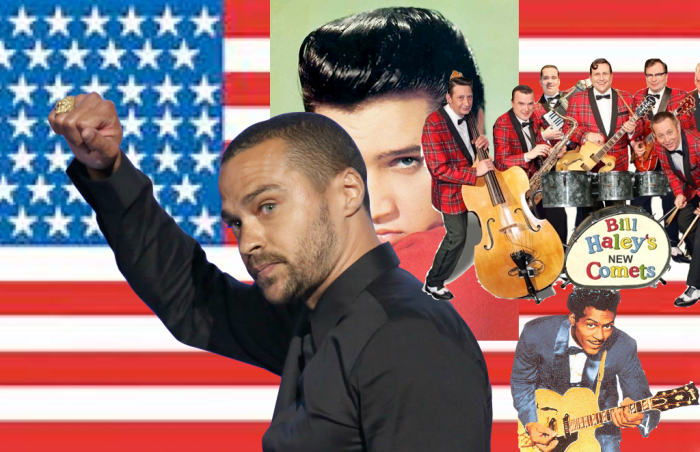
Black musician Chuck Berry was one of the first to play what we’d recognize as rock n’ roll. He took standard jump blues and played the two-note lead line on his guitar that until then was typically performed on piano. He put guitar at the center of the sound, amplified it, electrified it and rock was born.
The genre developed organically with many black musicians taking the lead – Fats Domino, Sister Rosetta Tharp, Goree Carter, Jimmy Preston, Bo Diddley, Little Richard, Joe Hill Louis, Guitar Slim, Howlin’ Wolf and many others.
However, the first certified rock hit “Rock Around the Clock,” was recorded in 1954 by an all white band, Bill Haley and His Comets. With this recording, the die was cast. The music was invented and developed mostly by black musicians, but it wasn’t a major success until it was recorded by white musicians.
The same thing can be seen with Elvis Presley, the so-called “King of Rock n’ Roll.” He wasn’t breaking any new ground. He was just the first white person who could sing like the black blues musicians who came before him. They toiled in obscurity. He cashed in.
This isn’t to say that no black musicians succeeded playing rock n’ roll. But it was predominantly white musicians who popularized the style that their black forebears had created.
To understand this, perhaps it is best to turn to the insight of Amiri Baraka (formerly known as LeRoi Jones). In his classic book “Blues People,” he dissects the complex American relationship of race and music through the 1960s.
Baraka writes that white and black America have different value structures. As such it is a very different thing for a black American and a white American to play the same music.
When a black musician like Louis Armstrong played jazz music – another invention of black culture – he was fulfilling the ideals of his culture. By contrast, when a white musician like Bix Beiderbecke played jazz music, he was rebelling against his.
There is something jarring and revolutionary when white musicians play black music, Baraka writes. In doing so, the music becomes devoid of race. It is no longer black music. It is just music.
However, the musicians who created it are not likewise freed from the ghetto. They’re still black even if their music no longer is.
So what are black musicians left to do but create new music that they can call their own?
This may explain why so few black performers play rock music anymore. It was taken from them. They had to move on.
Even so, their fingerprints are all over everything that came after. The Beatles, Rolling Stones, Led Zeppelin, Metallica, all the way through the White Stripes and Black Keys. Ask any hardcore fan to name the best rock guitarist who ever lived, and the answer is bound to come back – Jimi Hendrix. Yet, Eddie Van Halen made an awful lot more money.
Perhaps the most incredible thing is that black musicians have continued to develop new and more creative music after every appropriation. Funk, Rap, Pop, Hip Hop, modern R&B. One can see all of it as a progression of gentrification and subsequent creation.
As Williams said to end his speech this weekend, “…just because we’re magic doesn’t mean we’re not real.”
Black people have achieved amazing things in America. But white people rarely give them their due.
For instance, people generally think of rap as a black thing. But the largest audience for the genre is us, white folks.
There’s something jarring about white teenagers singing along with every n-word in the lyrics of a black rapper’s song as if these kids had the right. We don’t, people.
As Baraka might say, it’s a very different thing when we say it. But it’s more than just rebellion.
Too often white people turn to music that is characterized as black as a way to mock that culture. We demand black culture be commodified in a way that makes sense to our vision of what black people are. And when someone like Williams comes forward to call us out on it, we resent it.
Look around, white folks.
We love our culture, but we’re ignorant of our history.
We enjoy living vicariously through a marketed vision of black struggle but we don’t do anything about the actual struggle before our eyes.
Our black brothers and sisters are crying out in pain. And we’re the cause.
No, we probably didn’t light any crosses afire on anyone’s lawn, but what about our attitudes? What do we say when race comes up? Do we indulge in gut reactions of colorblindness or do we actually listen to what black people have to say? Do we do anything but shrug?
This isn’t about white hate or white guilt. It’s about accepting our responsibilities.
We owe black people much of our very idea of what it is to be an American. Isn’t it time we started paying it back with love and action?

¡Solidaridad!  #Oaxaca
By:  Kimberly Mooney 


Too often it is forgotten that dissent is an essential part of democracy.  This is especially true when dissenters disrupt what we expect to be our daily routines. The recent murders of striking teachers and their allies in Oaxaca, Mexico is the latest in a long string of actions on the part of government entities that illustrate how far we have yet to go to guarantee even basic civil liberties to all.  


On Wednesday, June 29th, about a week and a half after the most recent acts against the protesters in Oaxaca, a number of my colleagues who work in the Baltimore City Public School System as well as some retired educators from the DMV area joined me in D.C. to protest this and other acts of violent repression, such as the kidnapping and murder of 43 students from the Ayotzinapa Rural Teachers’ College.  One teacher, seeing my post in a teacher group on Facebook about this protest in D.C. questioned why we’d be worried about what’s going on in Mexico when we have problems in our own education system here.  I responded that this is not an either-or situation.  I said that for two reasons:  one, as Martin Luther King Jr. asserted, “an injustice anywhere is a threat to justice everywhere,” and two, this problem IS our problem.

What are some of the things that the teachers in Oaxaca have been organizing against? 
1.  Increased testing to qualify teachers to keep their jobs, which sounds reasonable unless you listen to the teachers from remote, poor, mountainous villages who will tell you they can’t get the education needed to pass these tests.
  2.   Insufficient salaries/benefit packages which politicians will spin as teachers ‘breaking the bank’ out of greed, which might sound true unless you listen to teachers who tell you they only want to stay out of poverty and want raises that will keep pace with rising costs of living and inflation so they can continue to work with children, as they’re committed to doing.
 3.  Excessive testing of students which is often praised as “accountability” but any teacher will tell you that the government makes demands without providing the resources needed to give students the education they’d need to pass the tests, and disregards the impact of these tests on the quality of instruction and the student experience of the learning environment. 

How familiar these issues sound, no?  I’m sure there were other issues too but regardless of the specifics, the teachers in Oaxaca realized that as professionals, they had the obligation to stand up against policies that hurt their students and their communities.  So they organized themselves, and talked to neighbors, and they went on strike.  Many of the issues that brought our Mexican Union brothers and sisters to the point of going on strike are the ones we face here in the U.S.  We are one body of educators and we are all facing governments that have forgotten the education, training, passion, and dedication that teachers bring to their work.  We cannot let them villainize us.  We must continue to build coalitions to overturn systems that dictate from on high how our education systems must be run rather than allowing communities to dictate how their own children should be educated.


As for the outcome of the protest in D.C., employees of the Mexican Consulate and the Mexican Embassy came out and spoke with us and took back with them our statement to the Mexican government, which echoed this statement from the Network for Public Education.  Perhaps more importantly they bore witness to our demand that our own government listen not only to our teachers here regarding U.S. education policy, but also that President Obama address human rights concerns during his meeting with Mexican President Peña Nieto, which was taking place that same day.  Unfortunately, from what has been publicized thus far it sounds like this issue was ignored entirely during the “tres amigos” summit but that is why we must continue to keep the pressure on.  The Mexican citizens we met throughout the day were extremely gratified that we made the 50-mile trek and took the time to speak up for them.  And we hope that, through the magic of social media, our message of solidarity reached the suffering families in Oaxaca that are mourning their dead and that continue to stand strong against unacceptable “reforms” even through their pain and loss.

¡Solidaridad!  #Oaxaca

-Kimberly Mooney
Spanish Teacher, Baltimore City Public School System
Member, Baltimore Teachers Union

Twitter:  @KimberlyMMooney


¡Solidaridad!  #Oaxaca
 By:  Kimberly Mooney

Con demasiada frecuencia, se olvida de que la disidencia es una parte esencial de la democracia. Esto es especialmente cierto cuando los disidentes interrumpen nuestras rutinas diarias. Los recientes asesinatos de maestros en huelga con sus aliados en Oaxaca, México es la última en una cadena de acciones que han cometido entidades de gobierno, y que ilustran cuanto más hay que hacer para garantizar las libertades civiles para todos.

El miércoles, 29 de junio, una semana y media después de los más recientes actos en contra de los manifestantes en Oaxaca, mis colegas y yo (del Sistema de Escuelas Públicas de la Ciudad de Baltimore), con algunos educadores jubilados de la zona DMV, nos reunimos en Washington D.C. para protestar en contra de éste y otros actos de la represión violenta, como el secuestro y el asesinato de los 43 estudiantes de la Escuela Normal Rural de Ayotzinapa (que ofrece formación para profesores de educación primaria).  Una maestra vio mi post en un grupo de profesores en Facebook acerca de esta protestación en D.C., y cuestionó por qué estaríamos preocupados por lo que estaba sucediendo en México cuando teníamos problemas en nuestro propio sistema de educación aquí. Respondí que esta no era una situación excluyente. Dije que estaríamos preocupados por dos razones: una, como Martin Luther King Jr. afirmó, "una injusticia en cualquier parte es una amenaza a la justicia en todas partes", y dos, este problema es nuestro problema.

¿Por qué están protestando los maestros de Oaxaca?
1.  Están en contra de los exámenes nuevos propuestos para calificar a los profesores para que puedan mantener sus puestos, lo cual suena razonable, a menos que se considere los maestros de los pueblos remotos, pobres y montañosos que dicen que no pueden obtener la educación necesaria para pasar estas pruebas.
2.    Quieren salarios adecuados y préstamos que los políticos llaman “de maestros consentidos” lo cual puede parecer verdadero a menos que se escuche a los maestros que dicen que sólo quieren mantenerse fuera de la pobreza y proponen que se siga al ritmo de costos de vida y la inflación para poder continuar a trabajar con los niños, como están comprometidos a hacer.
3.  Luchan en contra de la examinación excesiva de estudiantes que a menudo se elogia como "responsabilidad," pero cualquier maestro puede señalar que el gobierno hace demandas a) sin aportar los recursos necesarios para que los estudiantes tengan la educación necesaria para calificar en los exámenes y b) ignorando el impacto de estos exámenes sobre la calidad de la enseñanza y el ambiente de aprendizaje.

Suenan muy comunes estos temas, ¿no? En el caso de los maestros en Oaxaca, estoy segura de que también habían otras cuestiones, pero además de los detalles, queda claro que los maestros de Oaxaca se dieron cuenta de que, como profesionistas, tenían la obligación de plantarse ante las políticas que perjudicaban a sus alumnos y sus comunidades. Se organizaron, hablaron con sus vecinos e hicieron huelga. Muchas de las cuestiones que llevaron nuestros hermanos y hermanas de los sindicatos al impulso de hacer huelga son las mismas que enfrentamos aquí en los Estados Unidos. Somos un colectivo de educadores y estamos todos en frente a los gobiernos que se han olvidado de la educación, la formación, la pasión y la dedicación que los profesores aportan a su trabajo. No podemos permitir que nos denigren así. Debemos continuar construyendo coaliciones cuyo propósito es revertir los sistemas que dictan desde arriba cómo deben ser nuestros sistemas educativos en vez de permitir que las comunidades dicten cómo sus hijos deben educarse.

En cuanto a los resultados de la protestación en D.C., unos empleados del consulado mexicano y la Embajada de México salieron para hablar con nosotros y se llevaron nuestra declaración al gobierno mexicano, que reflejaba esta declaración de la “Network for Public Education”. Lo que tal vez sería lo más importante es el hecho de que estas personas escucharon durante que exigimos que nuestro propio gobierno nos escuchara con respeto a la educación en los Estados Unidos y que presidente Obama abordara las preocupaciones de los derechos humanos durante su reunión con el presidente mexicano Peña Nieto, que estaba tomando lugar el mismo día.  Lamentablemente, de todo lo que se ha publicitado hasta el momento, parece que este tema fue ignorado totalmente durante la Cumbre de Líderes de América del Norte pero por esta misma razón debemos mantener la presión. Los ciudadanos mexicanos que conocimos durante el día estaban muy satisfechos de que hiciéramos el viaje de 50 millas e hiciéramos el esfuerzo de alinearnos en solidaridad con ellos. Y esperamos que, a través de la magia de las redes sociales, nuestro mensaje de solidaridad haya llegado a las familias en Oaxaca que están de luto por sus muertos y que continúan apoyando la lucha contra de las "reformas" inaceptables, incluso a través de su dolor y su pérdida.

¡Solidaridad!  #Oaxaca

-Kimberly Mooney
Maestra de español, Sistema de Escuelas Publicas de la Ciudad de Baltimore
Miembro, Sindicato de Maestros de Baltimore (Baltimore Teachers Union/BTU)

Twitter:  @KimberlyMMooney