Thursday, July 18, 2019

Busing and School Segregation Used for Politics not Policy by Steven Singer

Screen Shot 2019-07-08 at 1.15.57 AM

If children of all races went to the same schools with each other, it would be harder to treat them unequally.

Moreover, it would be harder for them to grow up prejudiced because they would have learned what it’s like to have classmates who are different from them.


Perhaps that’s why it was so astounding when Kamala Harris brought up the issue of school segregation and busing at the first Democratic debates.
 
If you’re anything like me, for the first time these debates made Harris look like a viable contender for the party’s Presidential nomination to face Republican incumbent Donald Trump in 2020.


During the debates, Harris called out front runner and former vice president Joe Biden for opposing court-ordered busing in the 1970s as a way of combating school segregation.

The California Democrat and former federal prosecutor rightly said that 40 years ago there was a “failure of states to integrate public schools in America,” so “that’s where the federal government must step in.”

But her star-making moment was when she made the whole matter extremely personal.

“There was a little girl in California who was part of the second class to integrate her public schools and she was bused to school every day,” Harris said. “That little girl was me.”
 
The tactic was so successful that Biden has been fumbling to apologize and explainaway a history of obstructing desegregation ever since.

Reuters/Ipsos poll conducted after the debate showed Biden had lost half of his support among black voters since earlier in June.


It could almost be a masterclass in how to make a political point to both boost your own campaign and change the narrative to improve national policy.

That is if Harris actually backed up her rhetoric with action.
 
While perfectly happy to support busing as a measure to stop segregation in the past, she seems much less comfortable using it to stop our current school segregation problems.

Because even though the landmark Supreme 
Court decision that found racial segregation to be unconstitutional – Brown v. Board of Education – is more than 60 years old, our nation’s schools are in many places even more segregated now than they were when this ruling was handed down.

So the question remains: in some areas should we bus kids from black neighborhoods to schools located in white ones and vice versa to ensure that our classrooms are integrated?

Since the debates, Harris has waffled saying busing should be “considered” by school districts but she would not support mandating it.

In subsequent comments, she said she’d support a federal mandate for busing in certain situations where other integration efforts have not been effective or when the courts have stepped in to provide the federal government that power. However, she does not believe that either of these conditions have been met.

Frankly, it sounds a whole lot more like someone desperately making things up as she goes along than someone with a true plan to fix a deep problem in our public education system.

She rightly attacked Biden on his record but then came up short trying to prove that she would be much different, herself, if elected.

However, that doesn’t mean all Democratic candidates are so unprepared. A handful have detailed integration policy proposals.

The most obvious is Bernie Sanders.

In fact, it is a cornerstone of his “Thurgood Marshall Plan for Education.” Not only would he repeal the existing ban on using federal transportation funding to promote school integration, he would put aside $1 billion to support magnet schools to entice more diverse students. However, the most ambitious part of his desegregation effort goes beyond legislation. Sanders promises to “execute and enforce desegregation orders and appoint federal judges who will enforce the 1964 Civil Rights Act in school systems.”


At least two Supreme Court rulings have taken away the federal government’s power to enforce Brown v. Board. The first was 1974’s Milliken v. Bradley ruling which established that federal courts could not order desegregation busing across school district lines. They could only do so inside districts. So in big cities like Detroit – where the case originated – you have largely black city schools surrounded by mostly white suburban ones. The ruling forbids busing from city to suburban districts and vice-versa thereby destroying any kind of authentic desegregation efforts.

More recently, in 2007, the Supreme Court’s Parent’s Involved decision put even more constraints on voluntary busing programs.

Sanders is acknowledging these problems and promising to select judges to the bench who would work to overturn these wrongheaded decisions.


However, former Housing and Urban Development Secretary and San Antonio Mayor Julián Castro comes in at a close second.

As you might expect, his school integration plan focuses on real estate and housingissues. According to his Website, Castro’s plan includes:

“Fulfill the promise of Brown v Board of Education through a progressive housing policy that includes affirmatively furthering fair housing, implementing zoning reform, and expanding affordable housing in high opportunity areas. These efforts will reduce racial segregation in classrooms.”

In other words, Castro hopes to work around the courts by incentivizing integration in neighborhoods which would also increase it in our schools.

It’s a good plan – though perhaps not enough in itself.

Unfortunately, there are reasons to doubt Castro’s sincerity here. Unlike Sanders’ plan, Castro’s education policy statement is littered with jargon right out of the school privatization, edtech and high stakes testing playbook. These are, after all, the same people who have worked to increase segregation with the promotion of charter and voucher schools.

For instance, the second point of his plan is called “Reimagining High School” – a monicker stolen from the XQ Superschools program, a philanthrocapitalist scheme to rebrand school privatization funded by Laurene Powell Jobs, the widow of Steve Jobs.

This shouldn’t be surprising coming from 
Castro. In 2013, the mayor went on a tour of cities sponsored by Education Reform Now – an arm of Democrats for Education Reform, a school privatization lobbying network. In the same year, he was also a featured guest at a ribbon cutting ceremony for IDEA charter schools. In 2010, he admitted he had no problem taking money with strings attached – a reference to the Obama administration’s chief education initiative of offering education grants if states increased reliance on high stakes testing and charter schools. In particular, Castro said: “I would have taken the Race to the Top money if I was mayor, dogcatcher, or whatever.”

And speaking of standardized testing and edtech, there are other telling hints that he’s on the neoliberal bandwagon in his current education plan:

“Provide educators and public schools flexibility in defining success, including competency-based assessments and support for transitions away from seat-time requirements. Provide maximum flexibility for school leaders, teachers, and students to work together to develop rigorous, competency-based pathways to a diploma and industry recognized credentials,” [Emphasis mine].

These terms “competency-based” and “rigorous” have strong associations with the privatization industry. “Competency-based” education programs usually mean making kids do daily mini-standardized tests on iPads or other devices and other untested cyber education programs. “Rigorous” has been associated with topdown academic standards like the Common Core that provide students with few resources or even taking them away and then blaming kids for not being able to meet arbitrary and developmentally inappropriate benchmarks.

Castro has some good ideas, but his troubling associations and language give any person familiar with these issues reason to pause.

Of course, Castro has not yet made a real mark among those Democrats seeking their party’s nomination.

Perhaps more important is the relative silence of a more popular candidate, Sen. Elizabeth Warren.

She hasn’t spoken much about integration efforts on the campaign trail. Along with Sanders, she is a co-sponsor of the Strength in Diversity Act, the leading congressional vehicle for school integration. However, that legislation is deeply flawed because it not only increases grant money for desegregation but also gives a big chunk of change away to charter schools.

In the past, Warren has supported a kind of school voucher program to separate where a student is enrolled in school from where they live entirely, but you can add it to the list of education issues she has not seen the need to clarify as yet.

It’s no surprise that so few Democratic hopefuls want to address the issue of desegregation – especially doing so through busing.


I went to an integrated school from Kindergarten to high school. My daughter goes to the same district. I teach at another integrated school.

The benefits of attending such a school far outweigh any negatives.

If students have to spend more time getting to and from school via buses to reach this goal, it wouldn’t matter if we valued the outcome.

In fact, many white parents don’t mind putting their kids on buses or driving them to get away from minority children.

Certainly we should try to minimize the time it takes to get to and from school but that shouldn’t be the only consideration.

They say we get the leaders we deserve.

If white people really want to defeat Trump, they may have to start by defeating the bigot inside themselves first.


Like this post? I’ve written a book, “Gadfly on the Wall: A Public School Teacher Speaks Out on Racism and Reform,” now available from Garn Press. Ten percent of the proceeds go to theBadass Teachers Association. Check it out!

thumbnail_IMG_8249

Will This Be On The Test? by Steven Singer

Screen Shot 2019-07-12 at 12.30.13 AM

As a public school teacher, I’m confronted with an awful lot of urgent questions.

Sometimes all at once and in rapid fire succession.

But perhaps the most frequent one I get is this:

“Mr. Singer, will this be on the test?”

Seriously?

Will this be on the test?

In 8th grade Language Arts, we’re discussing the relative merits of the death penalty vs. life imprisonment – or the history behind the Nazi invasion of Holland – or the origin of Dill Harris’ obsession with Boo Radley — and this little kid wants to know if any of it is going to be on the test!?

What in the almighty universe does he think we’re doing here!?


I pause, take a deep breath and reflect.
After all, it could be worse. The kiddo could have interrupted the flow just to ask to go to the bathroom.

So I try to put a positive spin on the inquiry.

It does give me some important information about this student. It tells me that he is really concerned about doing well in my class.

The kids that don’t care about that, the ones who are more preoccupied with survival or fear or malnutrition or a thousand other adult cares foisted too early on childish shoulders – those are the ones I really worry about.

But this kid isn’t like that at all. He just wants to know the rules.

On the other hand, it also tells me that he really doesn’t care about what we’re talking about.

Oh, this student cares about getting a good grade, to be judged proficient and to move on to the next task in a series of Herculean labors. But does he care about the tasks or does he just want to end the labor?

He sees school like a tiger sees a circus – a series of hoops to jump through in order to get a juicy hunk of meat as a reward at the end of the day.
For him, our class contains no magic, no mystery – it’s just a pure extrinsic transaction.

I tell you X and then you spit it back up again. Then I’m supposed to give you a gold star and send you on your way to do things that really matter.

And I suppose it bothers me this much because it’s a way of looking at things that ignores the larger context of education.

If we must see things as either assignments or tests, as either work toward a goal or a reward for working toward a goal – well, then isn’t everything in life a test, really?

After all, every action has its own rewards and significance.

Looked at from that vantage point, one can feel almost sorry for these sorts of students. Because in a matter of minutes the bell will ring and they will leave the classroom to encounter this awesome experience we call life.

It’s a collection of majesty and the mundane that will be unfiltered through bell schedules and note taking, homework and assignments.

It will just be.

And no matter what it consists of these children will be tried, tested and judged for it.

Some of it will be tests of skill. They’ll encounter certain obstacles that they’ll have to overcome.

Can they express themselves in writing? Can they compose an email, a text, a Facebook post that gets across what they’re really trying to say?

Presumably, they’ll want to apply for a job someday. That requires typing a cover letter, a resume, and being able to speak intelligently during an interview.

But even beyond these professional skills, they’ll come into contact with other human beings. And what they say and how they interact will be at least partially determined by what they’ve learned both in and out of the classroom.

People will judge them based on what kind of person they think they are – is this someone knowledgeable about the world, do they have good judgement, can they think logically and solve a problem, do they have enough background knowledge about the world to be able to make meaning and if they don’t know something (as inevitably everyone must) do they know where to find the answers they seek?

When they come into social contact with others, will they have digested enough knowledge and experience to form interesting, empathetic characters and thus will they be able to experience deep relationships?

Will they be victims of their own ignorance, able to be pushed around and tricked by any passing intellect or will they be the masters of their own inner space, impervious to easy manipulation?

Will they be at the mercy of history and politics or will they be the captains of consciousness and context molding educated opinions about justice, ethics and statecraft?

Because for these students all of that, all of their lives really, is an assessment in a way. And the grades aren’t A, B, C, D or F. There is no Advanced, Proficient, Basic or Below Basic. It is not graded on a curve.

It’s a test that’s timed in the minutes they breath and in each pump their hearts push blood throughout their bodies.

This exam will assess everything they do, everything they think, everything that’s done to them and every action they do or think in response.

This is an evaluation with the highest stakes. They will not get to take it again. And if they fail, their grade will be final.

But what they don’t seem to realize is that no matter how they score, the result will be the same as it is for everyone who’s ever been born – it will be terminal.

Because each of these students, and only these students, as they grow and mature will have the power to determine ultimately what that score will be.

We are all judged and evaluated, but it is our own judgements that we have to live with – and this passive acceptance of being tested and this petty goal of grade grubbing your life away, it denies your individual agency, your freedom of thought.

So, you ask if this will be on the test?

The answer is yes.

Everything is on the test.

But you’re asking the wrong question.
 
That’s what I really want to say.
 
That’s what I want to shout at a world that sees learning as nothing but a means to a job and education as nothing but the fitting of cogs to a greasy machine.

Yet invariably, when the question comes I usually narrow it all down to just this simple answer.

“Yes.

It will.”


NOTE: This article owes a debt to the author and YouTube personality John Green. It was partially inspired by a speech he gave to introduce his video about The Agricultural Revolution:

“Will this be on the test?
The test will measure whether you’re an informed, engaged, productive citizen of the world.

It will take place in schools and bars and hospitals and in dorm rooms and in places of worship.

You will be tested on first dates, in job interviews, while watching football and while scrolling through your twitter feed.

The test will test your ability to think about things other than celebrity marriages, whether you’ll be easily persuaded by empty political rhetoric and whether you’ll be able to place your life and your community in a broader context.

The test will last your entire life and it will be comprised of the millions of decisions that when taken together make your life, yours.

And everything, everything will be on it.

I know right, so pay attention.”


Like this post? I’ve written a book, “Gadfly on the Wall: A Public School Teacher Speaks Out on Racism and Reform,” now available from Garn Press. Ten percent of the proceeds go to the Badass Teachers Association. Check it out!
book-4

Reforming California’s Dysfunctional Charter School Law by Thomas Ultican

Originally posted at: https://tultican.com/2019/07/18/reforming-californias-dysfunctional-charter-school-law/?fbclid=IwAR0Ow0L1E10MRwZMi0JEHrWuqNYPx3wnKUUa75jT48kmDCKQa2EMf5nOvKU

Members of the California legislature have engaged in an internecine battle over charter schools. Even the California Charter Schools Association (CCSA) has expressed concern over lawless cyber charters and filed the first known complaint with the California Department of Education over A3 Education and Valiant Prep which were recently charged with stealing a stunning $50 million. California State Sen. John Moorlach (R) is warning that 85% of school districts in California are running deficits. Governor Gavin Newsom has stated “rising charter school enrollments in some urban districts are having real impacts on those districts’ ability to provide essential support and services for their students.”

The drive to privatize schools in Oakland, San Diego and Los Angeles has been fueled by enormous sums of money spent on elections. Billionaires led by Eli Broad and Richard Riordan have successfully installed a former investment banker – a proponent of school privatization with no education experience – as Superintendent of Schools for Los Angeles. In Oakland, hundreds of thousands of dollars have been donated to pro-privatization independent expenditure committees and a similar amount has been donated directly to charter friendly candidates running for that city’s school board. Very few of the donations come from Oakland. The story is similar in San Diego.
With so many extremely wealthy individuals like Michael Bloomberg from New York City, Stacy Schusterman from Tulsa, Oklahoma and Alice Walton from Bentonville, Arkansas continually making six and seven figure donations to privatize public schools in California, the defenders of public education are fighting with all they have against what they see as an undemocratic attack by oligarchs. At the same time, many charter school leaders are feeling insecure and under attack.
It is this Gordian Knot that legislators are addressing. As Upton Sinclair observed, “It is difficult to get a man to understand something when his salary depends on not understanding it.
California’s new Democratic governor does not seem as mindlessly pro-charter school as the outgoing Democrat but his long time backers and chief of staff have public school advocates concerned. The Sacramento Bee reported “Gavin Newsom turns to top Hillary Clinton adviser to launch administration.” That would be his Chief of Staff, Ann O’Leary, whose Fortune magazine biographysays she was a key voice in creating the No Child Left Behind (NCLB) law. She defends NCLB stating, “We were committed to high standards and helping states get there.
For those of us working in classrooms in 2001, it became clear that O’Leary’s education ideology harmed students and facilitated privatizing public schools. Her theory comes from the neoliberal business mindset that venerates market based solutions and competition. The writer Anand Giridharadas recently labeled this philosophy “MarketWorld.”
Leading up to the 2018 general election, the Los Angeles Times ran an in-depth article about the eight elite San Francisco families that have funded Newsom’s political success. Although his own family was not particularly wealthy, they did provide him with connections to the wealthy elite. The Times story included,
“He has said he was primarily raised by his mother, who at times struggled to make ends meet. But Gordon and Ann Getty viewed him as a son, according to interviews the couple gave to the San Francisco Chronicle and W Magazine, and they provided him with experiences his parents could not afford, including an African safari when he was a teen, Newsom said in an earlier interview with The Times.
‘“It all goes back to the Gettys as far as Gavin is concerned,’ said Jerry Roberts, former managing editor of the San Francisco Chronicle and an expert on Bay Area politics.”
The Getty’s are the heirs of John Paul Getty. However, of the eight families described in the Time’s article it is the Fishers and Pritzkers that most concern public school advocates. Doris Fisher and her late husband Don founded The Gap. They were the first major contributors to KIPP charter schools and Don was a cofounder of the Charter School Growth fund. Doris continuously contributes to efforts for privatizing public education. The Fisher family has provided more than $300,000 in contributions to Newsom since 1998.
The Pritzker family are heirs to the Hyatt Hotel empire. Penny Pritzker was Barack Obama’s campaign treasure and his Commerce Secretary. As Secretary of Commerce, she used the Malcolm Baldrige award to promote charter schools in the mall. In Chicago, the family financed a charter school called Pritzker College Prep which is part of the Noble Network of Charter Schools. Since 1998, the Pritzker family has donated more than $600,000 to Newsom.
Newsom and the SF Billionaires
Newsom Hob Knobbing with San Francisco Elites (from the LA Times)

Legislature Takes on the Issue

Four bills were introduced in February aimed at reforming the charter law. Newly elected Senator María Elena Durazo from Los Angeles submitted SB 756 for a moratorium on new charters. Over at the assembly education committee three reform bills were presented AB 1505, 1506 and 1507. AB 1506 would have introduced a new meaningful cap on new charter schools. In May, both SB 756 and AB 1506 were pulled by their respective authors. The Los Angeles School Report said,
“On Wednesday, Sen. Maria Elena Durazo sidelined the Senate moratorium bill, which she authored. The bill would have placed a two-year halt on new charter schools in the state unless the Senate passed further regulations. The measure could return for consideration next January, according to Senate rules.
“The next day, Assemblyman Kevin McCarty opted to hold his bill on the last day it was eligible for a vote in the chamber. AB 1506 would have mandated a statewide cap on charter schools…”
Now the battle is centered on AB 1505 and AB 1507. 1505 increases local control over chartering and reduces rights of appeal and 1507 bans charters not authorized by the district in which they operate.
On July 9th, EdSource reported, “Governor’s team jumps into fray over contested charter school bill.” It said,
“On Wednesday, the Senate Education Committee held a hearing on Assembly Bill 1505, which included a substantial number of amendments that Newsom’s office submitted after numerous discussions between his advisers and representatives of charter schools, organized labor and the bill’s author, Assemblyman Patrick O’Donnell, D-Long Beach, according to sources familiar with the discussions.
“With the final vote expected at day’s end, Senate Education Committee Chairwoman Connie Leyva, D-Chino, characterized the amended bill as ‘the makings of a deal with the governor’s office’ and said she is ‘cautiously optimistic’ that remaining issues can be resolved over the summer for passage in the fall.”
Scholar and former US assistant Secretary of Education, Diane Ravitch, reacted to this news with a post on her blog titled, “California: Is Governor Gavin Newsom Selling Out to the Charter Industry?” Diane points out that the one thing the charter Industry has going for it is money. She noted that politicians are always in search of money for their next campaign and says, “Big donors always find open doors.

Back in the Education Committees

The Assembly Education Committee chairman is Patrick O’Donnell a 20-year classroom teacher who worked mostly in middle school. He is leading AB 1505 through the difficult legislative process. The authors of the bill are San Jose Assembly member Ash Karla and East Bay Senator Nancy Skinner who are both representing areas suffering at the hands of the charter industry.
The other bill still alive is AB 1507 which blocks districts from authorizing charter schools out of their own boundaries. Assembly members Patrick O’Donnell, Kevin McCarty and Christy Smith authored this bill.
The Assembly Education Committee has seven members; five Democrats and two Republicans.  One of the first big hurdles for these two bills came at an April 10th hearing. It was the first opportunity to keep these bills alive or kill them. Charter school supporters came out in droves to talk the bills down. It was during this hearing that Assembly member Shirley Weber from San Diego said “since the four coauthors are here this is a done deal.” Weber also said she did not think these bills addressed the right issues and announced she would not be supporting them. Interestingly, Weber did not vote against the bill, she just didn’t vote. The bills passed out of committee by a vote of 4 to 1 with the lone descent coming from the only Republican in attendance Kevin Kiley.
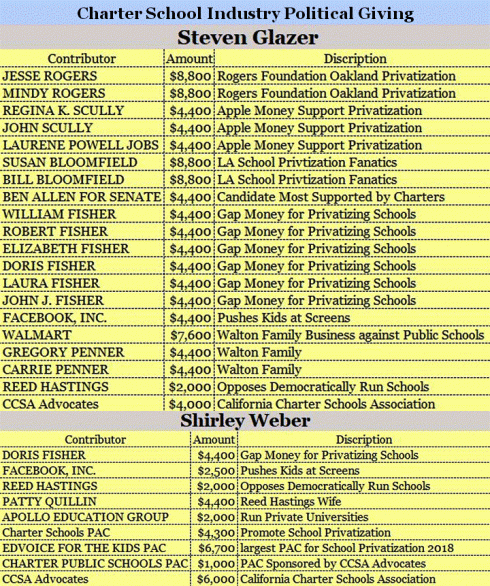
There was a similar dynamic when these bills finally arrived at the Senate Education Committee this July. The Senate Committee is also a seven member committee with five Democrats and Two Republicans. Democratic Senator Steven Glazer said “781 public schools in the state have poor performance” and “We have failures all across the state.” Like Weber he was not satisfied with the content of the bills and said we need to worry about too many students in failing schools. Glazer did not make clear what he based his failing schools charges on. However, the charges by the Contra Costa Senator are similar to the charges made by leaders of the school privatization movement like the current US Secretary of Education, Betsy DeVos.
Both AB 1505 with the Governor’s amendments and AB 1507 were voted out of the Senate committee by identical 4 to 3 votes. The two Republicans and Glazer were the no votes.
Possibly Weber and Glazer agree with DeVos and her choice advocacy and that is why privatizing money is going to them or did they take this anti-public school position to attract that money? In any case, privatization money is flowing their way.
Glazer and Webber
Data from California Secretary of State Glazer ID #1377665 and Weber ID #1393376
When these two bills went to the Assembly for a floor vote, every Republican voted no or didn’t vote. Weber didn’t vote and Glazer joined two other Democrats voting no. The final tallies were AB 1505 44 yes 19 no with 17 not voting and AB 1507 54 yes 18 no with 8 not voting.
As a child growing up in a Republican community in Idaho, I remember Republicans as being very pro-public education and suspicious of big business and big centralized government. What happened to my grandfather’s Republican Party? How can it be that not one Republican during any of the votes taken supported protecting our public schools from plunder by large charter management organizations or stood against the demise of Democratic local control of schools?
If we consider the development of political action committees (PAC) for privatizing public school, the anti-democratic nature becomes stark. If your holdings are $2 or $3 billion, then you are generating at least $100 million income every year. So, donating a $1 million to four PACs is not a strain. That means besides creating a huge pot for independent expenditures, the 4 PACs will also send 4 more max donations to your favored candidates. No matter how bad the idea being pushed, this kind of spending gives it consideration and drowns out opposition.

The Bills and Amendments

Former State Sen. Gary Hart, a Democrat who represented Santa Barbara in the Assembly and Senate for 20 years, authored the original 1992 California charter school law. Sue Burr, a current member of the State Board of Education, played a major role in drafting it. EdSource interviewed Sen. Hart last year. Reporter John Fensterwald noted that the financial impact on a district was not part of the law and asked, “Was it brought up at the time?” Hart replied,
“I don’t think so. The law didn’t have large-scale financial ramifications. We were talking about 100 charters statewide.”
The original law capped charter schools at 100 statewide. In 1998, the cap was raised to 250 with a 100 schools a year escalator thereafter. Today, there are 1310 active charter schools in California and the current cap statewide is 2,250 for the 2018-19 school-year. Neither this uncontrolled growth with essentially no cap nor its financial implications were addressed in the original law.
As originally proposed, AB 1505 would have given all school districts broad authority to reject a charter school’s application and renewal after considering the financial impact on neighborhood schools and the district. That provision has been restricted to just school districts already certified as being in financial crisis.
The amended version also sides with charter schools in changing the language back to “shall” issue a charter to a petitioner who met the state requirements from the less demanding “may” issue the charter.
None of Governor Newsom’s amendments are more demanding on the charter industry, most make things easier on the industry and some of them smack of favoritism. For example, while Mayor of Oakland; Jerry Brown created a military charter school with the National Guard. The following amendment seems written for the benefit of that one school.
“Notwithstanding any other law, a charter school in operation as of July 1, 2019, that operates in partnership with the California National Guard may dismiss a pupil from the charter school for failing to maintain the minimum standards of conduct required by the Military Department.”
The Oakland Military Institute had tried during its reauthorization to be allowed to dismiss students who had too many demerits. The Chartering Authorities rejected the request. They felt that demerits were given for such minor offenses as not having a badge sewn on correctly and that a student should only be dismissed from a public school in extreme circumstances. Now the charter school’s questionable request is written into the amended law.

Conclusions

Money is still ruling but even watered down the bills as amended are better than what we have now, so it is important to keep pushing for their passage.
A parent and resident named Jane Nylund wrote a letter to Newsom expressing her disappointment at his amendments. Diane Ravitch posted the letter. I encourage you to read the whole letter. It makes many strong points. Jane personalized the letter noting,
“You and I have something in common-we both attended well-resourced public high schools. You went to Redwood High School in Marin, and I attended Miramonte High School in Orinda, located in what is now one of the wealthiest suburbs in the East Bay. Lucky us.
“The irony regarding your potential alliance with privatization groups like CCSA is that, because of your severe dyslexia, you would have been rejected by the same schools that are now being touted as “high quality seats”, aggressively marketed as superior to real public schools because of test scores. According to the bio I read, you were rejected from a private prep school and enrolled in your local public high school instead. So you have first-hand experience with the idea that real public schools enroll all children, not just the easy ones.”