Saturday, July 28, 2018

Since School Vouchers Don’t Increase Test Scores, Racism is an Acceptable Reason for Privatization, Says Advocate by Steven Singer


Screen Shot 2018-07-24 at 10.20.41 AM


Originally published at: https://gadflyonthewallblog.com/2018/07/24/since-school-vouchers-dont-increase-test-scores-racism-is-an-acceptable-reason-for-privatization-says-advocate/

For decades, school voucher advocates claimed that sending poor kids to private schools with public tax dollars was acceptable because doing so would raise students’ test scores.

However, in the few cases where voucher students are even required to take the same standardized tests as public school students, the results have been dismal.


So why are we spending billions of public tax dollars to send kids to privately run schools?

2018 Department of Education evaluation of the Washington, D.C., voucher program found that public school students permitted to attend a private or parochial school at public expense ended up getting worse scores than they had at public school.

Their scores went down 10 points in math and stayed about the same in reading.

These are not the pie in the sky results we were promised when we poured our tax money into private hands.

However, corporate education propaganda site, The 74, published a defense of these results that – frankly – makes some pretty jaw dropping claims.


In his piece, not only does he call for less accountability for voucher schools, he downplays the importance of standardized test scores.


Supply side lobbyists have been claiming we need school privatization BECAUSE it will increase test scores. Now that we find this claim is completely bogus, the privatizers are changing their tune.

But that’s not the most shocking irony in DeAngelis article.

Parents don’t really care about the scores, he says. Instead they send their children to voucher schools because… You know what? I’ll let him tell it.

“Families choose schools for their children based on several important factors, including culture, individual attention, and, of course, safety. Research tells us that parents — unsurprisingly — often value these things more than standardized test scores.”

Certainly parents prefer their children have more individual attention. But many private schools have larger class sizes than public schools.

Moreover, reducing class size at all schools would be a more equitable reform than letting some kids enjoy smaller classes if they can just get into the right school.

However, it is his other two claims that sent my racist dog whistle senses tingling.

So parents don’t like the CULTURE of public schools. And they’re afraid public schools aren’t as SAFE.

Hmm. I wonder what culture these parents are objecting to. I wonder why they would think public schools wouldn’t be as safe.

Could it perhaps be fear of black students!?

I don’t want my little Billy to be exposed to all that rap music and kids with sagging pants. I don’t want my little Susie to cower in a class full of thugs and gangstas.

This is racist, stereotypical and just plain wrong about what you’ll actually find in public schools.


Where did the boom for privatized schools come from historically?

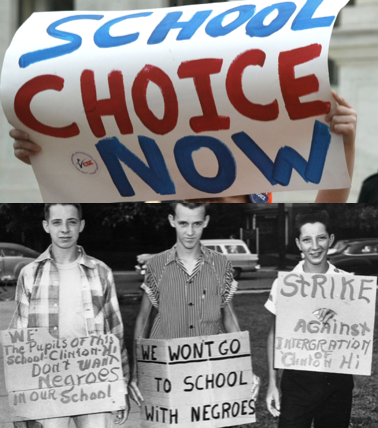
It was a reaction to Brown vs. Board. When the US Supreme Court ruled in 1954 that segregated schools were unconstitutional, many white parents rebelled. They didn’t want their kids to go to school with THOSE kids. Hence, Georgia Gov. Herman Talmadge’s aborted plan to close all state schools and issue vouchers to private schools instead.

Hence, the plan that actually did take place in Price Edward County, Virginia, in 1959 where the public schools were closed and all taxpayer money for education was funneled to segregated white academies that would not admit black students. Though the term had yet to be invented, these were proto-“charter schools.” They were publicly funded but privately run. They were housed in privately owned facilities such as churches and the local Moose Lodge.

Hence, various segregationist “freedom of choice” plans in several states that allowed white students to transfer out of desegregated schools. Black students could apply but because of various administrative hurdles were never admitted.

This is the history of so-called school choice. And it is a history that DeAngelis, the 74 and the Cato Institute are willing to bring full circle.

School privatization advocates pretend they’re defending choice, but what choice are they championing?


Pardon me, but I don’t think we should be spending public tax dollars to enable bigots.

If you want to shield your children from the horrors of kids with darker skin, do so on your own dime.

Public money should only be spent on policies that are in the public good – and that’s not segregation. It’s the exact opposite – integration.

Learning how to get along with people who are different than you is an essential skill for good citizens. Understanding that people of different races, ethnicities, religions and cultures are also human is vital if our nation is to survive.

Being exposed to another culture isn’t a bad thing. It’s the definition of the American melting pot.

Our public schools are not perfect. They suffer from targeted disinvestment – especially those situated in urban neighborhoods and those serving larger populations of children of color.

But that is because of the same segregation school privatization lobbyists are empowering. If all students went to the same schools, parents wouldn’t allow this kind of inequity. 


But this isn’t the goal of privatization promoters. They don’t care about what’s best for children. They’re looking out for what’s best for the businesses running the privatized schools.

So what have we learned?

School vouchers do not increase test scores.

And when that excuse behind the entire school privatization movement is exposed as nonsense, opportunists have no problem using racism and prejudice to defend their industry.


Like this post? I’ve written a book, “Gadfly on the Wall: A Public School Teacher Speaks Out on Racism and Reform,” now available from Garn Press. Ten percent of the proceeds go to the Badass Teachers Association. Check it out!
WANT A SIGNED COPY?

book-4

Something To Think About Before You Share That “Great Deal” For Teachers by Kelsey LaMar


Originally posted at: https://www.kelseylamar.com/something-to-think-about-before-you-share-that-great-deal-for-teachers/


About a week ago, I hopped on Facebook and was greeted with about 15 tags on an article about Target. “Wow, this must be good,” I thought.  In the back of my mind, I was imagining grand gestures such as fully funding school supplies for all students. Free gift cards for teacher appreciation. Complimentary Starbucks to celebrate the upcoming school year. I must say I was more than a little underwhelmed to read about a 15% discount on select school supplies.
Now, this is NOT a blog about Target. I love Target as much as any other girl (okay, let’s be honest, probably quite a bit more!) If my husband gave me a free hour to do anything I want, I would probably use it to peruse the aisles of the store at a leisurely pace. What this article is about is that pesky assumption Target is making in the first place.
You see, they know, as do most people in America today, that teachers will soon be hitting the stores to supply their classrooms. They’ll be loading up their carts with paper, glue, and pencils (Ticonderoga of course!). They’ll be buying boxes and boxes of binders and folders. Hand sanitizer and erasers. Colored pencils and white board markers. Some will be buying exercise balls and bean bags for their new flexible seating model. For others it will be new colorful borders for their bulletin boards. Some will be buying white boards for their small groups. But the one thing they all have in common is that the money will come out of their own meager pockets.
As I sat there reading the article, debating whether to share the “great” deal with everyone I knew, I started to get angrier and angrier. When did this become the norm? When did society just start assuming that teachers would buy their own supplies? When did people come to expect it from us because “it’s for the children, after all.”
I’m trying to imagine a world where other professions are treated the same way. Where doctors are asked to pony up the dough for their own scalpels and surgical face masks. It’s for the patients after all!
Or a world in which police officers are asked to open their wallets to buy their own Tasers, bullets, and sirens. “Don’t have them? I guess you’ll have to just make do. But I’m sure you won’t mind buying them. You do care about the safety of the community, don’t you?”
Would the big box stores offer a 15% off discount to firefighters buying their own hoses? Sure, they could make do with garden hoses provided by the government, but if they really cared about saving people’s homes, they’d buy their own.
No! This would never happen. We would never allow it to. So why is it okay to expect it from teachers?
As Americans, we should be utterly ashamed of ourselves. Ashamed that we let it come to this. That we allowed lawmakers to cut more and more from schools every year until they were bled dry. Ashamed that we rob from children to fund tax cuts for the rich. Ashamed that we take to social media every year to complain about the “absurd” school supply lists. Ashamed that we praise stores for offering teachers $0.15 off a box of tissues like it’s the most charitable thing that we’ve ever heard.
I can’t help but wonder when this madness will stop. Will I see the day when large portions of my minuscule salary don’t go towards markers and crayons? When a slight shopping discount is seen as a slap in the face rather than the best news we’ve seen all day? When I’m not taken advantage of year after year simply because I care?
Now, I could sit here and say that the best course of action would be to simply stop buying supplies. If enough teacher’s put their foot down, maybe things would change. People only treat you how you let them, right? However, I know that in a few weeks, I’ll be loading up my cart with supplies, just like millions of other teachers across the country. I’ll stand in line for hours to fight like crazy over free printer paper and rulers. Want to know why?
I’ll do it for the 2/3 of my class who show up with empty backpacks (if they even have a backpack at all). The student’s whose parents work multiple jobs just to put food on the table, and they can’t spare even a pack of pencils. The students who are embarrassed as they watch all of their friends unpack their shiny new binders as they sit empty handed. No student should ever have to feel that way.
I’ll do it for the sake of my targeted small groups. They run so much more smoothly when every student has quick access to a white board and marker to prove their learning.
I’ll do it to help ensure high attendance rates. Access to hand sanitizer, Clorox wipes, and tissues is important to keep everyone safe and healthy during cold and flu season.
I’ll do it so that 27 nervous students have a warm, welcoming environment to walk into on the first day of school. Colored bins, beautiful backdrops, and organized spaces go a long way in making children feel welcomed and excited for the new school year.
I’ll do it because, it’s for the children after all.
Bio: Kelsey has taught 2nd, 3rd, 4th, and 7th grades in Alaska and Colorado for 11 years. She is passionate about teaching in Title 1 schools, and says there is no place she'd rather be!


Monday, July 23, 2018

Is Your State Pension or Retirement Plan Complicit in Migrant Abuse

What would I have done? Would I have stood up to the fascist regimes as they rose to power?

We’ve all asked ourselves this question when faced with the horrifying truth that everyday citizens in Nazi Germany stood by in silence as their neighbors, colleagues, and friends were forced into cattle cars, bound for concentration camps and gas chambers.
The parallels between the Trump administration and 1930s Germany are alarming. In a recent article in Newsweek, the executive director of the Anne Frank Center for Mutual Respect noted that “1930s Germany imposed a series of escalating steps of oppression, including demonization, discrimination and isolation of vulnerable communities, that evoke what we are seeing today. That comparison is just, and not to make the comparison would be a dereliction of our duty to ensure 'never again' to any people.”

Our responsibility to ensure history doesn’t repeat itself goes far beyond this, however, and understanding how each of us can fight back against the administration’s cruel immigration policies is as simple as following the money. With little transparency and accountability in the financial world, it’s hard to know where our investment returns are coming from. That is to say, what corporate activities are driving up the value of our portfolio?

The horrible reality is that public state pension funds and retirement plans in twenty states have more than $2.5 billion invested in “just” four companies – General Dynamics, United Rentals, CoreCivic, and GEO Group – that are providing essential support for the administration’s Zero Tolerance policy, including the concentration camps and detention centers where migrants have allegedly been tortured.

Here’s what we know thus far about each company’s role in this nightmare:
CoreCivic (formerly known as the Corrections Corporation of America) and GEO Group are the largest for-profit prison companies in the country; CoreCivic’s South Texas Family Residential Center in Dilley, Texas and GEO Group’s Karnes Center in Kansas City, Texas are the largest family detention centers in the US and the vast majority of detainees at both facilities are seeking asylum.1 Parents desperately seeking information on their children’s whereabouts have been presented with the option of either pursuing their asylum claim or being reunited with their child.

Plaintiffs in six federal lawsuits have alleged forced labor and other abuses in immigration detention facilities owned by CoreCivic and GEO Group, including threats of solitary confinement; revocation of family visitation rights; and withholding of water, food and medication which detainees could only afford by working for the respective company. According to independent medical experts, CoreCivic and GEO Group’s practices have contributed to the deaths of numerous detainees, and advocacy groups continue to voice concerns over medical neglect, sexual assault, and horrifically unsanitary conditions at the companies’ migrant detention centers. A recent report by DHS’ internal watchdog concluded that ICE detention facilities, including those operated by CoreCivic and GEO Group, are not subject to rigorous oversight and therefore are not held accountable for substandard conditions; this conclusion is all the more alarming given that Trump’s executive order provides for indefinite family detention.

While much of the media’s attention has pivoted to the issue of family detention in light of the ACLU’s successful battle for a nationwide injunction on family separation, the practice of of separating children from their parents at the border continues. This comes as no surprise given that a week after Trump signed the executive order “reversing” the family separation policy, HHS officials refused to answer questions about reports that children were still being separated at the border. The vast majority of children (nearly 3000) and parents originally detained under the Zero Tolerance policy have yet to be reunited; and the administration failed to meet the court order to reunite all detained migrant children under five by July 10th, with records showing that fewer than half of the identified children were reunited by the court’s deadline. To make matters worse, administration officials have stated that they view placing migrant children in foster care as an equivalent to reuniting them with their actual families.

General Dynamics, a US defense contractor, is currently under contract with the Department of Health and Human Services for “cadre and infrastructure services for shelter care for unaccompanied children – training and technical assistance service area” at the Homestead Temporary Shelter for Unaccompanied Children in Florida, where children who have been forcibly separated from their parents under the administration’s Zero Tolerance policy are being detained. ž The welfare of these children is now in the hands of a company that specializes in missile defense systems and combat vehicles. United Rentals appears to be providing rental equipment and infrastructure for the children’s detention facility in Homestead, Florida and allegedly the tent city in Tornillo, Texas as well. In a recent statement from the UN Office of the High Commissioner for Human Rights, experts concluded that placing immigrant children in detention facilities may, in and of itself, amount to torture. To make matters worse, the Homestead detention facility for migrant children is technically located on federal land, thereby exempting it from state child welfare inspections.


That’s right, public state funds in Alaska, Arizona, California, Colorado, Florida, Kentucky, Louisiana, Michigan, New Jersey, New Mexico, New York, Ohio, Oregon, Pennsylvania, South Dakota, Tennessee, Texas, Utah, Virginia, and Wisconsin are aiding and abetting these crimes against humanity.2

So, what can you do to change this?
The US Department of Homeland Security has indicated that the lack of resources, including building facilities, is one of the main reasons they have stopped separating families. By providing the very resources the administration depends on to commit such egregious human rights abuses against migrants, CoreCivic, GEO Group, General Dynamics, and United Rentals have played a crucial role in this nightmare; and they can reasonably be expected to continue doing so, absent sufficient pressure from their investors. To put that in legal terms, these four companies are aiding and abetting human rights abuses that qualify as crimes against humanity under international law. Continuing to invest in these companies with knowledge of their role in migrant abuse makes pension funds complicit.

The Strategy
For CoreCivic and GEO Group: divestment
EXPECT PUSHBACK – investors tend to resist calls to divest on the grounds that divesting means that they won’t have a place at the table to push companies to change their behavior. This argument doesn’t hold for companies like CoreCivic and GEO Group, whose for-profit prison business model – where the company has a financial incentive to incarcerate as many people as possible – is inherently irreconcilable with the concept of corporate social responsibility. No amount of pressure from investors can persuade a company to abandon its business model. Shareholder pressure can be leveraged to elect new board members or call attention to issues to change internal policy, but divestment is the only appropriate course of action for companies with a demonstrated history of systemic human rights abuses, like CoreCivic and GEO Group. Divesting from these two companies poses no threat to pension fund returns; CoreCivic and GEO Group’s share prices have skyrocketed as a direct result of the administration’s migrant abuse policy, and this makes it the ideal time to cash out and invest those earnings in a company whose long-term profitability isn’t threatened by unsustainable corporate conduct.

For General Dynamics and United Rentals: pressure companies to end their operational support for the detention of migrant children and asylum-seekers
The detention of migrant children and asylum-seekers constitutes a tiny fraction of General Dynamics and United Rentals’ overall business activities. General Dynamics and United Rentals provide material support for concentration camps in Homestead, Florida and [allegedly] Tornillo, Texas where children rendered unaccompanied by the administration’s Zero Tolerance policy are detained; these children must be reunited with their families as mandated by the court order. Keeping the facility open enables the administration’s detention of innocent children, including 46 children under five who will never be reunited with their families. With the court-ordered deadline for reunification of all detained migrant children separated under the Zero Tolerance policy less than one week away, fewer than 15% of detained migrant children have been reunited with their families.

Financial complicity in these horrific abuses isn’t an option, nor should it be. Investing in your future shouldn’t come at the expense of the most vulnerable members of society. We have the power of $2.5 billion behind us - let’s use it to demand an end to corporate human rights abuses!


WAYS TO TAKE ACTION

Check the spreadsheet to see if your pension fund or retirement plan is listed. If it is:

  • Pick up the phone and call the phone number provided.
    • State which union you’re a member of and repeat the asks in bold (above) for the respective companies. Read my statement to the CalSTRS board for inspiration.
    • Explain why you care.
    • If they respond by saying that they’re already looking into it, ask for specifics: Which companies are they looking it? What are they specifically asking the companies to do (immediate asks and long term goal)?
    • We want to see concrete action and follow up!
  • Share this information with your colleagues and wider network! We know people are looking for ways to get involved and want to play an active role in ending migrant abuse, they just need the information.
  • Tweet about this on Twitter or post on Facebook with the hashtags #EndConcentrationCampProfiteering #Educators4MigrantJustice and #TBATs
  • Help us build a wider coalition! We have a letter template for people to sign on to and read or deliver directly to their respective state fund board members. 
     
Read the article from the Sac Bee about the campaign in California.

Emily Claire Goldman is an international human rights advocate specializing in corporate accountability, corporate social responsibility and responsible investing. Follow her on Twitter @mle_goldman for updates.
2Rome Statute of the International Criminal Court, article 7.

Sunday, July 15, 2018

This Public School Teacher Does Not Pledge Allegiance to the Flag by Aaron Michael Baker


I have not pledged “allegiance to the flag of the United States of America” in more than eight years. My personal objections to participating began as religious (see Anabaptist theology and practice). I was not teaching at the time, so like so many Americans, public situations that observed the pledge were a very irregular part of my life. Then, for the first four years of my teaching career, the pledge was recited at my school during first hour, which was my planning hour, so my non-observance was not an issue. Convocations, school board meetings, and Veterans Day assemblies are the most common occurrences where I am among my peers, the national pledge is observed, and I quietly refuse to participate.

It is quite easy to not pledge allegiance. I always politely stand and usually fold my hands in front of me. This is a very silent and non-disruptive form of protest. Everyone’s attention is on the flag, and everyone is speaking in unison. My silence and my right hand in the wrong place do not draw a lot of attention. Perhaps if I remained seated during the pledge, my behavior would draw more attention and thus be interpreted similarly to the high profile NFL protests of the national anthem. The influence of those like Colin Kaepernick have caused my objections both to the national pledge and to the national anthem to shift from the religious to the more political.
For 75 years, it has been unconstitutional for public schools to require or even compel individual students to recite the pledge. Teachers who are former or current military personnel sometimes find the 1943 Supreme Court ruling in West Virginia State Board of Education v. Barnette to be at odds with their personal experience and ideas of respect. Statutes regarding school observance of the pledge vary from state to state, but even where the pledge is required daily, there is no formal way to track if schools are observing this requirement. Whether or not a school recites the pledge daily is mostly determined by the level of patriotism among administration and the general convenience to the learning day.
Kaepernick
Through mere repetition, our schools, especially our elementary schools, have woven the pledge into the very fabric of our society. Americans pledge for many reasons, and many Americans pledge for no reason at all. As with so many other rituals, in the process of being routinized, the pledge has lost much of its potency. Those who are mindful while pledging are likely filled with national pride similar to the way they would at the playing of a song such as “God Bless America.” Similarly, for many, pledging is simply a matter of nostalgia. It may mean something to them in a way that they may or may not understand. Americans reciting the pledge are unlikely to be thinking about fidelity to the U.S. government or considering the implications of the word “pledge.”
Americans pledge for many reasons, and many Americans pledge for no reason at all.
All kinds of Americans pledge allegiance, but the fiercest defenders of its sacredness tend to be social conservatives. But unknowing to those today that embrace pledging as an act that epitomizes conservative values, the pledge was written in 1892 by a self-described “Christian Socialist.” The National Education Association was even involved in the introduction of the pledge into American public schools. Leftist nationalism was clearly on the political scene at the end of the 19th century in a way that it is not today. In 2003, Gene Healy of the libertarian think tank Cato Institute strongly questioned why “conservatives support the Pledge at all, with or without ‘under God’?” Perhaps Healy and others could launch a conservative movement to formally end recitation of the pledge in public schools, citing its socialist propagandist origins.
Compared to national anthems, of which virtually every country has one, there are only a handful of countries that have national pledges. Besides that, there are some important distinctions between the performance of the national anthem and the observance of the pledge. It is not generally expected that people sing or even recite the words to the national anthem. The general expectation is to stand quietly with the right hand over the heart while the song is being performed. The song itself tells the story of the bombing of Fort Henry by British ships during the War of 1812. The national anthem does not include a promise of any kind and there is no call to duty for those who perform it or hear it. The reason the national anthem has been a source of controversy and protest is precisely because it is observed publicly much more frequently than the national pledge.
Pledging Allegiance
I cannot pledge allegiance because I do not agree with the majority of current U.S. policy, both domestic and foreign. If I were to pledge allegiance, I would be stating that I believe that the United States government is on the correct side of all international policy disputes. I have no plans to commit an act of treason, but that should not compel me to promise my loyalty to the U.S. government. I am not prepared to denounce my citizenship, but I would like to retain the future possibility of expatriation. To put it very plainly, the pledge of allegiance is very “America First,” and I am decidedly not “America First.” And in light of a resurgence of this political mantra, I refuse to take an oath to place America first. I do not want “America First” international relations. I do not want Trump’s “America First” version of fair trade. And I do not want “America First” immigration policies.
I cannot pledge allegiance because I believe that this nation is the most divided it has been in my 41 year lifetime. Of course, we are technically “one nation,” but that phrase is intended to evoke a sense of unity. Americans from all places on the political spectrum believe that there is a growing sense of disunity in the United States today. There has been a sharp rise in hate crimes sparked by the xenophobia and intolerance on display in the rhetoric of Donald Trump. Public demonstrations and protests are at levels not seen since the Vietnam War. We are a nation divided, and we have yet to turn the corner toward unification. I cannot publicly proclaim my confidence in the continuing solidarity of American society.
Americans from all places on the political spectrum believe that there is a growing sense of disunity in the United States today.
I cannot pledge allegiance because I do not believe that the U.S. government is providing “liberty and justice for all.” Where is the liberty and justice for the millions suffering under incarceration in our almost 50 year “War on Drugs?” Where is the liberty and justice for wage workers breaking their backs under a capitalist system that only fills the pockets of corporate elites? Where is the liberty and justice for young black men continually being slaughtered in the streets by a racist system of policing? And where is the liberty and justice for asylum seeking mothers having their babies stripped from their arms simply because they risked their lives for a better life?

Many people that are as disillusioned as I am may be able to pledge allegiance with an appeal to yet unrealized American ideals or from a place of belief in the spirit of the American people. I cannot. And yet, I am hopeful. I believe in progress. I believe that the arc of the moral universe does indeed bend toward justice. I believe that there will be better days. Will I pledge then? I don’t believe I will. Maybe someday in the future, I will be “proud to be an American,” but that feeling of ostensible patriotism will more likely come out in the form of humming along to the national anthem when an American wins gold at the Olympics.