Monday, April 23, 2018

Oklahoma Teacher Walkout: What We Can Do Different Next Time by Aaron Michael Baker

Originally posted at: https://spoonvision.wordpress.com/2018/04/21/oklahoma-teacher-walkout-what-we-can-do-different-next-time/

Most of Oklahoma’s public schools were closed for nine days, April 212, 2018, as a show of strength and commitment in what came to be known as the Oklahoma Teacher Walkout. It was two weeks of rallying, marching, lobbying, organizing, singing, chanting, and picketing. Each of these forms of civic engagement is now an essential part of an emerging political will among Oklahoma teachers that has not waned since returning to the classroom. The walkout was demanded by teachers, made possible by cooperative superintendents and local school boards, funded and orchestrated by the Oklahoma Education Association, and overwhelmingly supported by the public; yet largely ignored by the Republican controlled legislature, and even derided by Republican Governor, Mary Fallin. In the aftermath of the walkout, however, horizontal hostility is threatening the Oklahoma “education spring” from the inside.

The term “horizontal hostility” has been used by feminists since the 1970’s to describe the practice of enforcing the dominant system of oppression from within the women’s movement. Expanding the concept to other movements, horizontal hostility is when infighting occurs and threatens progress toward the common goal of positive social change. When movements stall, it is easy to forget who the real enemy is. When the walkout stalled late into the second week, leadership at the Oklahoma Education Association decided it was time to shift focus, and President Alicia Priest announced an end to the walkout (but also a continuation of the movement). Many of the teachers whose groundswell demand was the impetus for the walkout felt betrayed by this move and immediately began speaking out on social media. At this moment of the movement, it is not advantageous for the grassroots fervor of influential Facebook groups to be at odds with the established institutional power of the OEA.
John Thompson has “Five takeaways from the Oklahoma teacher walkout” that are well worth the read. In that vein, I present a few ideas for what the Oklahoma public education community can do different the next time we have a walkout.
Over the course of the nine day walkout, I was privileged to experience a variety of low risk opportunities in nonviolent direct action. The various marches that originated in places like Moore, Del City, and Edmond were perfect examples of what is called “escalation.” When repeated tactics fail to produce the desired social change; the movement does not end, the movement does not continue uninterrupted, the movement escalates. The various marches were a demonstration of the lengths that Oklahoma teachers are willing to go for their students’ education. Marching from Moore to the Capitol was an escalated form of marching around the Capitol. Marching from Tulsa to Oklahoma City, “March for Education,” was the highest level of escalation that was seen during the Oklahoma Teacher Walkout, and one that took so many, myself included, by surprise.
IMG_3614
When repeated tactics fail to produce the desired social change; the movement does not end, the movement does not continue uninterrupted, the movement escalates.
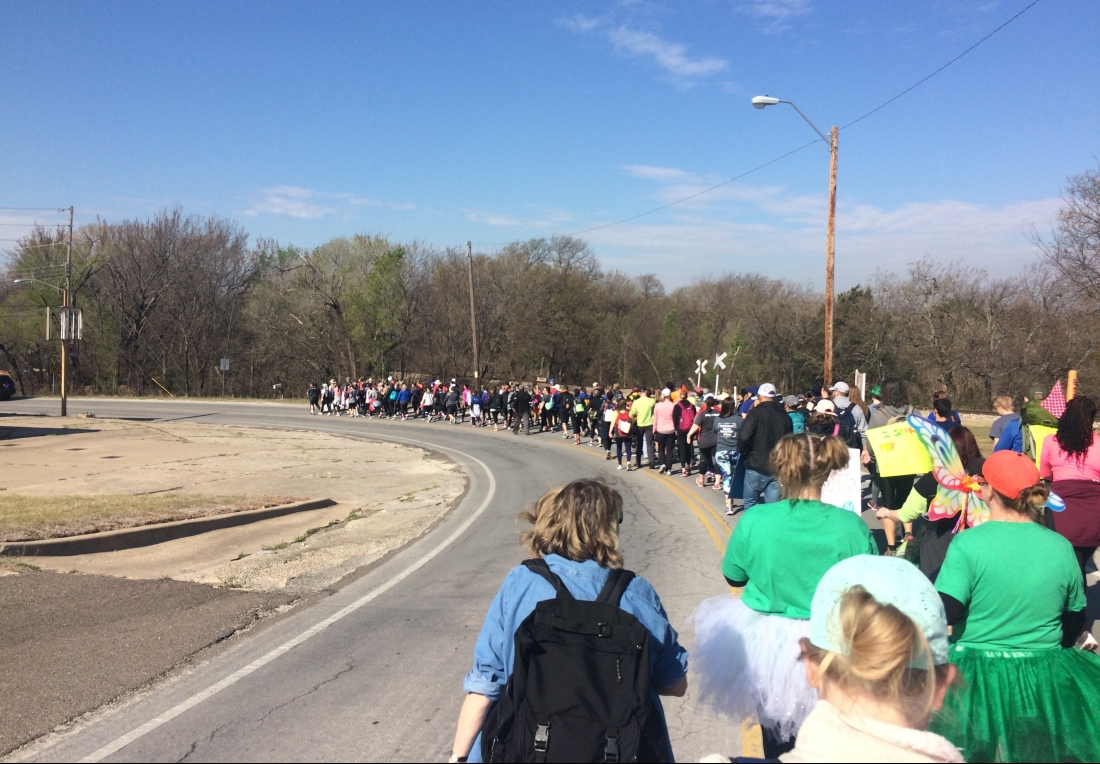
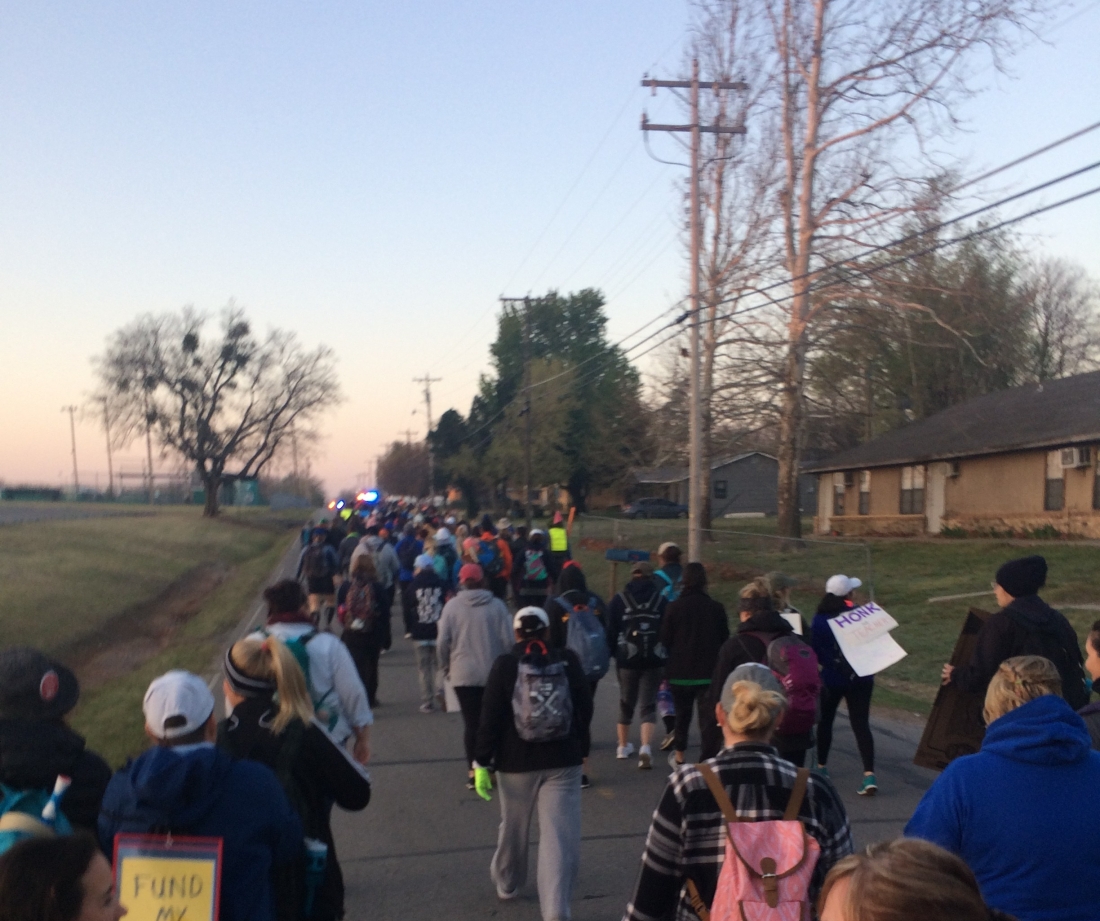
Walking 110 miles over a period of seven days was an experience unlike any other in my life. But it became clear on day five and six that we had not prepared for escalation beyond the march. To be honest, it did not occur to me that the legislature would have continuing intransigence upon facing the arrival of our historic march. When I returned to the Capitol on day nine of the walkout, Thursday, April 12, (the final day) I witnessed another form of escalation. The emotion of the crowd outside the House of Representatives on the fourth floor had reached a fever pitch. The people were chanting, the chanting was well organized, and the feeling was aggressive yet clearly nonviolent. But you could feel the question hanging in the air, “What do we do next?”There were organized efforts to turn votes on specific legislation. There were still plenty of people outside rallying. The gallery was packed, as was the rotunda. The thought that I had in that moment was, “This is all we have. This is all we can do. If this doesn’t work today, then we need to go back to school and regroup for next time.” There are forms of escalation beyond what occurred during the Oklahoma Teacher Walkout, but we did not plan for them, and effective escalation must be organized.
A wildcat strike is strike action by unionized workers taken without the approval or authority of union leadership. To be clear, the Oklahoma Teacher Walkout was never a wildcat strike. For that matter, it wasn’t a strike at all. If teachers walked out of school with the blessing of superintendents and school boards, it is best that they returned to school with that same blessing (and timing). The grassroots efforts that demanded the walkout, while highly influential, by and large did not originate with unionized workers. “We don’t need the union,” is exactly the attitude that right-to-work legislation intends to inspire. It seems unlikely for a true wildcat strike to occur in a “right-to-work” state. The very idea of a wildcat strike presupposes the kind of institutional power that automatically derives from an “agency shop” situation where non-members must pay an agency fee to the union for collective bargaining costs. Perhaps the true success of the Oklahoma Teacher Walkout was that the Oklahoma Education Association was capable of leading nine days of lobbying, marching, and rallying with a unified crowd that swelled to well over 35,000 and included members, many non-members, and even members of competing associations.
IMG_3528
The thought that I had in that moment was, “This is all we have. This is all we can do. If this doesn’t work today, then we need to go back to school and regroup for next time.”
Walkouts should not be routine, nor should they be extraordinary. The occasional work action may be necessary, if for no other reason, than to show the bosses (or politicians) who holds the real power. Oklahoma teachers are mobilized like never before. Even those who walked in 1990 believe this. The statement, “The time is now,” need not imply that it is “now or never.” There will be a next time. If teachers want it bad enough, it can be done. In the meantime, we can organize, we can campaign, and we can grow our institutional power (association membership) and stop pretending that we can advance our profession and successfully advocate for students without “sticking to the union.”

Sunday, April 22, 2018

School Closures and Privatization


In 2016, the American Bar Association highlighted two main reasons for school closures, low academic performance and under-utilization. These two categories are a broad description of labels that are placed upon schools to justify their closure. There are many factors that actually lead up to that point. 


                                                                Standardized Testing 
Now that testing season is once again upon us, we are bombarded by images of closed computer labs that are being used as secure testing sites, bare classroom walls, and “Shhhh! Testing in Progress” signs. We are hearing stories of children sitting for hours in New York, testing issues in Ohio that wasted an entire day, cyber attacks of TNReady that forced invalidation of the test (as if it is a valid test in the first place), and graduation requirements in New Jersey that can leave tens of thousands without a high-school diploma if changes are not made.

Decision makers in different states are starting to explore other options to replace the current standardized test. Tennessee has stated an intention to return to paper-and-pencil tests, New Jersey has announced that it will be transitioning away from PARCC. We must seize upon this opportunity to have deeper conversations about the history of standardized testing and to push for it as a tool to measure academic performance to be stopped altogether.

Wayne Au recently wrote wrote about the SAT test. In his piece, he addresses the racist history and its role in the eugenics movement to sort people under the guide of providing opportunity, explains how the SAT continues to feed racial disparities with its self-reinforcing cycle of inequality and how the SAT test feeds into the myth of meritocracy and capitalism. We know that our standardized tests are modeled after the process that is in place to sustain the use of the SAT tests. The fact that these tests have become a main tool to measure the success of our communities schools only increases the role of institutionalized racism that is present in education.


                                                            Under-utilization 
Why do schools see a drop in enrollment? Are there less school-age children in our communities? Are people moving out of the state? While this may be the case in some areas that are suffering hard economic times, this is not so true for the majority of the areas we are seeing schools being closed. Most school closures occur in urban areas where we see strong evidence of one other initiative, gentrification. In 2015 the Urban Institute asked if school choice affects gentrification. At that time, the researchers concluded that further research would need to be done to examine the intersection of school choice and gentrification, but that they are definitely related. Recent research has found evidence that “college-educated white households are far more likely to gentrify communities of color when school choice options expand.” This leads to the under-utilization of community schools in these areas. As rent and property values increase, local families are pushed out of their homes, new families move in, enroll their children in the schools that they find to be more appealing, and our community school enrollment declines. 

                                                              School Funding 
Declining enrollment affects school funding. When it comes to funding schools, there never seems to be enough money. The reality of this argument is, there is enough money. The real issues are that:
1) Enough emphasis is not placed upon the importance of education when state budgets are passed. 
2) Monetary resources are not allocated in the best manner to positively impact students, such as smaller class sizes, highly qualified teachers, creative arts programs, updated textbooks, or even safe and clean facilities. 
3) Barely ethical practices are employed to contract consultation services that capitalize upon the false promise of the silver bullet that will be the magical answer to academic performance gaps - the very same gaps that are highlighted by the racist standardized testing system as described above. 
4) Pathways have been created to siphon funds out of schools and into private pockets through the shell game of the charter school system, whether it be under the name of a private or public charter school, co-location and renaissance schools, a portfolio district, and turnaround schools. In some areas we have even begun to see a co-opting of the language of a community school from those pushing the agenda of removing local control and diverting money. 

                                                       Privatization of Services 
As districts face a decrease in funding levels without a decrease of overhead costs (lights and heat still need to be on whether or not the class is full) decisions need to be made about where cuts and reduction of services will occur. In conjunction with efforts to decrease the power of public sector unions, an increase of privatized services has been seen as these smaller associations of unions are destroyed. Employment that used to be stable in that it provided community members with a livable wage and benefits are being cut and economic bases are being further destroyed. We now see privatization through food services, custodial services, technology support, paraprofessional staff, substitute teachers, transportation, and even teaching staff. Outsourcing of school services has become a widespread practice across the country. While the dollars saved may look good on paper, the community value leaves us at a deficit. Staff turnover with these services is high, making it harder for relationship building within a school or district. Community members often lose health and pension benefits, causing them to find employment elsewhere. The National Education Association summarized research about privatization of paraprofessional services and explains the risk of privatization. 


                                      State takeovers, turnaround schools, co-location, 
                                            portfolio schools, Renaissance schools...
                                                     Anything but OUR SCHOOLS. 
There are many different names out there for the many different types of schools that are being made available through the many different forms of school choice. Different names are given in different areas of the country as part of the marketing plan to lure the student away from the local public school. As the charter school (and similar networks) began to see strong push back from the outright closure of public schools in favor of opening new charter schools, hybrid district models began to develop. A lot of these operate under the enrollment oversight of the public school district, but each system has its own board of directors that it is accountable to. Little accountability lies towards the public, the source of funding in these districts. The common enrollment system makes it easy to funnel students out of the public schools that have been pre-slated for closure in order to force a decline in enrollment numbers. Oakland Unified School District, Camden City School District, and Newark Public Schools are well known for their issues with this system. 

                                                Climate Crisis Capitalization 
Another alarming trend has been the capitalization of privatization efforts during the aftermath of a natural disaster. The most well known case of this was after hurricane Katrina in New Orleans. As the city began to rebuild, it became evident that decision makers decided to leave the rebuilding of the cities schools to private interests. The state took over the school system and handed it over to charter schools. When the NAACP put forth their call for a moratorium on charter school expansion, the disastrous effects of this decision in was exposed. Today, we watch Puerto Rico closely and stand in solidarity with the Teachers Federation of Puerto Rico to fight back as colonizers force


                                                                     Vouchers 
                                         The Big Monster and Its Little Friends 
With Betsy DeVos as our Secretary of Education, school vouchers is never far from being mentioned in the news. Many argue against vouchers for the fundamental reason that it is a direct diversion of public money out of public systems. Some groups fight for the separation of church and state and do not want to see that money go to religious schools. Others argue that vouchers will lead to segregation of schools as evidence over time is starting to show that it is a majority of white families that navigate and utilize the voucher system. Most recently, there has been a push for military vouchers as we continue to face these attacks that are chipping away at our school systems. There are actually numerous ways to divert public money and strengthen the premise of school choice that are named something other than vouchers. The Education Commission of the States reported on these different types in 2012. Most recently we have been hearing about tax credit scholarships and education savings accounts.

Thursday, April 19, 2018

Oklahoma’s 110 Mile March for Education in Retrospect by Aaron Michael Baker

Originally posted at: https://spoonvision.wordpress.com/2018/04/16/oklahomas-110-mile-march-for-education-in-retrospect/

My wife and I were halfway to Tulsa on the Turner Turnpike before the full realization hit me; I was about to walk 110 miles of Route 66 from Tulsa to Oklahoma City. I had been interviewed by a local news channel that afternoon, and I joked on the way that evening that I could not back out because I was to be on television that evening saying that I was going. I felt confident that the experience had been well planned by a coalition of leaders from the Tulsa Classroom Teachers Association, the Oklahoma Education Association, and the National Education Association. At the same time, however, I could not escape a growing sense of uncertainty. Will I be physically and mentally able to complete such a challenge? How will our march be received by the communities through which we will travel? How will this all end?
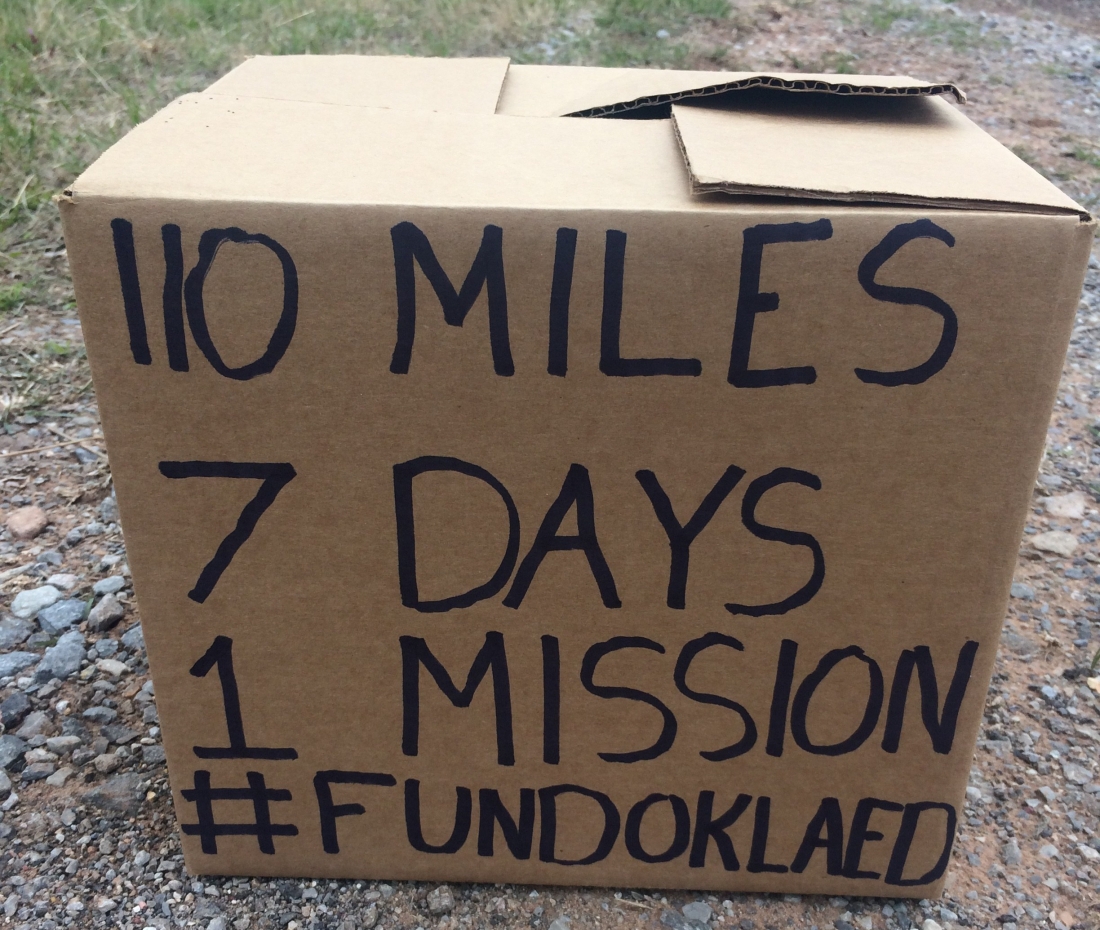
The idea for “March For Education #WalkTheTalk” was born out of local organizing meetings in Tulsa leading up to the Oklahoma Teacher Walkout, which began on Monday, April 2, 2018. The march was planned in part to bring further attention to the commitment, perseverance, and strength of Oklahoma’s educators, and more specifically, educators from within Tulsa Public Schools. The plan was to walk from Webster High School in Tulsa to the Oklahoma State Capitol in Oklahoma City over a period of seven days and six nights. The launch of the march took place on Wednesday, April 4, to honor the 50th anniversary of the assassination of Dr. Martin Luther King Jr. The march concluded the following Tuesday, April 10, to coincide with the 1966 arrival in Sacramento of 8,000 farmworkers who, led by Cesar Chavez, marched 340 miles across California to bring attention to those striking against planters in the San Joaquin Valley.

As a teacher from the Oklahoma City metro, I began this experience considering myself a “guest marcher.” I viewed my participation in part as a show of solidarity with my soon to be new Tulsa friends. I learned very quickly the first day that I would not be viewed as an outsider by Tulsa marchers. There are over 2,500 teachers in Tulsa Public Schools, and while many marched with family and friends, most of us that first day were marching in front of and behind complete strangers. I met some people on that first day march from Tulsa to Kellyville that I would not see again because they were only participating in the first leg. There were others I met on Wednesday, April 4, who I learned were part of a group that would soon come to be called “Through Marchers,” a group of close friends with a shared experience that cannot be fully captured with the words expressed here.
The first and last days of marching were not exceptionally difficult because additional marchers and the anticipation of what was to come provided a helpful dose of adrenaline. The first evening, however, was particularly difficult for me. As each day passed, my body began to acclimate to the average 15 mile walk, making each evening less difficult than the one before, but upon arriving at Kellyville High School on Wednesday afternoon my muscles quickly began to shut down. The desire to get to know each other as marchers and organizers was complicated by our need to care for our ailing bodies. By 9 p.m. the room was quiet, the lights were off, and marchers were sleeping indiscriminately around the cafeteria floor on wrestling and cheerleading mats.
IMG_3596
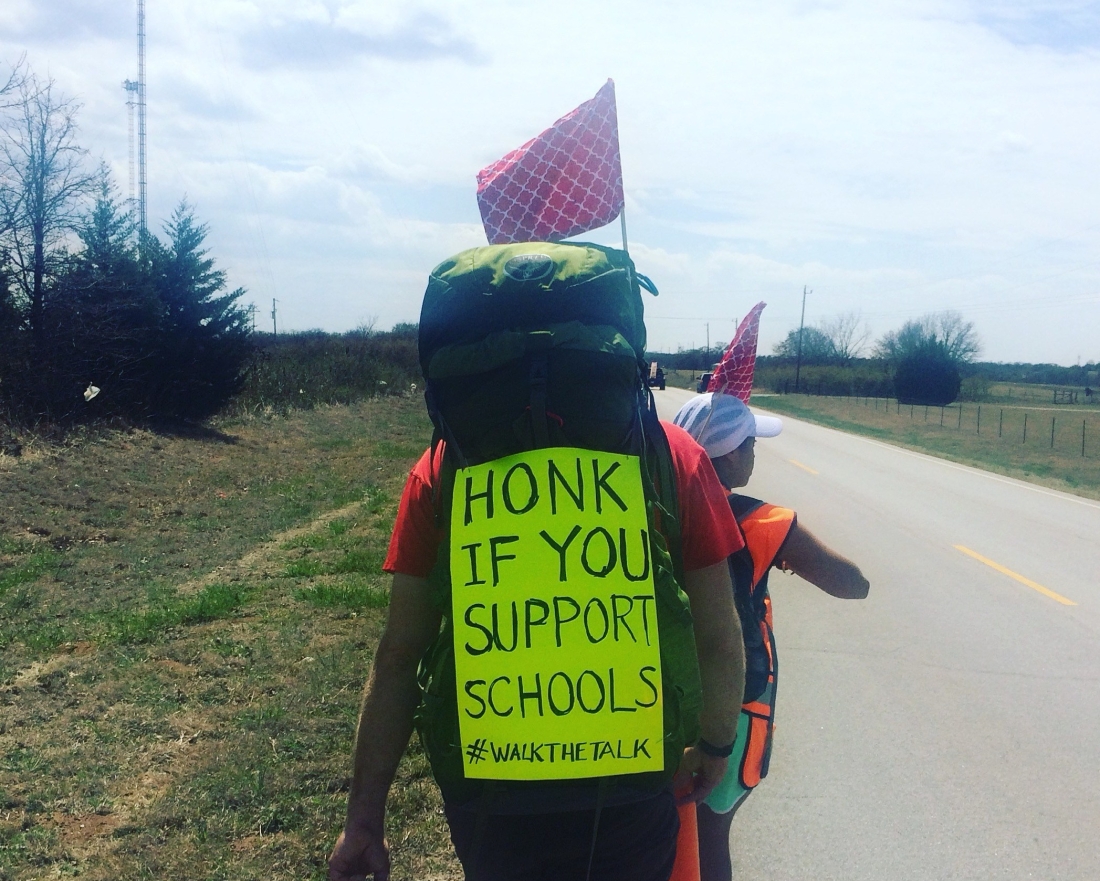
During our six days of walking on Route 66 (the last day of walking took us off Route 66), there seemed to be not a single person travelling by vehicle that was unaware of what we were doing. If I had to guess, I would say that the number of honks of support numbered well into the thousands. By my count, the number of aggressive motorists, drivers that expressed frustration with our presence, was two. As uplifting as the travelers were, the support from local residents was at times completely overwhelming.
There was Larry, a retired 5th grade teacher from Sapulpa, who walked a few blocks from his house, joined our march for at least a mile, and then turned back toward his home offering prayers and best wishes.
There was the Department of Human Services building where staff gathered at the windows with cheers and signs expressing support and solidarity.
There was the conservative pastor of the Church of Christ who partnered with an interfaith group and an LGBTQ advocacy group to provide us lunch.
There was the daycare with young faces and sticky hands pressed hard against the glass trying to catch a glimpse of the marching teachers.
There was the group of elementary age kids with two women that offered us snacks and water and then identified themselves as homeschoolers, but nonetheless strong supporters of public education.
There was the lawyer from Tulsa that brought us lunch, a pizza for every two marchers, high atop a hill in someone’s driveway.
There was the team of Stroud teachers and families who took up a personal collection to allow us to stay in and utilize the state of the art facilities at Stroud Coliseum.
There was the truckload of 3rd grade boys who marched a full day with us, doubled back in the bed of mom’s truck only to march again with a different group, and then topped off the day with a game of basketball in the park in Luther.
There was the group of teenage girls that gave us helium filled balloons to tie to our packs providing an extra measure of visibility.
These experiences and countless others created an emotional state for marchers where tears were never far below the surface. The most often repeated comment as we passed by was, “Thank you for what you are doing!” To which we replied, “Thank you for your support! We are doing this for the kids!”
IMG_3606
The 110 mile march from Tulsa to Oklahoma City seemed aggressive enough to satisfy my personal desire for an escalated means of nonviolent direct action, incredible enough to attract attention from multiple media outlets, and ambitious enough to elicit empathy from Oklahoma legislators most reluctant to approve further revenue raising measures for public education. No doubt other marchers felt as I did on that first day, that there was a very real possibility that the march would be cut short by a clear end to the walkout, that we would be bussed to the Capitol early because all of the union demands had been met with fully funded legislation. The efficacy and timing of the nine day walkout is easily debatable, but the impact and value of our march for education cannot be denied.
img_3618.jpg
In the gymnasium at Northeast Academy in Oklahoma City, marchers were informed that we would be ushered the final mile to the Capitol by a high school marching band. Minutes later outside, I found my way near the front of the large crowd to see the Douglass High School Marching Band, “The Pride of the East Side,” ready to lead the way. The perfect representation of why proper funding for public education is so important was right there in front of me. Just blocks away from the Capitol, our parade was stalled, and we began chanting toward the band, “This… is… for… you!” When we arrived at the Capitol, I had the privilege to speak to the passionate crowd, where I said in part, “We marched for black students. We marched for Latinx students. We marched for native students. We marched for differently abled students. We marched for every underserved student population all over the state of Oklahoma. It is true what they say; a truly free, truly public education is the great equalizer in our society. But it must be fully funded!”
The perfect representation of why proper funding for public education is so important was right there in front of me.
As of writing, public education in Oklahoma is still not fully funded. But the greatest achievement of both the walkout and the march for education is the full knowledge of the possibilities of what mobilized and organized Oklahoma educators can accomplish together.


Tuesday, April 17, 2018

With Education Such a Low Priority in America, It’s No Wonder The Holocaust is Fading From Memory by Steven Singer


The Holocaust has never been more relevant than it is today.

Racism and prejudice are on the rise. Hate crimes are becoming more common. Anti-immigrant sentiment is becoming more widespread.

And anti-Semitic incidents have increased by 57 percent in the past year, according to the Anti-Defamation League.

Yet just last week, a comprehensive study of Holocaust awareness was released concluding that Americans are forgetting this vital chapter of our history.


From 1933-1945, approximately 12 million people – 6 million of whom were Jews – were systematically put to death by Nazi forces.

However, even many of those who admitted to having some knowledge of these events were unsure about the specifics. For instance, one third of respondents – and 41% of millennials – said that only 2 million people were killed.

This is unacceptable.

But not unexpected.

Not in a country that has made education such a low priority for decades.

Only a handful of states mandate Holocaust curriculum in schools – Florida, Illinois, New Jersey, California, Michigan, Indiana, New York and Rhode Island – and each one does so to varying degrees of detail.

Other states like Pennsylvania have laws strongly encouraging the teaching of the Holocaust but not requiring it outright.

Wasn’t this why 42 states adopted Common Core – to make sure all students were learning the same things?

Well, first of all those standards were only adopted in English and Math. Social studies standards were far too controversial to make it over the partisan divide.


principal in Delaware refused to let a concentration camp survivor speak to students because he didn’t think it was rigorous enough under Common Core.

Another district tried to encourage critical thinking by asking students if the Holocaust was true or if it had been exaggerated – as if proven facts were up for debate.

Additionally, the reading standards push for texts to be taught as if they were standardized test items without proper context for a robust understanding. Combine that with an emphasis on texts that are exceedingly complex and it’s no wonder that young people’s understanding of this important part of history is fuzzy.

And I write this as an educator who taught the Holocaust in middle school for more than a decade.

The first thing I did was throw those corporate-written standards in the trash.

My 8th graders and I watched various award-winning documentaries such as “Auschwitz: If You Cried, You Died.” We read the play version of “The Diary of Anne Frank,” but supplemented it with various interviews and autobiographical articles from concentration camp survivors and even a presentation from community members who had first-hand experience of these events until their age and health made that impossible.

The whole unit culminated in a trip to the Holocaust Museum in Washington, DC.

Unfortunately, this does not appear to be the norm.

Though America students make up one third of the 1.7 million visitors to the National Holocaust Museum, 80 percent of Americans say they have never visited any Holocaust museum.

I get it. Teaching about this is hard.

It’s ugly and scary and repulsive – but it’s meant to be.

The DC National Holocaust Memorial  recommends the following guidelines for teaching about the European Holocaust:

“Be sensitive to appropriate written and audiovisual content. One of the primary concerns of educators teaching the history of the Holocaust is how to present horrific images in a sensitive and appropriate manner. Graphic material should be used judiciously and only to the extent necessary to achieve the objective of the lesson. You should remind yourself that each student and each class is different and that what seems appropriate for one may not be appropriate for all . . . Some students may be so appalled by the images of brutality and mass murder that they are discouraged from studying the subject further. Others may become fascinated in a more voyeuristic fashion, subordinating further critical analysis of the history to the superficial titillation of looking at images of starvation, disfigurement, and death . . . There is also a tendency among students to glorify power, even when it is used to kill innocent people. Many teachers indicated that their students are intrigued and, in some cases, intellectually seduced by the symbols of power that pervaded Nazi propaganda (e.g., the swastika and/or Nazi flags, regalia, slogans, rituals, and music). Rather than highlight the trappings of Nazi power, you should ask your students to evaluate how such elements are used by governments (including our own) to build, protect, and mobilize a society. Students should also be encouraged to contemplate how such elements can be abused and manipulated by governments to implement and legitimize acts of terror and even genocide.”

That’s what I tried to do.

This is the first year that I’m not explicitly teaching the Holocaust – and the only reason is because I’m not teaching 8th grade, I’m teaching 7th.

It’s not in my curriculum.

However, I know my students will get it when they advance to the next grade.

I wish that were true everywhere.

Unfortunately, a deep knowledge of history does not come from a society obsessed with standardization and privatization.

In fact, our policy of high stakes testing is an artifact of the eugenicist movementthat inspired the Nazis. Our privatization movement is a holdover from the white flight reactionaries trying to circumvent the integration of Brown vs. Board.

We don’t do a comprehensive job teaching the Holocaust because we haven’t, as a society, learned its lessons.

We don’t teach the consequences of the European Holocaust because we haven’t come to terms with the consequences of our own American varieties. We haven’t acknowledged the effects of Europeans conquest and genocide of Native Americans, the slave trade, Jim Crow, Japanese internment or the prison industrial complex.

To teach the Holocaust we must take a step toward understanding where we, as a nation, have engaged in similar practices.

These are lessons vital to our survival and progress.

And that is exactly why it hasn’t been made a priority. It is exactly why we don’t have equitable education for all children in America.

Doing so would upset the status quo.

Doing so would be troublesome to the powers that be who use a racial and economic caste system to keep us all in line.

Understanding the Holocaust prevents us from reliving it.

And the people in power want to keep that door unequivocally open.

Like this post? I’ve written a book, “Gadfly on the Wall: A Public School Teacher Speaks Out on Racism and Reform,” now available from Garn Press. Ten percent of the proceeds go to the Badass Teachers Association. Check it out!
book-1