Sunday, January 28, 2018

An Interview with Merrie Najimy, Massachusetts Teachers Association


I had a pleasure of meeting Merrie a few years ago at a summer conference and I was lucky to be able to spend some time with her in person to get this interview. She is running with Max Page to represent EDU in the next MTA leadership election. I hope you find Merrie to be as inspirational as I have!
~Melissa Tomlinson


Who is Massachusetts EDU?
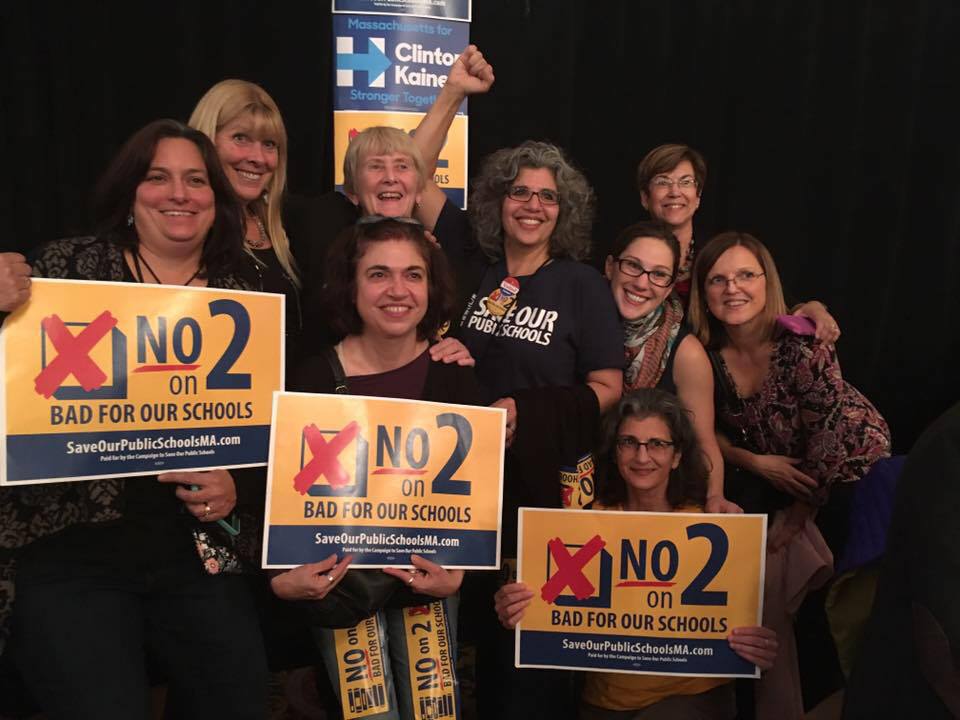
EDU is a progressive caucus that formed in response to MTA operating under the norm of always going to the legislature and the statehouse, negotiating bad deals for the general membership. We believed that it was capitulation and the more that they did it, the more it hurt our students and our profession. Over the past six years we have become a caucus that has come to be the caucus of rank and file educators that support each other to go back to our buildings to bring teachers together to understand the roots of the problems we are experiencing and to work together to find collective solutions. EDU is now a caucus that has shaped the business agenda and the direction of MTA. every year at annual meetings we propose progressive NBIs that direct the work of the MTA. We are finding that rank and file embrace our agenda and vote to put it in place.
We are the caucus that got Barbara Madeloni elected. We are the caucus that can do statewide work, fighting testing, demanding a cap on charters, without being hindered by the bureaucracy of the institution.
You are an endorsed candidate of EDU. This is new for EDU. Tell us about the endorsement process that was established.
It is the first time for this internal democratic process. We knew that the state elections were coming up so we created a process where eight EDU members stepped up to be the candidates to run for president and vice-president. We held three forums around the state, regular campaign forums, and a final forum on the day of voting. Members had a chance to talk to the candidates an we had vigorous debates amongst each other to decide who we felt was best equipped to fill the positions.
We had elections to vote for the one out of the eight that would be our candidate to run for president. There was a run-off so before we voted again we had more rounds of member-to-member conversations. Overall, there were about one hundred people for the four forums.
We went through the same process for vice-president, including another run-off and more member-to member conversations.
This has changed everything because last time we did not run as EDU candidates. At that time there was not established procedure for formally recognizing who was an EDU member. With the previous campaign, specific EDU members volunteered to help Barbara and Mary with their campaign. Now the members of EDU feel like this is THEIR campaign. They are volunteering to take leadership positions on the campaign and coordinate work in different areas across the state.
Tell us about some of the successes you have had as a union representative.
I was directly involved in a campaign to stop the privatization of the bus drivers in my district. I was their representative on the MTA (Massachusetts Teachers Association) Board. The decision to privatize was the direct agenda coming from the superintendent. No communication was done with the community at all about this decision.
We would meet at their break time, in the breakroom at the bus depot. I helped them with a SWOT analysis - strengths, weaknesses, opportunities, and threats.
For the drivers
Strengths: strong community relationships and respected by the parents
Opportunities: (related to the strength) many opportunities to communicate with parents and community members
Threats: facing privatization, imminent threat of funding issues
I assisted with the campaign as an information provider. I helped them create talking points. Parents were mobilized to make phone calls and write letters to the district. Editorials and articles for the newspaper were written. The community members of the town let the district know that they were not happy with this and the decision to privatize was changed.
Since then, the start time has changed for the high school; some of the routes have had to be contracted outside of the district  because there are not enough busses. But there has been a new contract negotiated since this campaign. But the change in routes may provide us with another organizing opportunity.
Our success with this campaign became a public relations nightmare for the superintendent. I experienced retaliation soon afterwards. Since then, there has been a turnover of school committee seats, that superintendent retired, and some of those parents involved in the original campaign have took a large role in the decision-making process for the hiring of a new superintendent.
Some teachers are reluctant to build relationships with or approach parents and community members to create allies. Advice?
Start with the parents that you know respect you. Parents of children that you have had contact with for multiple years, or ones that you have a good relationship with. Intentionally think about who has expressed how happy they are that you have been their child’s teacher. Be honest with them and ask them if you can have a conversation with them. Begin to tell stories about what is going on - talk about the real classroom experiences. Speak from experience and speak from your heart. It can be scary for teachers. There is work that needs to be done with union members to prepare for this, role playing for example. Role play, debrief the role play and then after the interaction, debrief about the experience. This does not happen naturally for a lot of members and there is work that should be done to prepare. Even if a connection is made with one parent, it is possible to ask that parent to invite other parents to their house to be joined by a group of teachers. Look for courageous teachers to start this process. But it is from these opportunities that genuine parent teacher organizations form.
Leaders in Massachusetts have been trying some different approaches to collective bargaining. Please explain rethinking collective bargaining through member leadership and transparency.
It is an open approach to the collective bargaining process that involves members from the beginning to the end of the process. Before actual negotiations began, we invited all members to join us for a meeting. We asked them to answer three questions:
What brings you joy in the work that you do with students?
What sucks the joy out of the work you do with students?
What can we propose through bargaining to bring about change?
We analyzed the different themes in the discussions that took place. From those themes we developed a three-pronged platform.
Time for teaching and learning - uninterrupted time with students, less testing, more time in class, less time in data meetings. More recess, art, and music for the kids
 Professional dignity - the administration needs to view the teachers as the experts, autonomy over pedagogy, curriculum, instructional practices and assessment.
Equity: the high school is a different bargaining unit and there was not equity in pay, planning time, or lunch periods.
We developed a platform, communicated it back to the members, got feedback for provisions and then ratified it for use in guiding our proposals during negotiations. The bargaining items included: number of meetings per year, one early release day every week for teacher collaboration and team planning, and a testing task force to analyze the testing in the district and create a baseline for later proposals to reduce testing.
We were able to shift the power by bringing members into negotiations meetings. At first we had limited our power by agreeing to confidentiality in the beginning of the process. But we, as union members, need to recognize that agreements like this limit our power and we need to stop agreeing to these ground rules. We built momentum through the platform itself, it came from what the members wanted. We built our member capacity and soon we were able to convince the school team that it was in their best interest to let members into negotiations. But we did not do this by asking. We showed up to a meeting with 50 members and the lawyers understood that we had the power that we said we had. There was an agreement made of ground-rules that included an allowance of both parties to be able to invite non-participatory guests. We had to uphold the responsibility of making sure that members did not become unruly and did not participate.
The best part was that the membership began to experience themselves as a union. The negotiating team would meet with them afterwards help them analyze what they saw at the table. They were involved in forming responses to proposals. The negotiating team would caucus together afterwards and refine the final response. This was great in building membership power. The members that were involved in this process would go back to their own buildings and communicate to others what had happened. They felt connected to each other and to the union.
What role does the community have in the collective bargaining process?
We invited parents in. But we were not as successful with this part as we had hoped to be because of the timing. We had a short window of time in which to mobilize and we needed to reach the community in a broad way. There was involvement though. The superintendent had not historically been involved in the bargaining process but she had to be in the audience. She then insisted that the administrative team attend. The school committee soon started attending, even local elected officials. The whole process helped bring about a better understanding of the issues that still existed in the district.
The commitment to transparency comes from our commitment to never have a sidebar away from the table to try and solve a problem. We felt that it all needed to be said in front of members. We moved away from the idea that there should be a lead negotiator. We had two co-chairs for scheduling and seven team members that became experts on each of the platform points.
MTA had a recent success with the campaign “No on 2”, a ballot vote that would have lifted the current cap on charter schools. Talk about the work that paved the way for this success.

The organizing work we had done on smaller local campaigns became the backbone of our success with the “No on 2” campaign. Relationships with community members were already built and the push for a no vote became a partnership effort. Also, because we had worked hard to not only listen to our members and their concerns, but to help them advocate for themselves, our members saw the need for their involvement in this campaign. They were willing to volunteer to go out canvassing. As we were canvassing, we told the community that we were educators and they embraced that fact and listened to our opinion on this issue.
Overall, there are a lot of concerns about teacher apathy in the union. Now that we face the hearing of the Janus case in the Supreme Court, this can be dangerous for the future of our unions. Thoughts?
In Massachusetts, because we won that “No on 2” fight, teachers have found a new sense of confidence in themselves and in their union. Apathy is characterized as despair, disengagement, a feeling of being overwhelmed by issues. The way to break that down is just by talking. Not necessarily of union leadership talking to the members, but by creating atmospheres in which union members talk to each other. Create spaces where members can discuss what they are experiencing as educators. Bringing them together to share these experiences brings about the realization that they are not alone. Once they realize that, help members understand the roots that cause these experiences. Ask them to start collectively thinking about what can be done at the local level to change that.
MTA has a campaign already in place to respond to a negative decision in the Janus case. We have been working on an “All In” campaign where each member promises to have a conversation with 20 other members in their building, four times a year. MTA has been bureaucratic with data collection and systems with this campaign. So EDU has taken the premise of the campaign and transform it to dig deeper into the real experiences of members in our buildings and take that information through the cycle of analyzing, collaborating, seeking solutions, planning actions, and direct actions.
 For more information and to keep updated on Merrie and Max’s
campaign please go to their facebook page!


Saturday, January 27, 2018

A Conversation with Jitu Brown - The Power & History of  #WeChoose


January 22nd to the 26th has been dubbed School Choice Week.  In 2018 the #WeChoose National Coalition seeks to take the narrative back and proclaim that #WeChoose Public Education, NOT the illusion of choice.  During the week of January 22nd, the #WeChoose National Coalition has held activities to show that #WeChoose stands for education, social, and racial justice.  On Thursday, January 25th education bloggers sat down with the national director of The Journey for Justice Alliance Jitu Brown for a conversation about the #WeChoose National Coalition and its mission. 

Jitu Brown is, first and foremost,  a public school parent from the South Side of Chicago.  He has also been a community organizer for over 25 years. Jitu explains the #WeChoose Coalition as a coalition that “understands that there are more of us in this country that wants a just society.” The #WeChoose National Coalition is a grassroots coalition made up of over 1200 local organizations nationwide.  Jitu explains regarding the formation of #WeChoose, “We can’t do this alone. How do we build a multi-racial coalition without people of color having to shrink?  We want unity rooted in self-determination; rooted in what works and benefits all of our children.”

The #WeChoose National Coalition gained steam with the nomination of Betsy DeVos. The coalition sent millions of letters, made millions of phone calls and sent two busses of parents to DC for her nomination hearing.  What that led to is a historic vote by the Vice President for the nomination of the Secretary of Education.  A tie-breaking vote by the Vice President to appoint a Secretary of Education had never been done before.  Jitu noted, “This renewed belief that we can work together. Journey for Justice Alliance, Alliance for Education Justice, The Badass Teachers Association, The Network for Public Education, the national unions, the NAACP, Dignity in Schools Coalition, Moms Rising, multiple state networks, AQE NY, and the Advancement Project all united around a platform that is inclusive of what we are all working on.”

The #WeChoose National Coalition was born! The #WeChoose education platform is rooted in seven pillars -Teachers of color in the classroom, ending standardized testing, sustainable community schools, ending appointed school board, Moratorium on School Privatization, End Zero Tolerance Policies in Public Schools NOW, and a national equity assessment. 
As Jitu noted, “Our goal is to unite in our local cities and rooted in self-determination. Our charge is to nationalize and support those local fights.”


That local fight resulted in Critical Conversations, which were held in town hall style, in over 35 different cities last year. In Pittsburgh community members wanted to stop the suspension of k-2 children. The Pittsburgh community won this fight.   In Newark community members demanded a return to local control. The Newark community won this battle.    “We need to make local officials terrified of selling us out. I have been dealing with school closings since 1997. They don’t care. School choice is a hoax,” Jitu noted in the interview. 

Brown shared the fact that in the Englewood area of Chicago all five high schools are going to be closed. The premise behind the school privatization movement is the removal of black and brown community members from urban spaces. Brown noted that this is directly related to housing, loss of access to food stores, and a policy of gentrifying urban spaces.  The population of people of color has gone from 53% to 32% in Chicago, but this is not only true for Chicago, but it is also happening all over the country.  Jitu noted, “Families of African descent have been purged. We cannot ignore the disease, and that is the elimination of people of color from these spaces and whites being given the space.The greatest thing about this coalition is that I can talk about it in this space across racial lines. It is not about minimizing anyone.”

Brown laid out that the goal of the #WeChoose Coalition is to mobilize in 50-60 cities.  The coalition is working towards making sure that children have the resources that they need to become whole.  Brown noted that would include after-school programs, counselors, and parental involvement. 

Karen Wolfe, a blogger, and founder of PS Connect had the first question for Jitu Brown.  She wanted to understand the history of the Chicago Hunger Strike that Jitu was involved in to keep Dyett High School open in 2015. 

Jitu detailed the history of Dyett and the community effort to elevate the school to a powerhouse.  Brown noted that Chicago had elected school councils. Jitu sat on the local school council with Dyett for ten years. He noted that he saw public school sabotage in action. At the time he was on the council, Englewood closed in 2006, and the children were sent to other schools. The climate at Dyett exploded. The community needed to bring in resources for the school to function.  The council brought in restorative justice programs and student leadership programs. In 2 years Dyett had the most significant increase of students going to college and the largest decrease in students going to prison. According to Brown, the district took Dyett's resources and slashed their budget. In 2011 Dyett won the ESPN Rise Up Award to revitalize athletic facilities, but the school was still slated to close. Organizers began to engage the parents and the community. As organizers began to develop a plan around what schools should look like, they began to gather support. Town Halls were held, letters and petitions were sent to the Chicago Public School Board. Brown pointed out that the community had developed a proposal of a K-12 system of education in the neighborhood that would be a high school with six feeders and leadership throughout. The district was, however, still determined to close the school and replace it with the Obama Presidential Center. Brown states, “We saw the bigger picture of gentrification. We began talking to parents from Little Village - another community that had a hunger strike previously. They became our mentors and told us what to expect; what the consequences could be. August 17, 2015, our hunger strike was launched, and it lasted 34 days. We did not win the school back with the name, but a lot of what we wanted is in place in the school. We have a youth farm and culturally relevant curriculum. There is a monument that was just erected in the school about the hunger strike.”  Brown finished the story with the fact that the strikers had two goals: an open enrollment neighborhood high school and global green technology implemented. In the end, this was the first time that a closed school was reopened as a neighborhood community school. Brown ended with information that there will be a video coming with Chicago grandmother Irene Robinson called Kings and Queens that will chronicle what many families of color are facing, and have encountered,  under Rahm Emanuel.


Next NY Blogger Jake Jacobs asked Jitu Brown how is #WeChoose getting the message out?
Jake noted that we have been shunned out of mainstream news outlets.  Brown responded,  “We have to push the left to the left, and we have to redefine what it means to be progressive. Neoliberal has captured that mantle and lowered the bar. We have a true alliance. I know that if I get arrested, they will get me. Because I have that confidence, I am more confident as an organizer.”  Brown pointed out that the #WeChoose National Coalition has built the infrastructure to get the message out. There is a communications committee and a policy committee. He noted that the coalition has calls every Monday night. He pointed out that we are up against well-monied organizations that have fake parents groups and recycle their proposals and work to each other.  Brown discussed how the #WeChoose National Coalition had harnessed the power of social media.  Brown says, “We have been able to trend on social media - get our message out there. Been able to recruit people. One of the things that I have learned is that oppressive societies work to isolate you. There is something wrong with you to want to be treated with respect. There is power in knowing that you are not alone.”

The #WeChoose National Coalition had their first national critical conversation in December in Washington D.C., and it was hosted by former MSNBC anchor Melissa Harris-Perry. The campaign also trended a few times on social media and had over 100k views on facebook live programming.  The next national critical conversation will be in Detroit on February 13th. Brown was asked how people can become a part of the coalition?  Anyone who wants to join the coalition can  reach out to national organizer Ronsha Dickerson at  info@j4jalliance.com, or they can sign up at The Journey for Justice Alliance website at  www.j4jalliance.com

As we wrapped up the evening Jitu Brown, one of the nations most potent organizers, had some enlightening words for all - “The privatizers are trying to throw charter parents at us. I had a conversation with one of them. I told her I am not your enemy. The traditional system has not always been accountable. We need to adopt measures that give us more voice, not less voice.”

Brown went on to say, “I know that teachers are concerned about what is happening in our schools. Who are these bankers and why are they concerned about my school. Isolation is defeat. Privatizers are not reformers. They are colonizers and settlers. We do not negotiate with our executioner. We need to kill the privatization movement. We have worked in silos and adopted the values of our oppressors. You want a seat at the table, but you are on the menu too. We have more in common with each other than any of us do with our oppressors. People will vote against their interest with hatred that they learned centuries ago - but we need to be different. We cannot adopt the language of our oppressors. We don’t have failing schools, we have been failed.”


“Inspire a demand for community-driven school improvement. Create a space where people get inspired because they are involved in creating what they want in their communities. Seek unity in folks that share our concerns and not just see the focus of education - the issues are all interrelated, planet justice, affordable housing, police accountability. What does every person have a right to in their life? Healthcare, quality education, local control over institutions of economic development,” Brown noted. 

In his closing words of advice, Jitu Brown noted that organizers must have, “Humility - there is something greater than you. All people have something to offer; Listening - listen to each other and hear each other. It is about what they think and what they have experienced; Validation - each other’s pain and stories; Consistency - we can’t do this sometime. We are on the battlefield, and this is where we need to be. What will this country look like in 20 years? In 50 years? I firmly believe that we are a part of that story. Victories can be small - but every victory is important when you are trying to build.”


Thursday, January 25, 2018

Peeling Back the Layers of ‘Choice’ by Terri Michal


There are so many stories in the news about the mismanagement of finances by charter school companies.  There are stories of parents who are forced to move their child to a new charter school year after year because the ones they had chosen thus far were far less than what their child needed, and deserved. There are stories of property management companies charging outrageous amounts in rent to charter schools. There are stories of charter schools cherry picking their students and ‘counseling out’ special needs students.  I can find reports and data that show a majority of charter schools fare no better than traditional public schools. I can find a story for just about every injustice in the charter school vs. public school argument that you can imagine.
But I won’t. There is no purpose, the line is drawn in the sand. No quicker would charter school proponents convince me that parents are the ones that have choice in this charter school movement than I could convince them that the real choice belongs to our legislators to more equitably fund our schools.
We have dug our heels in. Both sides are at an impasse concerning the stories that tug at our heart strings and the data that supports our views.
So what are we left with? The elephant in the room.  We talk all around the subject, coming up with all sorts of ‘solutions’ to improve public education. The truth is, however, nothing will work on a large scale, nothing will improve our struggling schools across the board until we are ready to face that elephant.
The way I see it, it comes in three forms:
Poverty. Alabama is the 6th poorest state in the nation, and the 4th highest in childhood poverty.  For our public schools to move forward we need, for a start, wrap around services to ensure the children are prepared to receive the instruction that is presented to them.  It’s hard to learn when you are hungry, have untreated health problems, or no consistent place to lay your head at night.  Our public schools in Alabama have the power to do this through Innovation Waivers.
Racism. Segregation still exists.  In 2014 Alabama had 54 desegregation orders still open, the second most in the nation.  While working in a district still under a desegregation order here in Alabama I had a white Chamber of Commerce employee tell me that the reason the predominately black side of town had no AP classes in their schools was because those students ‘weren’t capable of taking them’.
 Education laws, including the Alabama Accountability Act and the Alabama School Choice and Student Opportunity Act, were written and sponsored by a predominately white Legislature, with the predominately black minority in opposition. This predominately white establishment has singled out a predominately black feeder system in Montgomery and the entirety of Birmingham City Schools, which is 97% black and brown students, to be ground zero for the charter school movement.  
Greed. When the Alabama Accountability Act was passed it was said to be a mechanism for helping low-income students get out of low-performing public schools. According to Larry Lee, in 2017 3,458 students across the state were on scholarship through the AAA.  Of these, 967 went to students “zoned” to attend a “failing school”. Since the passing of this bill, 14,914 scholarships have been awarded and over 93 Million dollars have been collected.  That is well over the $3500 scholarship that each student received. So, not only are a majority of the students that have benefited from vouchers NOT from failing schools, but the Scholarship Granting Organizations are making millions.  Supporters of the bill have since been forced to admit that the bill was not the mechanism for helping low-income students like it was originally touted to be.
I would be remiss if I did not mention the money one can make by investing in Charter Schools.  In 2000, President Bill Clinton established the New Markets Tax Credit (NMTC). Concerning this, Stephen Vita with Investopidia states: “NMTC provides a tax-advantaged way and direct way for hedge funds to cash in on the charter school juggernaut. The NMTC has two components: a 39% tax credit on charter schools contributions over a seven-year period plus the ability to collect interest on the money they contribute. A hedge fund could double its investment in seven years, and the tax credit can be combined with other tax breaks without limit. It is not surprising that hedge funds have flocked to this deal handed out by the federal government.”  An added advantage? The investment is being made on an item created with the tax payer’s dollars, a funding source that is guaranteed.  
That’s just the tip of the iceberg. If, indeed, Birmingham City Schools is turned into a conversion school district, the entire $280 million dollar budget would potentially be behind the doors of private management companies.
So, let’s put all of this into focus: On Thursday, January 25th there will be hundreds of people at an event at the State House in Montgomery touting school choice, but on January 23rd in Birmingham, ground zero for the charter school movement, there will be about 20 people at the Board’s regular called work session.
The squeaky wheel gets the oil, but that doesn’t mean the motor is going to work.
No matter the stories cited or the data quoted on both sides of this argument, the truth does not change: Until Alabama’s Legislature values ALL STUDENTS, our high poverty students and our black and brown students will struggle.
What will influence this change? The ‘majority’ truly caring about the ‘minority’.
I say to ALL of our communities in Alabama: It’s time we start eating this elephant a bite at a time.
#StandUp #SpeakOut #VoteSmart #BeTheChange

Wednesday, January 24, 2018

Few Kids in the World Can Pass America’s Common Core Tests, According to New Study by Steven Singer


Could you jump through a hoop?


Probably if it were lying on the ground.


But what if it were held slightly higher? Let’s say waist high? Sure.


Shoulder height? Maybe with some practice.

How about if we raised the hoop to the rafters of a three story auditorium? Could you jump through THAT?


No. Of course not.


You could train with the world’s greatest coach, with the best equipment, 24-hours a day and you still couldn’t jump that high.


Yet that’s kind of what the U.S. has been expecting of its public school students – minus the resources.


We hold the hoop ridiculously out of reach and then blame them when they can’t jump through it.


But don’t take my word for it.


This is the conclusion of a new study that came out in January called “How High the Bar?” by the National Superintendents Roundtable and the Horace Mann League.


The difference is the NAEP is only meant to compare how other countries stack up against each other. Common Core tests, on the other hand, apply exclusively to kids within the US.


No one’s actually expected to pass the NAEP. It’s only given to a sample of kids in member nations and used to rank international education systems. The U.S. government, however, gives almost all its students Common Core tests and expects them all to pass – in fact, failure to do so could result in your public school being closed and replaced with a charter or voucher institution.


However, in both cases, the study concluded the score needed to meet the bare minimum of passing was absurdly too high – so much so that hardly any group of children in the entire world met it.


It’s important to note that these aren’t standardized testing skeptics.


They believe in the assessments. They even believe in Common Core. What they don’t believe in is the benchmarks we’re expecting our kids to meet to consider them having passed.


And this has massive consequences for the entire education system.


The media has uncritically repeated the lie that American public schools are failing based almost exclusively on test scores that show only one third of our students passing.


But if the same tests were given to students the world over with the same standard for success, even less would pass it, according to the study. If we drew the red line on the NAEP at the same place we draw it on Common Core tests, almost every child in the world would be a dunce.


Kids from Singapore would fail. Kids from South Korea would fail. Kids from Japan would fail. You name a country where kids do nothing but study for high stakes standardized tests, and even they couldn’t meet our uniquely American criterion for passing.


In fact, the percentage of our students who do pass under these ridiculous benchmarks often exceeds that of other countries.


So when you hold kids up to impossible standards a few actually make it – and more of our kids do than our international peers.


That doesn’t mean the benchmarks are good. But it doesn’t mean the American education system is failing either. In fact, just the opposite.


We have a high stakes standardized testing system that not only does not assess kids fairly, but it actually hides their success!


In the words of the study’s authors, “…the analysis suggest the U.S. has established benchmarks that are neither useful nor credible.”


How did this happen?


It comes down to one word – proficient.


If you’re proficient, it’s thought you’re competent, you are able to do something. You might not be incredible at it, but you can get the job done.


Kind of like this:


Hey. Did you hear about my leaky faucet? The plumber fixed it after three tries because he’s proficient at his job.


Oh really? My plumber fixed my leaky faucet in only one try and didn’t even charge me because she’s advanced at her job.


That sort of thing.


There are only four scores you can achieve on most standardized assessments: Advanced, Proficient, Basic and Below Basic. The first two are considered passing and the last two are failing.


However, this doesn’t line up with the five general grades most public schools give in core subjects:


A – Excellent
B – Very good
C – Average
D – Poor
F – Failing


A-D is usually considered passing. Only F is failing.


So you might expect them to line up like this:


Advanced – A and B
Proficient – C
Basic – D
Below Basic – F


However, that’s not how they line up on NAEP. According to Diane Ravitch, who served on the National Assessment Governing Board, the federal agency that supervises NAEP, they line up like this:


Advanced – A+
Proficient – A
Basic – B and C
Below Basic – D and F


This is important, because saying someone scored a proficient on the NAEP doesn’t mean they’re just okay at it. It means they’re excellent but have room to improve.


The problem is that when developers of Common Core tests set their benchmarks, they used almost the same ones as the NAEP. Yet the NAEP benchmarks were never meant to be the same as grade level ones. Confounding the two puts mere passing out of reach for most students.

And that’s not just out of reach for most American students. It’s out of reach for international students!

In short, American students are doing B work on their Common Core tests and failing with a Basic. Yet in other countries, this would be passing with room to spare.

Moreover, when you hear that only one third of American students are Proficient or above, that means only one third are doing A or A+ work on their Common Core tests. That’s actually rather impressive!

According to the study:

“National judgments about student proficiency and many state Common 
Core judgments about “career and college readiness” are defective and misleading… 
According to NAEP officials, Proficient does not mean grade level performance. The misuse of the term confuses the public. The effects of this misuse are reflected in most Common Core assessments…

NAEP’s term “Proficient” does not even mean proficient. “Students who may be proficient in a subject, given the common usage of the term, might not satisfy the requirements for performance at the NAEP achievement level.”

The report even cites other independent analysts that have come to similar conclusions such as the U.S. General Accounting Office, the National Academy of Sciences, and the Brookings Institution.

In short:

“Advocates who push for school improvement on the grounds of questionable benchmarks are not strengthening education and advancing American interests, but undermining public schools and weakening the United States.”

Some specifics.


The study was conducted by comparing performance of foreign students on international tests of reading, mathematics, and science NAEP with American Common Core tests.


Very few foreign students were able to score high enough on the NAEP to meet what is considered proficiency on Common Core tests.


In fact, in 4th grade reading, not a single nation was able to meet the benchmark.


In 8th grade math, only three nations (Singapore, South Korea and Japan) had 50 percent or more students who could meet the criterion.


In 8th grade science, only one nation (Singapore) had 50 percent or more students meeting the benchmark.


But wait.


Even though the benchmarks are unfair and few nations children could meet them, the percentage of U.S. children who did meet them was higher than most other nations.


Take 4th grade reading.

Screen Shot 2018-01-22 at 8.48.54 AM

No one had 50% or more of its kids scoring a proficient or advanced. But 31% of U.S. kids actually met the benchmark, putting us fifth behind only Singapore, the Russian Federation, Finland, and England.


Only 31% of our kids could do it, but only four other nations out of 40 could do better.


That’s kind of impressive. Yet judging our scores in abstraction solely on this unrealistic proficiency standard, we’re failures. The whole process hides how well our kids actually do.


Bottom line, Common Core benchmarks are too high and paint an unfair picture of our education system, according to the study:


“When citizens read that “only one-third” or “less than half” of the students in their local schools are proficient in mathematics, science, or reading, they can rest assured that the same judgments can be applied to students throughout most of the world…

Globally, in just about every nation where it is possible to compare student performance with our national benchmarks, the vast majority of students cannot demonstrate their competence because the bars are set unreasonably high.”

Screen Shot 2018-01-22 at 8.47.29 AM

At very least, this invalidates the scores of every Common Core test yet given in this country. It demands we set new benchmarks that are in line with grade level performance.

At most, it casts doubt on the entire process of high stakes standardized testing.

It demonstrates how the data can be manipulated to show whatever testing corporations or other interested parties want.

Standardized testing is a gun, and we have been demanding schools shoot themselves in the foot with it.

Instead of trying to hold our schools to impossible standards, we should be holding our lawmakers to standards of common decency. We should concentrate on equitable funding, reintegration, and supporting our public school system and public school teachers. Not enriching private testing corporations so they’ll paint a misleading picture of student performance to justify pro-privatization schemes.

When will our policymakers rise to meet the benchmarks of honesty, empathy and caring about the well-being of children?


In the final analysis, that may be bar they are simply incapable of reaching.