Thursday, April 20, 2017

Call This The Empty Chair by Patte Carter-Hevia


Today I attended a National Education Association Listening Tour stop. Dinner and then a keynote speaker and then a panel discussion. The theme was "How do we create the public schools that our children deserve?”

The keynote speaker was a business owner and author. He told the story of how he came to learn that a business model is not what education needs. Interesting. Engaging. Informative. Entertaining.

Please, God, from his mouth to corporate America’s and the policymakers’ ears.

The panel discussion that followed included an education lawyer, a university professor from the college of education, a university coordinator of urban education, a state representative, the school superintendent, and the school board president. All wrapped up in a bow with the union president as the moderator.

All advocates of public education and educators.
All well-informed individuals.
All intelligent and articulate professionals.
Each with much to bring to the proverbial table.

And, as far as I could tell from what I have been able to discern, not a current public school teacher in the bunch.

Instead we were the audience. We were once again being talked to and talked about. Once again, the discussion, as good as it was, ended where it should have begun.

Pity the poor colleagues of mine who were seated on my right and my left.

I had a LOT to say. No, I wasn’t shouting; I just wasn’t whispering either.

I think a colleague of mine was correct, when we spoke afterwards, in saying that perhaps the discussion should have been open mic.

With no teacher at the adult table, we were instead again the kid in the class who knows the answer but that the teacher won’t call on.

During one point in the discussion, the superintendent commented that she had been invited by the local newspaper to write an op-ed piece on the newly appointed secretary of education. She said she declined the invitation. She declined the invitation because she didn’t know anything about the SoE. The superintendent is coming to the end of a forty-plus-year career in education. During her career, she has been to multiple meetings on education and educational policy. She has read research. She has read journals. She has served on committees. She has been visible at the local, state, and national levels.

In all that time and attention and service to education, she has never seen or met the current secretary of education.

She stated that when she wanted or needed the services of a doctor or lawyer or accountant, she sought out professionals in that particular field.

That generated a round of applause.

I commented that that is what she should have written in her op-ed.

The implication of her comments was that the appointment of the current secretary of education was wrong on several levels.
Yet I realize as I consider the members of the panel for this evening’s discussion and I hear teachers scream for a voice and a seat at the “grown-up” table, that tonight’s event, as good as the discussion was and as passionate about education as the members of the panel were, was still a microcosm of what is wrong with education.

And we’re still no closer to making it right.

Wednesday, April 19, 2017

The Ones We lose by Cheryl Binkley

Originally posted at: http://3rdmillenniumteacher.blogspot.com/2017/04/the-ones-we-lose.html

Last week, right before Easter and in the middle of Passover, a vandal spray painted Nazi, anti-Jewish, and anti-LGBTQ messages on a Jewish Community Center and United Church of Christ in my neighborhood. The Community Center is a place I have bought gifts for family.  The church is a place I have both attended and led workshops, though it’s not my home congregation. The community rallied and removed the graffiti, but the attack has me in a deeply reflective place.

They quickly caught the alleged perpetrator: a 20 year old, who had attended a high school in my district. Had his eyes not looked dead in the photo he might have been handsome and capable looking.  Word among my former students on social media was that he is a member of local white supremacist groups; groups I did not know existed in my community. I had not been his teacher, but for a mile or two distance one direction or the other, I might have been.

I can still remember almost 20 years ago when a student was arrested, my first “loss.” A colleague, older and more experienced said, “You can’t save them all.”  It was one of the hardest things to hear.  It still causes me pain that we don’t find a way to save them all. 

Each “loss”: each drug overdose, each suicide, each prison sentence is a blow to your own “why” for teaching and being.  Just as each success, each life affirmation is a cause for joy. For teachers our “why I teach” is often to help each child to find a path to life’s gifts, and when one loses their way, or does not learn the lessons that will help them navigate life,  it triggers deep introspection for those who taught that child.

What did I miss? What could I have done differently? Could I have done more? How did this happen?

Ironically, students we lose the most these days are on opposite sides of the political spectrum.  I have been to memorial services for recent former students whom I knew struggled with gender identity and sexuality, heard of students who had wound up in prison, and visited the hospital for bullied students who OD’d.  

Until now, I had never thought it through that white supremacist boys (or girls) are lost; just as in need of help as our LGBTQ, or our impoverished students. I don’t mean that we should back away from acceptance, defense, and caring for our LGBTQ students or stop helping those who live with fewer resources.  It is just a realization to me the common cause of their struggling is feeling left out, marginalized, disrespected, and unmoored from belonging.

The conversations overheard of young white-supremacist men saying, “We are taking back our country,” speaks to a feeling of being outcast, and rejected.

The young man who spray-painted the community center and church is lost in similar ways to the Trans kid who died at his own hand or the at-risk kid who overdosed from despair. One’s alienation expressed in self harming despair, the other’s in violent hatred for others.

Both beg the question: Why am I not accepted and included in the compassionate caring of family, friends, and community? Why am I seen as unworthy of love and acceptance?

Clearly, there is no pat answer for either’s lostness.  But there is a mandate for us as families, neighbors, teachers, schools, and communities. 

We have to ask ourselves why,  and change the way we are treating our children and adolescents so that they don’t arrive on the doorstep to adulthood with anger and despair in their hearts. 

We have to understand how we are systematically doing things in our culture and society that bring them to such a sense of despair, and we have to stop doing those things.  We must find the ways to include and connect with those who feel most bereft of care, and reach out to them, support them, and create systems that are inherently kinder, affirming, and more giving and forgiving. 

We have to find a way to save our “lost” children before their anguish tears us all apart.

Arne Duncan Designed Rahm Emanuel’s Latest Attack on Poor Students of Color by Steven Singer

Sometimes an idea is just too stupid to keep it all to yourself.
Ask Arne Duncan.
Sitting at his lonely desk as managing partner of the Emerson Collective, a limited liability corporation pushing school and immigration policy, he must have missed his days as President Barack Obama’s Education Secretary.
After all, he was the architect of Race to the Top, a federal policy that at best wasted billions of tax dollars without helping students learn – at worst it enriched private charter school operators, standardized test and publishing corporations and private prison operators without helping kids learn.
At the dawn of 2017 with Donald Trump just beginning to flush public education down the toilet in favor of school vouchers, Duncan took to the Internet wondering how he, too, could bring harm to inner city students.
On Jan. 11, he sent an email to Chicago Mayor Rahm Emanuel with a suggestion that was pure Duncan – let’s help poor children of color by making it harder to graduate!
Chicago Public School students have suffered from decades of budget cuts, teacher layoffs and even the closure of 49 schools almost exclusively in poor, black or Latino neighborhoods. A former district CEO even plead guilty to a $23 million kickback scheme.
As a result, the more than 400,000 students, 37.7% of which are black and more than 80% of which are poor, have struggled academically.
How would Arne help them? Make them submit more paperwork in order to get a diploma. They must prove that after 12th grade they’re going to college, trade school, an internship, the military or would otherwise be gainfully employedOR ELSE they can’t graduate!
“Think about making completing a FAFSA [financial aid application] and applying to two or three colleges or the military a new CPS graduation requirement,” Duncan wrote to Emanuel in emails released to the Chicago Sun-Times through a Freedom of Information Act request. “Graduation rates continue to rise. This would signal the importance of ongoing education/training. A HS diploma is great, but not enough. No other school system I know of has taken this next step.”
Duncan followed up in February, and Emanuel replied, “Thanks. You know we are doing a version of your graduation requirement.”
Duncan responded, “Didn’t know. Good?”
No. Not good, Arne.
Because of your neoliberal meddling, when this year’s 9th graders finish their senior year, they’ll have to jump through yet another hoop to get their diplomas.
The Brookings Institute concluded in 2016 that cities like Chicago with pronounced income inequality are more likely to see higher rates of secondary school drop-outs, and lower graduation rates. An unrelated 2014 study found that Chicago ranked eighth among American cities in an index of income inequality.
None of that is helped by a new graduation requirement.
But Duncan disagrees.
He wrote an op-ed published in the Chicago Tribune praising the plan – his plan.
“Some people worry that raising graduation standards will cause more young people to drop out, but they’re wrong,” he wrote. “Young people don’t drop out because school is too hard. They drop out because it is too easy and they are not engaged. They don’t understand how it’s relevant to their lives.”
Wrong, Arne. It’s not a matter of school being too easy. It’s a matter of life being too hard. Imagine being an impoverished inner city student. You’re malnourished, there are few books in your home, you’re struggling to survive in a world populated by drugs and gangs, you’re suffering from post traumatic stress and your neighborhood school is closed, your teacher is laid off, there’s no tutoring, no arts or humanities classes. And they keep making you take endless high stakes standardized tests. THAT’S what makes students loose interest in school. Not because it’s too easy!
But Emanuel, a former investment banker and Obama’s White House Chief of Staff, only understands business solutions to human challenges.
When proposing this new graduation requirement, he said he got the idea from charter schools.
But of course! Private corporations running schools at public expense always know what is best!
Emanuel doesn’t think this new policy is a major change.
“We already have around 62 percent of our kids are already either accepted into college or accepted into community college, and our goal is to make sure nobody spikes the ball at 12th grade,” Emanuel said. “We want to make 14th grade universal. That’s the new goal line.”
Is it, Rahm? It’s interesting that you’re doing this for inner city kids but no one is suggesting it for wealthy kids in the suburbs.
This statement about expectations explains why:
“Just like you do with your children, college, post-high school, that is what’s expected,” Emanuel said. “If you change expectations, it’s not hard for kids to adapt.”
So poor black and Latino kids need YOUR expectations. Is that it? It’s up to YOUR patriarchy to step in and tell them what to do with their lives after high school or else – what? They’ll just sit home on food stamps doing nothing?
This is Chicago – where police brutality is an everyday thingGun violence is out of control. And you think these kids and their parents live in crippling, generational poverty because they aren’t trying hard enough to get jobs or better themselves?
Those seem to be the underlying assumptions here. It’s not about giving these 18-year-olds a helping hand. It’s about pushing them to pull themselves up by their own bootstraps.
It only takes a second of thought to realize why this is a bad idea.
The district has been cutting staff positions left and right – especially at schools serving poor students of color. Has any additional funding been budgeted to ensure district guidance counselors are in place to help students meet this goal? NOPE.
Students can graduate if they prove they’ve got a job after high school. Those aren’t exactly growing on trees – especially jobs that pay more than minimum wage. What if students can’t find employment? That’s reason to withhold their diplomas? Your academic fate should be held up because there aren’t enough positions as a fry chef!?
Sure, seniors can apply to a local community college, which according to a spokesperson for City Colleges of Chicago, lets everyone in. But what if this isn’t the path for them? Not everyone is made for college. Why is the city stepping in to demand a post graduate plan from students? Isn’t this really just a recruitment plan for these community colleges and/or the military?
Is this even legal? These kids have passed all their classes. They’ve earned a diploma. You can’t simply withhold it because their post-secondary plans don’t meet with your approval.
When the district withholds its first diploma, look for a legal challenge where taxpayers will be in the uncomfortable position of paying for legal counsel to stop a child from graduating.
This Duncan/Emanuel policy is something you might expect from a certified moron like current Education Secretary Betsy DeVos. (She wants teachers armed against grizzly bear attacks.)
But it should be noted that both Duncan and Emanuel are Democrats. They’re just not progressives.
You wonder why a fool like Trump won the Presidency? It’s because of neoliberal attitudes like these. Both of these men were part of the Obama administration. And Hillary Clinton was following in the same footsteps – or certainly she didn’t speak out against it.
Emanuel’s political career is backed by the same big money conservatives that back Chris Christie, Mitt Romney and Bruce Rauner. He’s a puppet of charter schools, hedge fund managers and the Koch Brothers.
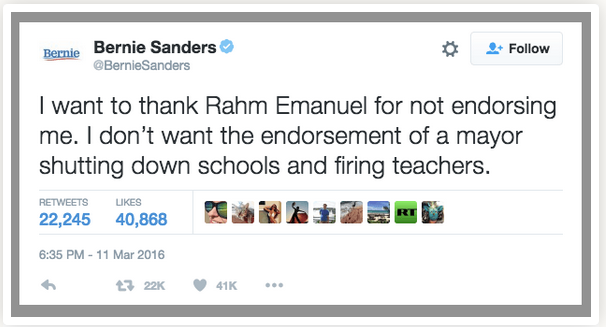
In fact, his corruption was so bad that during the 2016 primary, he became an issue for Democratic Presidential contenders. Bernie Sanders actually called him out in a tweet saying: “I want to thank Rahm Emanuel for not endorsing me. I don’t want the endorsement of a mayor shutting down schools and firing teachers.”
Screen shot 2017-04-18 at 12.51.54 PM
Rahm had endorsed Clinton putting her in a bad position. Ann O’Leary, Clinton’s education advisor, said in private emails that Emanuel was “bad for Chicago schools.”
Like Clinton’s campaign manager, John Podesta, O’Leary was a longtime supporter of corporate education reform policies – and so was Clinton. Hillary supported George W. Bush’s terrible No Child Left Behind – the law that changed federal education policy from focusing on equity to holding schools hostage for their standardized test scores.
O’Leary was worried about how Emanuel might hurt Clinton – especially in light of Bernie’s tweet.
In a private email to senior Clinton staff, she wrote:
“Bernie is beating us up over Rahm’s record on schools in Chicago. The Chicago school system is overloaded with debt and likely to run out of cash before the end of the school year. As a result, they are withholding their pension contributions, and laying off teachers and support staff.
I reached out to Randi W[eingarten, President of the American Federation of Teachers] and she suggested that she tweet something tomorrow making it clear that Rahm and Rauner have been bad for Chicago schools and then HRC [Hillary Rodham Clinton] retweets.
That sounds like a toxic idea to me given Rahm’s endorsement, but I don’t think this issue is going away.
We could: (a) have HRC say something more forceful about the state working to help Chicago pay off debt so the schools can focus on teaching and learning; (b) have Randi say something more mild and we could retweet. But I do worry that short of going after Rahm, these options are not going to be satisfactory. So the (c) option is to stay silent for now.
Thoughts?”
O’Leary’s final decision was to do nothing.
And we all know how that turned out.
Screen shot 2017-04-18 at 12.52.54 PM
The worst part is that the Democrats don’t appear to have learned anything.
Here’s what Duncan had to say just this month about how Democrats should be fighting the Trump administration’s education policies:
“The federal government is disinvesting in public education and withdrawing from accountability, so states and districts have to step up and lead.”
But Arne, your administration disinvested in public schools, too. Emanuel is famous for it!
And we all know what “accountability” means to neoliberals like you. It means endless standardized testing and closing schools catering to poor students of color. It means giving charter schools, book publishers and testing corporations a blank check.
No one is going to vote for that anymore.
That is just not a viable alternative to Republican policies that take all of this to its logical conclusion.
Destroying public schools slowly is not a viable alternative to destroying them quickly. Democrats need to either discover their real progressive roots or else move aside for grassroots groups to take over.
That’s a suggestion worth sending to your buddies Rahm, Hillary and Barack via email.

Monday, April 17, 2017

Corporal Punishment Does Not Belong in Our Profession by Dr. Michael Flanagan


Last year a video of a five-year-old boy being paddled by Georgia school administrators went viral, renewing the debate about corporal punishment. Corporal punishment is defined as “any time physical punishment is intended to cause pain or discomfort”. Watch this video of this child, pleading not to be spanked because he had missed too many days of school, while his mother is forced to watch and threatened with arrest if she intercedes. Beside the revulsion most of us feel witnessing the actual act of paddling, we also know that this action will only result in that child hating school, probably forever.

Yet, there are those who still adhere to the old adage “spare the rod, spoil the child”, believing that corporal punishment is an important means for maintaining a positive school tone.They not only practice it, but still cling to it as a viable means of discipline. Students learn best from respect and encouragement, not fear and pain. Corporal punishment has no place in our profession. When an educator is in a position of power over children, our greatest tool is compassion.


Georgia principal paddles 5 year old

A recent NPR article and its readers' comments revealed that there is ardent support for the use of corporal punishment as a means of school discipline in certain parts of the United States. How is it that so many still support the use of physical abuse as a means of discipline? Some teachers, not properly trained or proficient in non-violent disciplinary methods paddle children out of sheer frustration. Yet watching that video, it is hard to argue that this “punishment” is not in fact abuse. Striking children, at least as far as many teachers are concerned, is a form of weakness and ignorance. It is a means of revenge and used to force submission. How can we as a society ever effectively combat child abuse if we continue to allow it to occur in the one place where children above all else should be protected and feel safe? Their school.


The United Nations resolution against corporal punishment defines it as:
“any punishment in which physical force is used and intended to cause some degree of pain or discomfort, however light. Most involves hitting (“smacking”, “slapping”, “spanking”) children, with the hand or with an implement – whip, stick, etc.”.
But despite this international resolution, and the fact that corporal punishment is recognized as a human rights violation by the United Nations Committee on the Rights of a Child, it is legal in school districts in 22 states.


Corporal punishment is regularly used in 19 states; 15 states expressly permit it, while another 7 do not prohibit it. It is illegal in 28 states and Washington DC. The majority of the states that still permit corporal punishment are Southern states. Nationally, there were 163,000 cases of corporal punishment during the 2011-12 school year alone. Alabama paddled 19,000 students in 2013-2014, and Texas subjects more than 30,000 students a year to corporal punishment. Of the 19 states where corporal punishment is legal in schools, 11 states were former Jim Crow states, 14 states are Right To Work States and all went Republican in the last presidential election.


The Supreme Court ruled 5-4 in Ingraham v. Wright (1977) that states had the right to paddle students without a hearing. This statute remains despite the ACLU’s strong stance against the use of corporal punishment as a violation of a child’s civil rights, and the U.S. Department of Education -- as recently as 2016 -- urged states to end corporal punishment practices. Although the policy under Betsy DeVos is unclear at this time, she is a supporter of school choice and vouchers for charter and religious schools. This would indicate a partiality towards empowering local and state decisions over federal mandates.


Corporal punishment has long-term negative effects on student social and academic success. Research shows that punishment negatively affects a student’s academic performance and does not decrease inappropriate behavior, while positive behavior supports and reinforcement of good behavior do. States where schools paddle students have lower achievement and graduation rates than states where they do not. Students who have been subjected to higher rates of corporal punishment show increased incidence of incarceration, psychiatric treatment and substance abuse.


Nationally students with disabilities are 50% more likely to be paddled. Students with disabilities comprise only 14% of the total student population, yet make up 19% of those receiving corporal punishment. In some districts in Alabama, students with disabilities are 67% more likely to be violently disciplined than those without disabilities. This violent, often bruising, form of discipline is usually in direct violation of their federally-mandated IEP’s. Boys are also much more likely than girls to be paddled in school.


Corporal punishment disproportionately affects minority students, reflecting the systemic racism within the United States in general, and our educational system specifically. Black students on average are 51% more likely to be paddled than white students. Alarmingly, the racial disparity between Black and White students subjected to paddling increases to as much as 500% in certain school districts. Thus statistically, African-American male students with disabilities have the highest rates of corporal punishment than all other demographics.  


Even in the face of this overwhelming research, many national polls show strong support for the use of corporal punishment by parents, with more than 70% of people approving of the spanking of children. There are millions of parents who physically discipline their children, and most parents feel that an immediate spanking for a dangerous behavior, such as running into the street and almost getting hit by a car, is understandable. But parents also feel that this is very different from abusing children. Among those who do support corporal punishment in schools, there are identifiable correlations between low socioeconomic status, religion and race. Significantly fewer people who support corporal punishment at home feel it is appropriate in schools.


Most states where corporal punishment is legal have regulations on who can administer corporal punishment. All states have some procedural safeguards, such as only using a paddle or switch, and most districts (but not all) have protocols for parental opt-outs. However, In states where corporal punishment is legal, teachers are usually immune from prosecution. Teachers in those states are also less likely to speak out against abusive practices because of Right to Work laws. On the other hand, in states like New York where corporal punishment is illegal, not only can a teacher be fired for engaging in it, but they can be arrested and prosecuted.


Professional educators, by definition of their positions and the power vested in them by the state, are in loco parentis. While school administrations are empowered and expected to exercise some of the rights of a parent when students are in their care, violent discipline only teaches children that physical pain, fear, and retaliation are the preferred methods for dealing with inappropriate behavior. It ultimately makes children more aggressive; spanking simply reinforces the inappropriate behavior for which the child is being punished. Violence only begets more violence.


Educators must call out those in our ranks who perpetuate this Dark Ages mentality, and repudiate those who promote and defend corporal punishment. Corporal punishment can no longer be given credence as an acceptable disciplinary technique, and it must be clearly categorized as the bullying of children. To those who refuse to adhere to common sense and research, I wish them karmic justice. The children you paddle will one day be adults, and you may forget what you did to them, but they never will. Those children will be emotionally scarred for life. Education happens through love and respect, not through pain and bruising. Corporal punishment does not belong in our classrooms.