Saturday, April 23, 2016

Teachers are More Than a Score: BATs Report VAM Systems from Around the Nation
Marla Kilfoyle, Executive Director BATs and Melissa Tomlinson, Asst. Executive
Director BATs

Across the country teachers are being evaluated by a system known as Value Added Measure.  According to the American Statistical Association, “A VAM score may provide teachers and administrators with information on their students’ performance and identify areas where improvement is needed, but it does not provide information on how to improve teaching. http://www.amstat.org/policy/pdfs/asa_vam_statement.pdf


BATs asked teachers from across the nation  to report on the various evaluation systems used in their state.  Many reported the demoralization of teachers, the sense of unfairness, and an utter disdain for the lack of focus on how to support the profession rather than demean it.  We were also particularly interested in the idea that teachers can attach letters to their end of the year evaluations.  In many districts around the nation, local unions can negotiate attaching a “letter of protest” to your end-of-the-year evaluations (even if your evaluation is PERFECT, you should still write a letter of protest).  We will invite all BATs to find out if this is the case and to utilize it as a way to document our protest, officially, of using junk science to evaluate our profession.   Here are what some of our BATs reported around the nation.


Florida


Teachers are evaluated via Marzano and VAM on student growth on state assessment (FSA). The state allows districts to decide their own percentages for each category, as long as student growth is not valued less than 30%. Evaluation is returned in May for teaching practice, then in October for full evaluation including student growth. We are allowed to write statements and put them in our files if we disagree with the score or perhaps have circumstances with a classroom of children who are perhaps more disadvantaged than others.


Teacher  evaluation has 3 metrics: admin observation (40%), Professional Development plan (10%), student data (50%). Because we wait for the data number, the evaluation is not finalized until Nov. 1 of the next school year - at the earliest. Teachers  are allowed to sign that they do not accept it and to write a response that will be attached.

Ohio


  • We are evaluated with 50% based on  principal observation through TDES (5 "touches" based on Charlotte Danielson).  We are also evaluated on 50% test scores - part of Cleveland Plan Law and now state law.  Our pay has been tied to our rating for 3 years.  Composites are due April 29th.  Teachers cannot say anything about their evaluations to the state.  Districts send threatening emails if teachers don't go into Battelle (online reporting system) and confirm their rating.


  • More from  Ohio -We are rated on  50% observation and 50% Student Growth Measure .  Our contract spells out a range of time between April 1 - May 10.  Teachers  can and do attach  letters  to their final evaluation.  


  • Ohio, OTES & SLO (utter stupidity from our inept state department), within the time frame, my principal encourages all of us to respond with anything she may have missed.


  • From Ohio BAT - OTES only if tenured: once every three years if accomplished, once every other if skilled, every year ongoing if developing, until the rating is increased [not sure how long they give, but this is the third year and I know of one teacher still trying to improve, but our contract protected us] and if ineffective then during the year to make sure you are meeting the goals of your improvement plan [only have that year to improve]; the OTES eval is approved by admin with a post-conference with chance to defend and possible change with further evidence; teachers who are not tenured are otes if they are not in the resident educator program; our district review plan went out the window with otes; we do have the ability to add a written response to anything added to our file

  • From Ohio BAT - I teach elementary art, and although the SLO process was supposedly discarded & my district opted for "shared attribution" , I must "show student growth" with some kind of before instruction and after instruction numbers, which means I must still give tests to two of my 28 classes of fourth graders, 4 times a year. Last year we had to enter those test scores into an Ohio Dept. of Education portal. Even so, some percentage of my evaluation is based on math and LA scores, subjects I do not teach.

  • Ohio, 50% observation,50% shared attribute (cause Special Ed) May. Yes, you can respond on all parts and attach proof or documentation

New Mexico


  • Teachers are evaluated by 50% test scores and teachers get docked in evaluation for taking sick days and getting poor reviews by students and parents.  Teachers receive their evaluations at the end of the year.

New Jersey


  • Most teachers are observed 3 times a year (tenured) or 4 times a year (not tenured), with some districts having a waiver for only 2 observations a year for the tenured teachers. The most common model in the state being used seems to be the Danielson model, but other districts are also using Strong or Marzano. There are two basic types of observations - long (around 45 minutes) and short (about 20 minutes). The people doing the observations can vary around the state. In some districts it is done by supervisors and building administrators. In some districts, any supervisor, even outside of your content area or specialty can do the observation. Some districts even bring in an outside evaluation team. The final evaluation score is based calculated through the state AchiveNJ portal. The evaluation score is a formula of the teacher observation ratings, a Student Growth Objective Score (SGO), and if the teacher is in a tested area with above a specific number of students, a Student Growth Percentile score that is based upon the standardized test scores (now PARCC). The combination of these scores gives the teacher their summative rating for the year. In tested grades and subjects, the breakdown is 70% observation score, 20% SGO, and 10% (SGP). The SGP was supposed to count towards more of the evaluation this year but the union fought against an increase due to the issues of PARCC. The breakdown for a non-tested subject is 80% observation score and 20% SGO. Individuals may write a response to the final summative evaluations, or to any observation throughout the year. But the union has not pushed out the initiative for all teachers to attach a statement to the summative evaluation score. New Jersey BATs has been pushing for action on this.

  • Danielson model.. Usually completed for me to see (online) within a week or two. I can write a response if I want to.  We are also rated on SGOs too. I teach K,1,2 students with multiple disabilities. Danielson and SGOs are ludicrous.


  • Atlantic City NJ...LOTI Model, which I don't really care for. Eval returned in a timely manner and written response is permitted, although I have not yet needed to write anything.

Louisiana;


  • 2x/yr (1 formal, 1 informal) using Danielson rubric; get our observation report 1-2 wks later at a post-conference with that administrator; may attach a written rebuttal if desired to official report.

California.


  • I am evaluated by the principal or VP every other year on an online form based on the 6 California Teaching Standards. Each teacher gets a brief workshop on the process, then a re-conference with admin to cover understanding.


Connecticut


  • Tenured every three years for "official " eval. This means pre conference with admin, observation of lesson, scored by Danielson checklist, all entered into Pearson platform, of course . Complete paperwork on reflection of lesson. Worth 40% . 45% test scores, 40% 10% parent survey, 5% of whole school rating on SBCA. When not on official year, you have to prove your worth and upload evidence of indicators met via Danielson. ..non tenured are on official for 3 years. You can rebut, and have union presence at meeting. No set turnaround time for final score. Yeah, a score....


New York


  • We are evaluated on 40% standardized tests & 60% Danielson rubric through observations of supervisors with announced and unannounced visits. Next year this moves to 1 standardized test worth 50% and then outside evaluator 5% and 45% of direct supervisor both unannounced and announced based on Danielson rubric.

If you would like to send us your evaluation model please email it to our Executive Directors, Marla Kilfoyle or Melissa Tomlinson at Contact.BATmanager@gmail.com   We will continue to add to this post to keep everyone updated on evaluation models, based on junk science, throughout the country.  

Whiteness: The Lie Made True

By Steven Singer, Director of BATs Blogging and Research Committee
Originally published on his blog https://gadflyonthewallblog.wordpress.com/2016/04/21/whiteness-the-lie-made-true/
a456ccf8db4592c7a80552986d7ac86d
“The discovery of a personal whiteness among the world’s peoples is a very modern thing,—a nineteenth and twentieth century matter, indeed.” – W. E. B. Du Bois


What color is your skin?

You don’t have to look. You know. It’s a bedrock fact of your existence like your name, religion or nationality.

But go ahead and take a look. Hold out your hand and take a good, long stare.

What do you see?

White? Black? Brown?

More than likely, you don’t see any of those colors.

You see some gradation, a hue somewhere in the middle, but in the back of your mind you label it black, white, brown, etc.

When I look, I see light peach with splotches of pink. But I know that I’m white, White, WHITE.

So where did this idea come from? If my skin isn’t actually white – it’s not the same white I’d find in a tube of paint, or on a piece of paper – why am I labeled white?

The answer isn’t scientific, cultural or economic.

It’s legal.

Yes, here in America we have a legal definition of whiteness.

It developed over time, but the earliest mention in our laws comes from theNaturalization Act of 1790.

Only 14 years after our Declaration of Independence proclaimed all people were created equal, we passed this law to define who exactly has the right to call him-or-herself an American citizen. It restricted citizenship to persons who resided in the United States for two years, who could establish their good character in court, and who were white – whatever that meant.

In 1896 this idea gained even more strength in the infamous U.S. Supreme Court decision Plessy v Ferguson. The case is known for setting the legal precedent justifying segregation as “separate but equal.” However, the particulars of the case revolve around the definition of whiteness.

Homer Plessy was kicked off the white section of a train car, and he sued – not because he thought there was anything wrong with segregation, but because he claimed he was actually white. The U.S. Supreme Court was asked to define what that means.

Notably the court took this charge very seriously, admitting how important it is to be able to distinguish between white and non-white. Justices claimed whiteness as a kind of property – very valuable property – the denial of which could incur legal sanction.

In it’s decision, the court said, “if he be a white man, and be assigned to the color coach, he may have his action for damages from the company, for being deprived of his so-called property. If he be a colored man and be so assigned, he has been deprived of no property, since he is not lawfully entitled to the reputation of being a white man.”

Plessy wasn’t the only one to seek legal action over this. Native Americans were going to court claiming that they, too, were white and should be treated as such. Much has been written about the struggle of various ethnic groups – Irish, Slovak, Polish, etc. – to be accepted under this term. No matter how you define it, most groups wanted it to include them and theirs.

However, it wasn’t until 1921 when a strong definition of white was written in the “Emergency Quota and Immigration Acts.” It states:

“A White person has been held to include an Armenian born in Asiatic Turkey, a person of but one-sixteenth Indian blood, and a Syrian, but not to include Afghans, American Indians, Chinese, Filipinos, Hawaiians, Hindus, Japanese, Koreans, negroes; nor does white person include a person having one fourth of African blood, a person in whom Malay blood predominates, a person whose father was a German and whose mother was a Japanese, a person whose father was a white Canadian and whose mother was an Indian woman, or a person whose mother was a Chinese and whose father was the son of a Portuguese father and a Chinese mother.”

So there you have it – whiteness – legally defined and enforceable as a property value.

It’s not a character trait. It’s certainly not a product of the color wheel. It’s a legal definition, something we made upTHIS is the norm. THAT is not.


Admitting that leads to the temptation to disregard whiteness, to deny its hold on society. But doing so would be to ignore an important facet of the social order. AsBrian Jones writes, the artificiality of whiteness doesn’t make it any less real:

“It’s very real. It’s real in the same way that Wednesday is real. But it’s also made up in the same way that Wednesday is made up.”

You couldn’t go around saying, “I don’t believe in Wednesdays.” You wouldn’t be able to function in society. You could try to change the name, you could try to change the way we conceptualize the week, but you couldn’t ignore the way it is now.


Think about it. A range of skin colors have become the dominant identifier here in America. We don’t like to talk about it, but the shade of your epidermis still means an awful lot.


It often determines the ease with which you can get a good job, a bank loan or buy a house in a prosperous neighborhood. It determines the ease with which you can go to a well-resourced school, a district democratically controlled by the community and your access to advanced placement classes. And it determines the degree of safety you have when being confronted by the police.


But to have whiteness as a signifier of the good, the privileged, we must imply an opposite. It’s not a term disassociated from others. Whiteness implies blackness.


It’s no accident. Just as the concept of whiteness was invented to give certain people an advantage, the concept of blackness was invented to subjugate others. However, this idea goes back a bit further. We had a delineated idea of blackness long before we legalized its opposite.


The concept of blackness began in the Virginia colonies in the 1600s. European settlers were looking to get rich quick through growing tobacco. But that’s a labor-intensive process and before mechanization it frankly cost too much in salaries for landowners to make enough of a profit to ensure great wealth. Moreover, settlers weren’t looking to grow a modest amount of tobacco for use only in the colonies. They wanted to produce enough to supply the global market. That required mass production and a disregard for humanity.

So tobacco planters decided to reduce labor costs through slavery. They tried enslaving the indigenous population, but Native Americans knew the land too well and would escape quicker than they could be replaced.

Planters also tried using indentured servants – people who defaulted on their debts and had to sell themselves into slavery for a limited time. However, this caused a lot of bad feeling in communities. When husbands, sons and relations were forced into servitude while their friends and neighbors remained free, bosses faced social and economic recriminations from the general population. Moreover, when an indentured servant’s time was up, if he could raise the capital, he now had all the knowledge and experience to start his own tobacco plantation and compete with his former boss.

No. planters needed a more permanent solution. That’s where the idea came from to kidnap Africans and bring them to Virginia as slaves. This was generational servitude, no time limits, no competition, low cost.

It’s important to note that it took time for this kind of slavery to take root in the colonies. Part of this is due to various ideas about the nature of Africans. People at the time didn’t all have our modern prejudices. Also it took time for the price of importing human beings from another continent to became less than that of buying indentured servants.

The turning point was Bacon’s Rebellion in 1676. Hundreds of slaves and indentured servants came together and deposed the governor of Virginia, burned down plantations and defended themselves against planter militias for months afterwards. The significance of this event was not lost on the landowners of the time. What we now call “white” people and “black” people had banded together against the landowners. If things like this were to become more frequent, the tobacco industry would be ruined, or at very least much less profitable for the planters.

After the rebellion was put down, the landed gentry had to find a way to stop such large groups of people from ever joining in common cause again. The answer was the racial caste system we experience today.

The exact meaning of “white” and “black” (or “colored”) was mostly implied, but each group’s social mobility was rigidly defined for the first time. Laws were put in place to categorize people and provide benefits for some and deprivations for others. So white people were then allowed to own property, own guns, participate in juries, serve on militias, and do all kinds of things that were to be forever off-limits to black people. It’s important to understand that black people were not systematically barred from these things before.

Just imagine how effective this arrangement was. It gave white people a permanent,unearned social position above black people. No matter how hard things could get for impoverished whites, they could never sink below this level. They would always enjoy these privileges and by extension enjoy the deprivation of blacks as proof of their own white superiority. Not only did it stop whites from joining together with blacks in common cause, it gave whites a reason to support the status quo. Sound familiar? It should.

However, for black people the arrangement was devastating.

As Brian Jones puts it:

“For the first time in human history, the color of one’s skin had a political significance. It never had a political significance before. Now there was a reason to assign a political significance to dark skin — it’s an ingenious way to brand someone as a slave. It’s a brand that they can never wash off, that they can never erase, that they can never run away from. There’s no way out. That’s the ingeniousness of using skin color as a mark of degradation, as a mark of slavery.”

All that based on pigmentation.

Our political and social institutions have made this difference in appearance paramount in the social structure, but what causes it? What is the essential difference between white people and black people and can it in any way justify these social distinctions, privileges and deprivations?

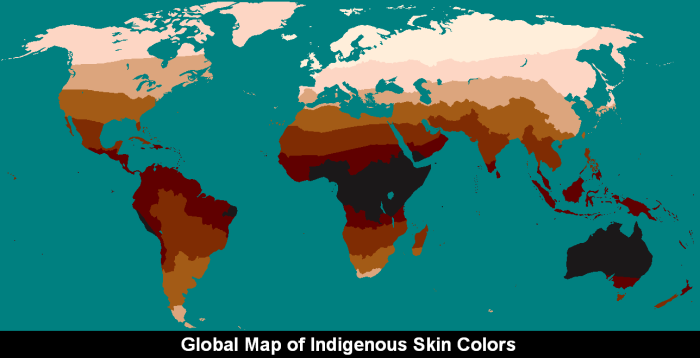
Science tells us why human skin comes in different shades. It’s based on the amount of melanin we possess, a pigment that not only gives color but blocks the body from absorbing harmful ultraviolet radiation from the sun. Everyone has some melanin. Fair skinned people can even temporarily increase the amount they have by additional solar exposure – tanning.

If the body absorbs too many UV rays, it can cause cancers or produce birth defects in the next generation. That’s why groups of people who historically lived closer to the equator possess more melanin than those further from it. This provided an evolutionary advantage.

However, the human body needs vitamin D, which often comes from sunlight. Having a greater degree of melanin can stop the body from absorbing the necessary Vitamin D and – if another source isn’t found -health problems like Sickle-cell anemia can occur.

That’s why people living further from the equator developed lighter skin over time. Humanity originated in Africa, but as peoples migrated north they didn’t need the extra melanin since they received less direct sunlight. Likewise, they benefited from less melanin and therefore easier absorption of Vitamin D from the sunlight they did receive.

Map_of_Indigenous_Skin_Colors

That’s the major difference between people of different colors.

Contrary to the persistent beliefs of many Americans, skin color doesn’t determine work ethic, intelligence, honesty, strength, or any other character trait.
In the 19th through the 20th Centuries, we created a whole field of science called eugenics to prove otherwise. We tried to show that each race had dominant traits and some races were better than others.

However, modern science has disproven every scrap of it. Eugenics is now considered a pseudoscience. Everywhere in public we loudly proclaim that judgments like these based on race are unacceptable. Yet the pattern of positive consequences for light skinned people and negative consequences for dark skinned people persists. And few of us want to identify, discuss or – God forbid – confront it.

And that’s where we are today.

We in America live in a society that still subscribes to the essentially nonsensical definitions of the past. Both white and black people have been kept in their place because of them.

In each socio-economic bracket people have common cause that goes beyond skin color. But the ruling class has used a racial caste system to stop us from joining together against them.

This is obvious to most black people because they deal with the negative consequences of it every day. White people, however, are constantly bombarded by tiny benefits without noticing they’re present at all. White people take it as their due – this is what all people deserve. And, yes, it IS what all people deserve, but it is not what all people are receiving!

We are faced with a difficult task. We must somehow both understand that our ideas about race are man-made while taking arms against them. We must accept that whiteness and blackness are bogus terms and yet they dramatically affect our lives. We must preserve all that makes us who we are while fighting for the common humanity of all.

And we can’t do that by simply ignoring skin color. That kind of colorblindness only helps perpetuate the status quo. Instead, we must pay attention to inequalities based on the racial divide and actively work to counteract them.

In short, there are no white people and black people. There are only racists and anti-racists.

Which will you be?

Wednesday, April 20, 2016

Photo  © Gebbe at Flickr

Public Education for all, versus “my babies”: Shocking Ethics and Inequity in Pennsylvania

.

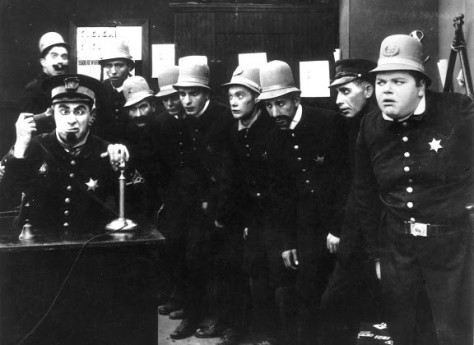
By Mack Sennett Studios-Public Domain via Wikimedia Commons.
.
New episodes of Keystone Cops just keep coming from the “School Reform Commission” (SRC), Pennsylvania’s legislative concoction to take over the School District of Philadelphia(SDP).
.
The episodes all have the same story line and the same ending, but the characters take turns embarrassing us.  Public Education actually suffers, charter schools expand. “Local control” is gone.  State government integrity is rated 45th in the nation.  Misfeasance is rampant.

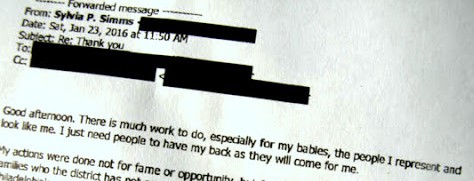
Sylvia Simms is the new lead character, the ‘starlet, Keystone Cop’ with self-focused loose lips.   In a recent episode, during after-dark hours, when many school kids were already in bed sleeping, and in a direct slapstick move on the quiet ‘leading man’, CEO William Hite, Simms railroaded a motion to eliminate another Public School for yet another charter: Mastery Charter.   Her own, recently released email contains divisive, racial overtones, illuminating possible motive:

Simms’ alarming email asks people to “have [her] back”, while she worksespecially for [her] babies, the people [she] represents and look like [her].”  Full email text here(page 87).
.

Public Document: Right to Know

.
.
Simms is much more tight-lipped when folks ask to understand her family connection to the very same Mastery Charter business.  Simms’ philosophies and loose lips headlined a different episode a year-ago when school children interrupted another of her pro-charter efforts.  She responded by shaming the children, squawking  “You must attend failing schools”, “belong in jail”.  Of course, Commissioner Simms is responsible for those Public Schools in her ‘professional’ role.

Bill Green: former ‘head cop’ demoted by  the show’s producer, new Governor Tom Wolf.   Even in a side role, Green remains in the midst of the approvals of more and more charters.  In fact he couldn’t wait to ‘second’ Simms’ motion to add the Mastery charter mentioned above.  Note that Green is a graduate of a private school in Philadelphia.

Lately, Green has been heard claiming that state law “prohibits considering financial impact of additional charters on the public district when deciding whether to approve [charters]”.  Never mind that funding a charter opportunity for a few select kids takes funds from all the other kids in Public Schools.  Never mind that the whole purpose for the ‘Reform’ Commission is to alleviate financial ‘distress’ in the Public Schools: financial impacts of his decisions “can’t be considered” (in Green’s opinion).
You have to watch closely for the next ‘Cop’:  Farah Jimenez.  Commissioner Jimenez often “recuses” herself from ‘Reform’ decisions, especially about Mastery Charters, because of family conflicts of interest.  She can ‘duck and dart’ with the best of slapstickers….

Context:  “School Reform” in Philadelphia


Fifteen years ago, the state created the SRC to take away local control from Philadelphia in order to “alleviate financial distress” (PA Acts 46 and 83).  In the interim, politicians’ record includes stunningly consistent academic starvation with simultaneous fiscal disaster.  The previous Governor cut a billion dollars from state funding of education operating budgets.

Since 2001, the State has appointed the majority of SRC members.  The SRC has hired multiple “outsider” CEOs.  The School District operating budget has been described as a “Doomsday” budget (for the past 3 years).  Teachers have been working without a contract since 2013. Thousands of children are without regular teachers.     “Equal access” funding is missing, given overwhelming incidence of childhood trauma and its shocking neurobiology detailed here and hereTeaching staff is at all-time lows.  Vacant positions remain unfilled.    Substitute teachers decline to work here.   Class sizes increase.  Course offerings only decrease. Building conditions are atrocious,  even  dangerous.  Philadelphia  charter school approvals mushroomed to one-third of total students, draining public funds without public consent.
Those same charters  exclude (or expel) students with higher costs-to-serve,   which must then be served in public schools.  School District bonds are now junk.  Pennsylvania’s system of “base funding” for schools ranks worst in the nation for equity or ‘fairnessPoliticians’ persistent, precise underfunding of Public Education, in Philadelphia in particular, is a prime cause of our condition.  A contrived disaster.

Public Education, a Constitutional mandate in Pennsylvania, is being systematically bled.


Public Service becomes Private Business

The education “marketplace”, if commercialized, is measured in hundreds of Billions of dollars, attracting Walmart, Bill Gates, the Koch Brothers, the Broad family and many others in favor of privatizing education.  They’re often involved  for “their babies” too (for a different motive):  for profit for “their babies”.

In fact, a leading initial plan in Pennsylvania during the state takeover, was to begin contracting out public education services to Edison Schools, Inc., a private, for-profit business.

Privatizers promote “standardized testing” as the way to measure ‘results’, in other words to proclaim ‘failure’.  Standardized test results are deceptive and blind to large variations in personal situations, which radically change results.  This sort of ‘bubble’ testing has been shown to be an accurate way to measure socioeconomic status, no more.  Yet the tests can easily be misused to scream “failing” system, to the unsuspecting.  This contrived ‘failure strategy’ is in the playbook at Broad Academy, where CEO Hite trained and it has roots going back to Milton Freedman as outlined here (page 87).

State politicians pressing privatization agendas, threaten reduced revenues for schools or more withdrawal of support, if we don’t approve more charter businesses every year.

The moral vacancy in all this is that public, neighborhood schools are not collateral damage in this war, they are the very intentional bloodbath at ground zero.

Once privatized, the education pathway to the “American Dream” ultimately becomes a service we all need to buy, not something we all have a “right” to, in becoming an educated citizenry of a democracy.

This brings us back to Sylvia Simms.


Photo © Kenneth Flaxman
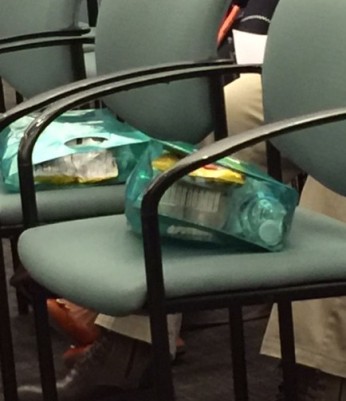
Privatization may seem good to Simms right now while a Charter Company is buying “her babies” color – coordinated  T Shirts to wear and providing  free, convenient bus rides and buying  boxed lunches to eat so some of her neighbors and friends can be used as “PR” for the Company at SRC meetings.
Sadly, their “free lunches” aren’t free.
  
Simms herself is a microcosm of the destruction of Public Education in the name of ‘self’ and ‘get what I can for me and mine’.  A tiny, selfish “vision”, dividing children.  All children.

Clearly, SDP revenue is a zero-sum system (Commissioner Neff’s term).  Charter company funding to support Simms’ babies comes directly at the expense of all our other babies.  All other babies lose efficiency, straining under the load of 60,000 students selected by charters, which are taking hundreds of millions of dollars of public monies from public education.

Meanwhile, many charter businesses ‘skim’ students, a very different process than Public schools, for all.  Unlike neighborhood Public Schools, only a limited number may enter, fewer are retained and some are even ‘expelled’ back to Public Schools which carry the higher variable cost for all students, plus the ‘sticky’ fixed overhead burden for all students.


The Constitution of Pennsylvania


We can not privatize our way out of accountability for Public Education for all.


The Pennsylvania Constitution, Article III. B  Section 14, mandates a “thorough” and “efficient” system of Public education…  Maybe the two most important words come earlier:  provide for the “maintenance” and “support” of a thorough and efficient system of Public Education.

We can not “maintain” what doesn’t exist.  According to the state Secretary of Education, the SDP is “distressed.”  We can’t be legally distressed and simultaneously legally “thorough” and “efficient”, so we violate “maintaining” “thorough” and “efficient”, day-in, day-out.

Next, the state is not “supporting” a thorough and efficient system of Public Education.  Political pressuring to approve more charters  every year is not “support”, but actually a direct attack on Public Education efficiency in a ‘zero-sum game’.

Even further, the state’s concoction of the “School Reform Commission” itself is in direct conflict with both: “thorough” and “efficient”.  The SRC is an unelected body, outside local accountability:  inefficient for local citizens, by definition and by intent.  The original context of Act 46, (private management by Edison, Inc.) and the recent, divided focus of SRC on charter approvals take away from a “thorough” approach to Public Education.  We have certainly not exhausted a “thorough” set of efforts to “support” Public Education, efficiently.

We need to get outside ourselves somehow and understand the cumulative effect of what we are doing to each other in the name of working “especially for my babies.


SIMMS EMAIL
Public Document: Right to Know


Like Simms, my wife and I have “babies” (and grandbabies).  We too live in north Philadelphia.  Some of our family look like Bill Green, some like Jimenez, some Simms. I am hurt and angry that Simms is working only for the part of my family that looks like her.

Yes, I can feel the frustration of Simms. I want Simms to feel that frustration for all children: a “universal” vision.  All 200,000 children in our city, not diminished to whatever thousand she thinks “look like her”.
Many like to talk about “universal”, “high-quality” Pre-K; why not “universal”, “high-quality” Pre-K to 12 ?  If that vision is too big for some, maybe it’s time for them to move on.

The list of groups who want change is long, broad and growing:   According to Dr. Flynn, President, PA State NAACP, the SRC “has clearly demonstrated an incapacity to facilitate a thorough and efficient public education for the children of Philadelphia, and has in fact, destabilized the entire system.”   Rodney Muhammad, of the Philadelphia Chapter called for ending the SRC: “They [want] to take over our children and put them back on the auction block”

There are multiple avenues back to supporting and maintaining Public Education for all.  Constitutional remedies beckon, as do Act 46, Sections 691, 696 (a), (b), (d), (d3), (j), (n), and maybe even federal oversight via violations of ‘equal access’ principles.

We can not be swayed by hand wringers like Sylvia Simms and Bill Green, who would lose power in a true grant of local control for Philadelphia.  We need a vision of true democracy for all, in the birthplace of democracy, along with taxing authority and with Constitutional “support” and “maintenance” of Public education from our great state.

The future of Public education hangs on this battle between “my babies” and “all children.”


Is City Council listening?  Mayor Kenney?  Anyone in the General Assembly?  Governor Wolf?  Someone in Washington DC?  Anyone?

Call your politicians.  Tell them that you support Public Education, with local control, as a key tenet of a healthy democracy.

City Council President  Darrell Clarke                                                                    .             .                                  (215) 686-3442,   (215) 686-3443

Mayor Jim Kenney  (215) 686-2181

Governor Tom Wolf,  (717) 787-2500

Speaker of the House Rep. Mike Turzai(717) 772-9943
House Majority Leader Rep. Dave Reed, (717) 705-7173
House Minority Leader Rep. Frank Dermody  (717) 787-3566
Senate President Pro Tempore Sen. Joe Scarnati, (717) 787-7084
Senate Majority Leader Sen. Jake Corman, (717) 787-1377                   Senate Minority Leader Sen. Jay Costa  (717) 787-7683

See this Op Ed as edited:  NewsWorks  WHYY.  Click  HERE.

Tuesday, April 19, 2016

NY STATE TESTING 2016 - FINAL THOUGHTS
By:  Alice

You can see other writings by Alice here at her blog
http://fromwhereiteach.blogspot.com/


Six days of testing in New York State are over. (apart for make-up days.)
I don't want to dwell on the past, but I do want to record some of my thoughts/concerns here in public cyberspace.
Here in New York we have a new Commissioner of Education - MaryEllen Elia. She replaced John King a year ago. (Despite spearheading the destruction of our State's public school system and demonizing teachers, Mr. King received a promotion to the highest Education Office of the Land when Arne Duncan resigned...)
Ms. Elia said she understood there had been serious concerns about the way in which Mr. King had rushed the implementation of new standards and tests of those standards (before teachers had had a chance to learn the standards and before there was new curriculum in place to address the new standards - all this referred to in a bizarre training video about "building a plane in mid-air.")
In an effort to "reboot" the process of education reform in NY, Ms. Elia went on a "listening tour" around the state (more than 20,000 miles of listening she's been know to boast,) to meet with and hear first hand from parents, teachers, administrators, and other interested stakeholders. She claimed she heard our concerns. You can read her words here.
She said she heard the concerns about the tests themselves.
"We brought teachers from across the State to Albany to review every reading passage, word problem, and multiple-choice question on this spring's tests to make sure they're fair. In all, every item has been reviewed by at least 22 educators."
But on the ELA tests my 5th graders took there were questions that had no clear right answer, math questions that required knowing 'the trick" rather than relying on the deep comprehension skills the "Shifts in Instructional Focus" for the new Common Core Standards demand, and please let's not forget about the planning page that was missing entirely. If these tests were reviewed by competent teachers, then there was a flaw in the process that needs serious consideration.
Ms. Elia also heard concerns about the stress the tests caused.
"We reduced the number of test questions and alleviated time pressure for test takers. Students who are productively working will be able to demonstrate what they know and are able to do, even if it takes more time. We're interested in what students know, not how fast they can go."
But Ms. Elia did not consult teachers when she created this response. Many elementary classroom teachers could foresee problems Ms. Elia had apparently not considered - mainly that some children, as young as 9 years old, might end up "choosing" to sit with tests for 3, 4, 5 hours a day and more. (And for a myriad of reasons - to meet expectations, to do their best, to please adults, in response to some diagnosed or undiagnosed anxiety issue, etc.) At a meet and greet session with Ms. Elia that I attended, she refused to give specific details of how "un-timing" tests would work. She seemed to think things would just magically work out. No timing. No pressure. No problem.
Lack of foresight? Lack of collaborative decision making? Lack of authentic interest in real change?
Can un-timing the tests possibly be considered age-appropriate or best practice? Is any test that requires a child to make such a choice (how long to sit for a test) designed in a developmentally appropriate manner? There are so many questions this particular "change" has triggered, I encourage you to read my past (and future) posts on this issue.
I've applied to be part of the committee Ms. Elia is convening to review all the Math Standards. It's a long shot, of course. And while I blog under a pseudonym (spoiler alert) I am who I am, whatever my name.
I do a lot of reading. I came across this quote from Ms. Elia in response to some less-than-favorable reviews of her performance as Hillsborough County Fla. Superintendent prior to moving back to New York.
“The concept of continuous improvement is critical,” Elia said. “That’s my agenda — to work in a constructive way and continually get better.”
Let's all hold her to that lofty goal.

Sunday, April 17, 2016


How Far We Have Come Fighting Against the Testocracy: Network for Public Education Conference Ramblings - April 17, 2016

GetAttachmentThumbnail


Kelly Ann Braun said it best.

“Do you remember three years ago when I said this would all be over in 6 months?”

And we all laughed. Me the loudest, because back then I had thought the same darn thing.

Corporate education reform is on its last legs. Once we tell people about the terrible mistakes of standardized testing and Common Core, it will all be over in an election cycle or two.

Kelly, that incredibly dedicated member of the Badass Teachers Association (BATs) from Ohio, hadn’t been the only one.

It seemed so reasonable back then. Once it became common knowledge, our leaders couldn’t keep perpetuating policies that harm our children, we thought.

No one would actually continue to stomp on the futures of our little kids once we’d pointed out that that was what they were actually doing! Right?

Now the Network for Public Education is having its third annual conference – this one in troubled Raleigh, North Carolina. And far from being on its last legs, the testocracy is mightier than ever with a new federal education policy, the Every Student Succeeds Act, rebranding and refreshing its same horrific disdain for the young.

But that’s not really news, is it?

The powerful have always tried to find ways to keep the poor and minorities under heel. It’s a struggle as old as civilization, itself.

What’s new is us.

Yes, us – the ragtag band of rebels and revolutionaries who gather together every year to celebrate our victories, lament our losses and plan for the future.

This is a real community – stronger than anything I’ve ever experienced. During the year we all have our separate support systems, be they Badass Teachers, United Opt Out, our teachers unions, our communities or – for many of us – some unique combination.

But once a year we all come together from our separate corners of the country (and in some cases beyond) to commune, to gather strength from each other so we can carry on the fight.

I cannot express to you the power and the glory I got this morning listening to Chicago parent activist Rousemary Vega talking about the pain of losing her children’s community school. This is still a raw wound for her, gushing blood. One moment she was heartbreaking sorrow; the next she was frightening strength and determination.

She told us how to learn from her example, how to put up a fight, how to make it as difficult as possible for anyone to ever do this again. And when she was done and I had dried the tears that she had somehow cried with my eyes, I found that I had a tiny Rousemary inside my heart. I will never forget her story. I hope I can call on even a fraction of her strength.

Later I sat in on a conference about Competency Based Education. Two of the founders of United Opt Out, Denisha Jones and Morna Mcdermott, gave the best presentation on the topic I have yet heard.

This is the future of standardized testing. It goes something like this: you don’t want a big high stakes test at the end of the school year? Okay. How about we sit your kids in front of a computer all day, everyday, and they can take endless high stakes mini-tests?

Morna would keep apologizing that what she was saying sounded too far-fetched to be true, but then she’d prove its veracity. Subsequently, Denisha explained how proponents of this new educational scheme had slipped this all under our noses by redefining and co-opting language we all thought we knew. You want “individualized” education? Fine! Kids can sit by themselves as individuals and take these standardized test snippets – in perpetuity.

I left them with a much clearer understanding of how this was happening and exactly what kind of push back is necessary.

Perhaps most inspiring so far though was the keynote address by the Rev. William Barber, president of North Carolina’s NAACP and organizer of Moral Mondays. He put the whole fight in perspective.

History, philosophy, economics, religion all mixed together into a picture that would have been grim if he hadn’t made it so beautiful. Our children are being harmed by the standardization and privatization of public education. The ones hurt the most are those who are poor and minorities, but that doesn’t make them any less “our” children.

This fight can’t just be about your school and your child. We have to love and care about all children and all schools. Only then can we really have a public school system worthy of the next generation.

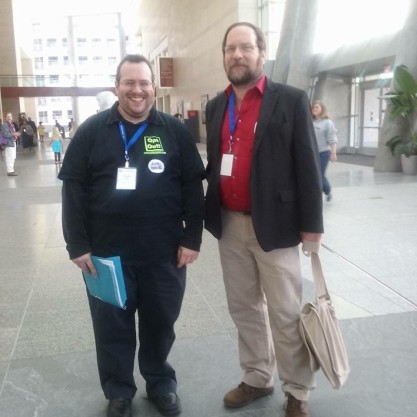
Finally, the moment came when I couldn’t just sit in the audience and passively take all this in. I was actually on the program – I was part of a bloggers panel!

It was called “Blogging and Other Tools to Educate, Persuade and Mobilize Targeted Audiences.” It featured the amazing talents of Julian Vasquez Heilig, Susan DeFresne, Dora Taylor, Anthony Cody, Jonathan Pelto and – somehow – me!

It was the first time I had presented anything at one of these conferences. Sure I’m in front of my students every day, but this was a room full of adults, many with PhDs or more, who really know what they are talking about.

I had agonized over what I was going to say, wrote out a few remarks and then was told by fellow BAT and activist Gus Morales that I shouldn’t read it. I should just go with the moment. That’s what he says he did during his TWO TED Talks!

I practiced. I tried it his way, but I just couldn’t make it work. So when my time came, I compromised. I talked off the cuff when I could and then returned to the script when I couldn’t.

It seemed to work. I got laughs. I got applause. It looks like no one noticed how utterly terrified I was. (Sh! Our secret.)

And so another year’s worth of inspiration has ended – all stuffed into that first day.

We’re a different group than we were last year. We’re more somber, perhaps. Maybe a bit more seasoned, more knowledgeable.

There’s a sadness that society hasn’t joined us to crush those who would harm our children. But there’s also a renewed commitment to the struggle. A feeling of our place in history.

We hear the marching feet of those who came before. We see their pale upturned faces, their sad smiles. And somewhere in the distance that may be the sound of our own children marching in our footsteps continuing this same fight.

We will have victories. We may end high stakes testing. We may abolish Common Core. But we may never see the promised land.

One day perhaps our children will get there. And the only thing we have to propel them to that place is our love and activism.

At the Network for Public Education, you begin to realize these are really the same thing.


GetAttachmentThumbnail-4