Thursday, December 31, 2015


The Best Way To Honor Tamir Rice is by Reforming Our Broken Justice System

Memorial for Tamir Rice, 12-year-old shot dead by Police in Cleveland

Michael Brown – no indictment.

Eric Garner – no indictment.

Sandra Bland – no indictment.

And now Tamir Rice.

How many times will our justice system refuse to charge police with killing unarmed black people?

What will it take for our courts to accept the responsibility for at least attempting to seek justice?

When will our judicial system deem the death of people of color at the hands of law enforcement to at least be worthy of a trial?

Brown had no weapon but was shot to death by law enforcement.

Garner had no weapon but was choked to death by police.

Bland had no weapon but was found hanged in her jail cell after being assaulted by police during a traffic stop.

Rice had a legal pellet gun that was not pointed at anyone yet he was shot to death two seconds after police arrived.

This is not justice. This is a national travesty that continues to be played out daily. How many more human beings will be ground under the boot of a system that finds no value in their lives?

And don’t give me any of your excuses! Police were just doing there job! These people should have listened to law enforcement! Rice shouldn’t have had a pellet gun!


Listen to yourself. Lethal force is the only option!? Police have no tasers anymore, no pepper spray? Their guns only fire death strokes? They can’t hit non-vital areas meant to incapacitate but not kill?

What a bunch of cowards we are if we don’t demand police publicly explain themselves when they kill another human being – especially someone who posed them no bodily harm! How morally and spiritually bankrupt a nation we are not to weigh the evidence and decide guilt or innocence! “Freedom and justice for all!?” What a sham! What a lie! What a farce!

I don’t know about you, but I am sick of it. I refuse to put up with it for even one more day.

But what can we do?

No. Really.

When reading about these government sanctioned murders, I feel helpless. I’m just one person. What can I do to stop it?

Here are a few suggestions:

1) Ban Grand Juries in Fatal Shootings by Police

Connecticut and – most recently – California already have laws to this effect. District attorneys should have to decide whether officers face criminal charges when they kill people in the line of duty. This decision should be made in the light of day in full view of the public and not behind the closed doors of a grand jury hearing. These hearings involve no judges or defense attorneys and the transcripts of these proceedings are almost always sealed.

The problem is that district attorneys work closely with police and depend on them for political support. Sending cases like these to a grand jury gets the DA off the hook so he or she doesn’t offend the officers.
If the decision had to be made in public, voters could hold DAs accountable. With the grand jury system, there are no consequences because we have no concrete evidence about what happened during the proceedings, what arguments were made, by whom and who made what decisions. That’s a poor breeding ground for justice.

2) Construct a National Database on Police Killings

Right now there is no way to tell exactly how many people are killed by law enforcement in this country every year. Moreover, there is no way to tell if officers involved in these killings were ever charged.

Information can be compiled state-by-state, often through unofficial and anecdotal sources. However, this does not nearly give the full picture of what is going on. The people of this country deserve to know the full scope of the issue. That’s why apologists often claim these sorts of incidents are relatively rare and blown out of proportion by the media. But are they? A national database would prove the matter one way or the other.

Federal law from 1994 already calls for just such a database, yet it has not been funded. This may be due in part to the cost. A pilot study found that it would take a decade and cost $1 billion.

Certainly this is not a quick fix. But don’t we deserve to know this information? And isn’t it suspicious that nothing is being done to compile this data now?

3) Overturn Graham v. Connor

Perhaps the biggest obstacle to seeking justice for those unnecessarily killed by police is a precedent set by the U.S. Supreme Court 25 years ago. Graham v. Connor effectively ruled that police can kill you if they feel you present a “reasonable” threat to their own lives.

The problem is the word “reasonable.” What does that mean? In court, it can be almost anything. It’s a “Get Out of Jail Free” card to police for wanton murder. Justice Sonia Sotomayor calls this a “Shoot first, think later” approach to policing. She says this violates the Fourth Amendment which stipulates what counts as “probable cause” for police actions including arrests. However, Sotomayor is the only sitting justice publicly to take this stance.

This is why without more robust protections for citizens and more realistic expectations for law enforcement, even when cases like these go to court, they rarely result in police convictions.

But courts change. Public opinion can move mountains if given enough time. We need to start putting on the pressure.

Organize, people. Start writing letters. Write petitions. Hold rallies. Meet with your Congress-people. Make some noise.

In the meantime, let us grieve for all the Browns, Garners, Blands and Rices.

Their lives matter. And the best way to prove that is to get off our collective asses and do something about it.


NOTE: This article also was published on Commondreams.org.

Wednesday, December 30, 2015

Hillary, Politicians, Education Reformers, & Education Profiteers: You Are Cowards & Failures

by Melissa Marini Švigelj-Smith, Ohio BAT

originally published on her blog:  https://msvigeljsmith.wordpress.com/2015/12/24/to-hillary-politicians-education-reformers-education-profiteers-cowards-failures/

Little girls in Cleveland Schools
You say my school is failing. You label my students as failing. You call me a failure. Then you shake hands with profiteers who wear fancy suits and promote edperialism and a testocracy. These profiteers and elitists you embrace send their kids to expensive private schools, so their children don’t have to endure the policies stuffed full of educational malpractice you collaborated to create. They sit cozy in offices and devise untested business theories for application to the humanity that is education. You let them steal our tax dollars, and you praise them as philanthropists for their astronomical failures in education. It’s time you change your narrative. It’s time you change your proximity. 

Do you really want to know what it’s like to be a public school teacher in an economically devastated & segregated neighborhood in one of our nation’s cities? Neither you nor the profiteers and policy makers really want to know. People like you want to keep judging and labeling, but you don’t want to admit that you helped create the suffering and disadvantage. You don’t want to claim the role and responsibility that you bear for the disasters you’ve created for other people’s children. Come take a look at my joyful, sad, sweet, angry, helpless, and hopeful students and tell them they’re failures to their faces. Come see me and my colleagues in our classrooms working 10-12 hour days and look us in the eyes and tell us we’re failures. Tell the families who rely on the existing public neighborhood schools we have left that they’re failures raising failures. 

Does that seem harsh? It should. 

But you have no problem preaching about “failing schools” full of “failing students” while you’re perched in expensive offices in skyscrapers, or as you muse about education in affluent and gated neighborhoods. Change your proximity and see if your narrative still feels all cozy, warm and righteous. See if you still possess the courage or ignorance to make bold declarations about failure when you’re looking into the eyes of hungry six-year-olds who suffered through childhood traumas and lead-filled homes in one of our nation’s cities. Can you look into those sweet, helpless faces and tell a little girl that she’s a failure? 

Yet, that is what you do every time you or your education reformer/deformer friends and contributors suggest competition and privatization or closuresinstead of addressing the poverty, historic and systemic racism, and epic failure of our society to care about other people’s children.  The real failures among us fill boardrooms, legislatures, executive offices, non-profits, and cabinets all over this country. They aren’t in my classroom. They aren’t in my school. And they aren’t the families in my city.  They’re people like you.  And I have the courage to state that directly.  Now, I challenge you to stand in front of us and tell us we are failures while you are looking straight into the eyes of my children, my students, our school staff, and my colleagues. OR you can finally gain the courage to change your narrative, examine the research, and acknowledge the role that our nation has played in making sure that some people’s children start out with less than others, and to admit that we don’t do enough to change that, or do enough to help our fellow citizens catch up.  

Maybe once you have the courage to admit to policy and approach failures, you and those who believe that having money makes them authorities about EVERYTHING, will actually ASK educators, healthcare providers, social workers, mental health providers, safety and security providers, nutritionists, and the people we serve what is really needed to improve our cities and education.  I am pretty certain the response won’t be that we need more politicians and reformers threatening us and calling us failures. You won’t know though until you change your proximity, and then change your narrative. Meanwhile, I’ll keep working under your failed policies and egregious labels while making sure that my students, their families, and my colleagues remain reminded that YOU FAIL US then label us. Yet, until you make an initiative for change, it is YOU who should wear the label of failure and shame.

Not us.

*Changing proximity and changing the narrative were ideas presented by justice advocate and lawyer Bryan Stevenson at a Boston Community Conversation on December 9th, 2015 at Emerson University’s Paramount Theater in partnership with Facing History.    

Ed Reform Groundhog Day

by Emily Kennedy Talmage, Maine BAT

originally published on her blog:  http://emilytalmage.com/2015/12/29/ed-reform-groundhog-day/

During a conversation about education reform at a holiday party I attended last week, a long-time high school teacher said to me, “You’ll see as you get more years of experience.  You start to feel like: haven’t we seen this already?”
I laughed and said it’s like that cliché you always hear about insanity: doing the same thing over and over again and expecting different results.
When it comes to ed reform, of course, it’s really not a cliché. It’s par for the course.
Check out the quote below, and see if you can guess the year it was written:
 …schools will offer a common core of learning and, at the same time, provide diversity and choice. In short, individualized education implies the personalization of the entire educational process.
If you guessed 1974, you were right.
This was written by Robert G. Scanlon, former Pennsylvania Education Secretary, in an article called: “A Curriculum for Personalized Education.”
Recently, with endorsements and investments from Mark Zuckerberg, the U.S. Department of Education, and members of the American Legislative Exchange Council, personalized learning has been heralded as the latest, greatest “innovation” to hit our reform-battered schools.
But a close look into the internet archives of educational history reveals that there is nothing innovative about this idea at all.
In “A Curriculum for Personalized Education,” Scanlon describes a curriculum that “permits student mastery of instructional content at individual learning rates,” “encourage[s] student evaluation of progress toward mastery,” and includes “a variety of paths for mastery of any given objective.”
Flash forward forty years to a portion of a document published by the Gates Foundation titled “Proficiency-Based Pathways”:
“Learning solutions—units, courses, and subjects—should have clear progress trajectories from novice through apprentice to mastery. Students should understand how to advance from one level to the next.”
The Gates Document boasts in its introduction: “We have been thinking in very nontraditional ways.”  But compare the two quotes above, and you’ll see that the Gates Foundation is calling for the very same reform ideas that have been planned and attempted for decades.
Now check out this quote from Scanlon in 1974:
“The objectives of individualized instruction can be used as a basis for designing educational technology. How these devices will be made more cost- effective by new miniaturizations and transistors remains a question, but plans for their utilization must begin now.
Can you imagine Scanlon’s delight at the invention of Chromebooks and iPads?  And is it any wonder why reformers like Gates are so optimistic that the time has finally come to bring about the dream of personalized learning?  See Gates below:
“Conditions are ripe for creating personalized learning opportunities beyond school—in an anytime, anywhere fashion…We believe it’s possible with the convergence of the Common Core State Standards, the work on new standards-based assessments, the development of new data systems, and the rapid growth of technology-enabled learning experiences.”
It also sheds new light on the borderline desperation found in this quote from Tom Vander Ark, who cannot bear the thought of having to wait any longer for the competency-based restructuring of our schools:
 “New tests will hinder rather than help competency-based models…In short, I don’t want one big cheap end of year test used for more than it should be…I don’t want it to lock in the teacher-centric age cohort model for another decade. I don’t want simple assessments…I want a system that will incorporate all the performance feedback that students will be receiving a few years from now.”
And it reveals why Jeb Bush and Bob Wise called their council “Digital Learning Now!” Reformers have been waiting for this for decades and are losing their patience!
If you’re beginning to wonder if perhaps I’m giving these guys too much credit for their ability to plan, check out this quote below, again from 1974, this time from Harold E. Mitzel in an article called “Computer Technology: The Key to the Future?”
“Education is so decentralized that it seems unlikely that individual school organizations will be able to afford the development of their own computer-based curriculum. Statewide or regional consortia seem to be the best bet for actually putting programs together…Even if states or regions can mount the necessary curriculum initiative, it will probably be up to the federal government to provide the financial resources for massive program development.
Several weeks ago, I wrote a post arguing that the one of the hidden reasons behind the formation of the Smarter Balanced and PARCC consortia was the opportunity for IT and assessment vendors to collaborate on “interoperability frameworks” – or common coding languages.  See this quote below from the 2012 National Conference on Student Assessment program:
 The Federal Government’s strategy to transform the Education Assessment industry by investing in standard technology platforms led by multi-state consortia such as Smarter Balanced Assessment Consortium (SBAC) has required unprecedented collaboration among consortia members, SEA and LEA representatives, assessment companies and the greater IT vendor community.
Voila!  Precisely what Mitzel called for back in 1974!
Here’s another quote from Mitzel:
These applications of the computer depend neither on new technological developments nor on new pedagogical concepts. The major restraints lie within the social institutions responsible for education.
And here is the U.S. Department of Education in its latest technology plan arguing the very same thing:
“The roles of PK–12 classroom teachers and post-secondary instructors, librarians, families, and learners all will need to shift as technology enables new types of learning experiences.”
The fact is, the reason these reform ideas keep coming back, decade after decade, is that they never really die.  The planners retreat but come back swinging, because at the end of the day, they can’t seem to shake this sentiment, uttered recently by the CEO of Exxon Mobile:
“I’m not sure public schools understand that we’re their customer—that we, the business community, are your customer…What they don’t understand is they are producing a product at the end of that high school graduation…Now is that product in a form that we, the customer, can use it? Or is it defective, and we’re not interested?”
Of course, what they don’t seem to understand is that we don’t want to turn our schools into human capital factories.
But this seems to be the fundamental misunderstanding that keeps us locked in this never-ending cycle, where “innovative” always means same-old same-old, and our schools are constantly under attack by bad ideas that just won’t go away.
I say keep opting out. It may be the only way to escape Ed Reform Groundhog Day.
tumblr_n3wcwjMTh71rzpyc0o1_500.jpg

The New Child Labor: Our Kids Belong to Corporate America

by Kathleen Hagans Jeskey, Member of the BAT Leadership Team

Originally published on her blog:   http://www.teachertalkstruth.com/blog/the-new-child-labor-our-kids-belong-to-corporate-america


  Picture
A recent Fortune article entitled “How Business Got Schooled in the War Over Common Core Standards” is a revealing look at how big business views children and public education. It begins with a dinner date between Bill Gates and Charles Koch, in which Gates attempts to convince Koch to support his $220 million dollar investment in the Core. After discussing this meeting, the article continues:

“This extraordinary tête-à-tête is just one example of how the war over Common Core has personally engaged—and bedeviled—some of America’s most powerful business leaders. Hugely controversial, it has thrust executives into the uncomfortable intersection of business and politics.

In truth, Common Core might not exist without the corporate community. The nation’s business establishment has been clamoring for more rigorous education standards—ones that would apply across the entire nation—for years. It views them as desperately needed to prepare America’s future workforce and to bolster its global competitiveness. One measure of the deep involvement of corporate leaders: The Common Core standards were drafted by determining the skills that businesses (and colleges) need and then working backward to decide what students should learn.”


This is what many of us have been saying for some time: these standards are backed, and were initiated, by business. They admit as much, finally, in this article. Not mentioned is how a few businesses stand to gain from the sales of curriculum designed to teach to the standards, nor how much the testing industry is making delivering the tests of the standards. But let’s leave that for another time. This article contains even more disturbing ideas about how our children should be used as profit making fodder. Those ideas come from Rex Tillerson, CEO of Exxon Mobil.

Tillerson apparently agrees with Gates and, as the Education Chair of the Business Roundtable, has been supporting and promoting the Common Core. And Tillerson, like Gates, reveals a lot about how he views our children when he speaks. While Gates speaks of education as a process that is easily measured and needs to be standardized like any manufacturing process, Tillerson goes even further and speaks of our children as the product of that process: one to be consumed by Exxon Mobil and the rest of corporate America.

“Tillerson articulates his view in a fashion unlikely to resonate with the average parent. ‘I’m not sure public schools understand that we’re their customer—that we, the business community, are your customer,’ said Tillerson during the panel discussion. ‘What they don’t understand is they are producing a product at the end of that high school graduation.’

The Exxon CEO didn’t hesitate to extend his analogy. ‘Now is that product in a form that we, the customer, can use it? Or is it defective, and we’re not interested?’ American schools, Tillerson declared, ‘have got to step up the performance level—or they’re basically turning out defective products that have no future. Unfortunately, the defective products are human beings. So it’s really serious. It’s tragic. But that’s where we find ourselves today.’ ”

That’s right. Children, human beings, are “defective products”. According to Tillerson, our job as parents is not to raise healthy, happy people. As teachers, our job is not to assist parents in that endeavor. It is all of our jobs to assure that corporate America has access to non-defective products, ready for their consumption.

Sorry, but this doesn’t inspire belief that they only want what’s best for our “defective products”.  I believe what they want is to have the “defective products” sorted from the “superior products” via a system of scoring children 1 through 4, a scoring system that has been promoted around the country. Check your kid’s SBAC or PARCC scores and see. The thing is, when we sort human beings on any basis, it often looks something like this.  

Of course the losers in this deal will be kids, the “defective products”. Because the “consumers” want them sorted early. After all, they backwards planned all these standards, to be measured incrementally, like all production processes. Never mind that children don’t develop in a linear fashion like that. Never mind that some children have extra challenges to overcome and need extra time. Never mind that there is great disagreement over how the bell curve relates to human intelligence and how nature vs. nurture affects one's landing spot on the curve over time. Never mind that some have used this normal probability distribution to justify elitist, racist, sexist, exclusionary policies. Never mind.

The very narrow focus of the Common Core and its tests on discreet English and Math skills will quickly and easily reveal to Exxon and other “consumers”  in the “cradle to career” system exactly where our kids fit into their business plan. No need to waste any money on the arts or music or drama or physical education or any of that silly stuff, either. They won’t need that down at the office … or factory … depending on where the cradle to career ranking places them. Gee, I wonder if there’s any way those rankings could ever affect access to student financial aid and college?

Of course, it won’t affect access to college for anyone with the ability to pay and avoid the ranking system.

And speaking of college, EVEN IF every kid in America were a highly educated college graduate, would industry have a high paying job waiting for all of them? One that would make it worth incurring often massive student loan debt? Or is all this sorting really designed to prepare most of our kids to accept jobs at the kinds of wages people are currently paid in countries where the citizenry, due to inadequate access to resources including education, is more easily exploited? Let's be honest: this isn’t about struggling to find American employees with adequate preparation. It’s about lowering corporate costsIncluding their tax burden.

Judging by recent revelations regarding Exxon’s involvement in repressing information about climate change, reminiscent of Big Tobacco’s insistence for decades that smoking was not a health risk, Exxon and other large corporations can’t always be trusted to act in the public’s best interest.

This is why corporate interests shouldn’t be in charge of education (or our government) in a nutshell:

The bottom line is their bottom line. They don’t care about our kids. Or any of us. At all.

Thanks to Educating the Gates Foundation for this powerful meme. ​

Let's Get Serious About Education Policy

by Mitchell Robinson, member of the BAT Leadership Team

originally published on his blog: http://www.mitchellrobinson.net/2015/12/23/let-s-get-serious-about-education-policy/


 It all started with the ridiculously named, "No Child Left Behind."

NCLB then morphed into the equally ludicrously labeled, "Every Child Succeeds Act."

In the meantime we've seen "No Excuses" charter schools, "zero tolerance" behavior policies, and a leading Presidential candidate say, with a straight face, that she "wouldn't keep any school open that wasn't doing a better-than-average job," seemingly unaware that such a policy--in addition to being impossible to monitor and enforce, and mathematically improbable if not impossible--is not within her purview if she were to become POTUS.

The national rhetoric around education reform has become indistinguishable from our current dialogue around politics and entertainment, which is dominated by the obscene and the grotesque, while serious and reasoned discussion on substantive issues is ignored and even scorned.
 
Leaving aside for the moment that it is not the President's job to determine which schools get closed and which remain open, that--although it sounds sweet and kind and warm--it's pretty naive to make it a goal of education policy to guarantee that "no child gets left behind," and that a policy recommendation that stipulates "every child will succeed" is a bit short on both definitions (what do we mean by "succeed"?) and details (how will student success be measured, by whom, under what conditions, what resources will this policy goal require, etc.), let's consider a few serious policy recommendations that would be worthy of our collective consideration and discussion.
  • The "No School or Teacher Left Behind" Act: This initiative establishes new state and federal funding policies that guarantee the end of so-called "unfunded mandates." In other words, no longer will state and federal politicians be able to pass new laws concerning student testing, curriculum changes,https://www.blogger.com/blogger.g?blogID=3410387772840321888#editor/target=post;postID=2357395254030315961 or teacher evaluation without simultaneously providing all necessary resources for implanting, supporting and maintaining such laws. Additionally, no education-related laws may be passed without significant input from practicing teachers--and this means real input; not faux "grassroots" efforts made up of "blue ribbon panels" consisting of folks with no education degrees, teacher certification, or actual classroom teaching experience.
  • The "Every School Budget Succeeds" Act: This new policy guarantees that all public schools receive adequate funding, and that government budgets include the necessary funds to bring all school buildings and facilities into compliance with state and federal regulations on workplace safety. As a part of the ESBS Act, all public schools must offer a rich and diverse curriculum for all learners, including music and art, physical education, library, school nurses, and time for recess. 
  • The "No Excuses for Charter Schools" Act: The NECS Act is a rider inserted into the ESBS Act that prohibits the use of any state or federal monies for the support of charter schools or private/religious schools, and mandates that all monies that had previously been earmarked for charter school support be returned to the public schools in those jurisdictions.
  • The "Zero Tolerance for Charter School Operators" Act: This new law would establish serious fines and punishments for charter school operators who embezzle funds, abruptly close schools when teachers show an interest in forming a union, falsify data, use their schools as fronts for money-laundering, and employ untested and miseducative pedagogical and behavior strategies (such as draconian suspension policies). All funds remitted for these fines would be returned, by law, to the public schools in those jurisdictions, and must be matched, dollar for dollar, by the charter authorizer in each incident.
  • The "Better Than Average" Act: This new federal law is not an education policy per se--it applies to political candidates, and requires that any candidate for elected office who is found to have lied more than the average of all candidates in their race must immediately resign from that campaign, and turn over all remaining contributions to the public schools in the candidate's home town and state.
Rather than making a series of empty, unfilled promises, these policies would actually improve teachers' working conditions, students' learning conditions, and school funding; would protect public schools from inequities of funding caused by the proliferation of charter schools; and would "encourage" the decision makers who currently establish public education policy to play within the rules, or forfeit the thing they are really most concerned about: those sweet, sweet campaign contributions. 
 
Policy making is not about coming up with fanciful names for unrealistic policy goals that over-promise and under-deliver. It's about developing serious, considered and thoughtful recommendations for improving the conditions under which we work and live.

It's time to get serious about education policy. Let's make sure the candidates from both parties understand that we won't accept more empty promises and unfunded mandates.

And let's make sure they also remember the most important thing: We vote.

Does Bernie Sanders Offer Education Advocates Enough? Are We Feelin’ the Bern or Just Feelin’ Burned?

by Steven Singer, Member of the BAT Leadership Team 

Originally published on his blog: https://gadflyonthewallblog.wordpress.com/2015/12/27/does-bernie-sanders-offer-education-advocates-enough-are-we-feelin-the-bern-or-just-feelin-burned/

150430-berniesanders-editorial

You probably didn’t hear about this on the news.

To my knowledge no one covered it on TV, the newspaper or even on the blogosphere.

But Bernie Sanders may have made a reply to his Democratic Primary rival Hillary Clinton’s gaffe about closing public schools.

“I wouldn’t keep any school open that wasn’t doing a better than average job,” Clinton said at a campaign stop in Iowa on Dec. 22.

The media took this to mean Clinton is in favor of closing half the schools in the country. The comment has been much debated with calls for context and explanation by the Clinton campaign.

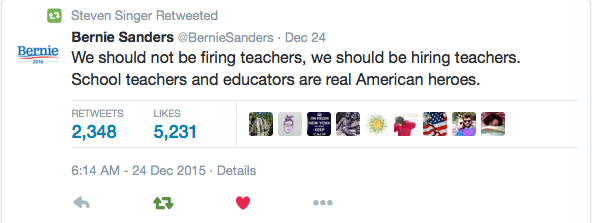
However, very quietly on Dec. 24, Sanders tweeted, “We should not be firing teachers. We should be hiring teachers. School teachers and educators are real American heroes.”

Screen shot 2015-12-26 at 8.06.51 PM
The @BernieSanders twitter account has more than 1 million followers, a little less than the @SenSanders account. But it does appear to be affiliated with the Bernie Sanders presidential campaign. If Sanders, himself, posted the tweet is unclear. The candidate used the same account to live tweet the Republican debates so he – at least sometimes – is personally responsible for the material that comes out of there.

Moreover, the comment can be connected directly to something he said on C-SPAN at a campaign stop in Cleveland, OH, on Nov. 16 – before Clinton’s gaffe. In a larger speech that touched on numerous issues he said, “We should not be firing teachers and childcare workers, we should be hiring teachers.” The line about teachers being American heroes is new.

Start the speech 56 minutes in to hear the comment.

So I think it’s fair to say that the sentiment is, in fact, Bernie’s. It’s only the timing that is in question.
Is this tweet an attempt to distinguish himself from Clinton? Is this his way of saying that he’s NOT interested in closing schools and firing teachers – instead he wants to invest in education and hire more educators?

Maybe.

It sure would be nice if he’d come out and tell us. Frankly, I’m getting tired of having to read the tea leaves to get a glimpse of Bernie’s K-12 education policy.

Don’t get me wrong. I love the guy.

He’s been one of my favorite politicians for years. As a U.S. Senator, he’s consistently worked against economic and social inequality for decades. He’s been a fearless critic of Wall Street and privatization, an advocate for single payer healthcare and fighting global climate change.

He champions historic investments in preschool and college – even vowing to make post secondary tuition free. But somehow when it comes to K-12 schools, he’s got very little to say.

Most notably, he voted against No Child Left Behind (NCLB) – the devastating schools bill passed with bipartisan support during the George W. Bush years. However, he also voted in favor of the Charter School Expansion Act of 1998 which further opened the nation’s piggy bank to for-profit school privatizers. He also opposed a bill in early 2015 that would have prohibited the federal government from imposing the terrible Common Core standards on the nation’s schools.

On the campaign trail, when asked about his stance on K-12 schools, Sanders has boasted he would end NCLB. That was just accomplished by Congress through a reauthorization of the bill now called the Every Student Succeeds Act (ESSA). As a member of the Health, Education, Labor and Pensions (HELP) Committee, Sanders was an active participant in that process.

When this legislation was still in the Senate, he – along with almost all Democrats – voted for a failed amendment that would have continued most of the worst aspects of NCLB. The bill eventually passed the chamber in a potentially more palatable form. Sanders eventually voted for that Senate version but was conspicuously absent from the final vote.

Though keeping a busy campaign schedule, Sanders is known for returning to Washington to vote for important legislation. He does this much more than most of the other sitting Congressional Presidential candidates.

So why was he absent for the final vote on the ESSA? Was that done on purpose, and if so why? Could it be an attempt to distance himself from this legislation? Or is it an attempt at plausible deniability – a way of justifying both his approval and disapproval of the same legislation?

Sanders hasn’t said much.

This puts would-be-supporters in an uncomfortable position. We like what Sanders has to say about the economy and poverty, but we have little to go on when it comes to K-12 education. Certainly if Sanders was elected President and came through with all of his other promises, that would help our public schools tremendously. And since Sanders has been fighting for these things his entire lengthy political career, it’s hard to doubt his sincerity. But why not include education as part of this platform? It seems to fit perfectly with everything else he believes.

On the other hand, there’s Clinton. She is making a real effort to clarify her education positions. In fact, last week’s gaffe was part of a much larger policy speech on K-12 schools. Sander’s reply – though better stated – was a one off. It was a sound-byte. It was an applause line. It didn’t have much substance behind it.

How are we to take it? Would Sanders hire more teachers as part of a nationwide education equity policy? If so, what exactly is that policy? Or is he – like Clinton – in favor of closing some struggling schools?

Certainly Clinton has a credibility problem. One of her first actions on the public scene as the First Lady of Arkansas in 1983 was to fight against the state teachers union to enact accountability-based school reform. Many of the billionaires and shady think tanks that are working so hard to destroy public schools have donated heavily to her campaign. Her endorsement by both major teachers unions – the National Education Association and American Federation of Teachers – were allegedly the result of leadership and not rank and file members.

But unlike Sanders, Clinton actually seems to care about getting the education vote. She is actively fighting for our advocacy. Bernie doesn’t seem to think he needs us.

The Democratic Primaries are about two months away. If Sanders is going to make a play for teachers, parents, students and education advocates, he still has a chance. But time is running out.

Personally I’d rather vote for him, and maybe I will. But if he finally came out swinging, if he actually made me feel like he’d strip away the high stakes testing, unproven or failing policies and put teachers in the drivers seat – he could get so much more.

There are tens of thousands of teachers and advocates standing on the sidelines looking to Bernie. If he gave us a major policy speech, he’d find his campaign offices flooded with new volunteers. Educators would take to the streets and phone banks. We’d lead the charge. We could help turn the tide in a Democratic primary where the margin of victory could well be razor thin.

We’re out there, Bernie. Just say the word and we’ll come running.

We want to Feel the Bern, but you’ve got to turn up the heat!

Sunday, December 27, 2015

BATs call to #BoycottExxon


Fortune magazine has a special report that has been released on the internet and scheduled to appear, as a shortened version, in the January 1st edition of their magazine. This special report spotlights the push back from the Tea Party against the corporate push to support the Common Core State Standards (CCSS). This report highlights Rex Tillerson, CEO of Exxon Mobil and Education Chair of the Business Roundtable as being the main proponent of the push for states to willingly adopt CCSS. In this report, comments from Tillerson are highlighted, even though they were said some time ago. These comments refer to our children as products, merely being primed for corporate consumption by the companies that exist to line the pockets of a small percentage of the population.

BATs call upon all parents, students, and educational professionals to publicly join us in a boycott of Exxon Mobil and take a stand against the corporate greed that is profiting against the backs of our children.

FOR IMMEDIATE RELEASE: December 28, 2015
More Information Contact:

Marla Kilfoyle, Executive Director, Badass Teachers Association

Melissa Tomlinson, Asst Executive Director, Badass Teachers Association

contact.batmanager@gmail.com

Badass Teachers Association - http://www.badassteacher.org/
Recently, Fortune Magazine released a special reportBusiness Gets Schooled” to expose how corporations have experienced pushback from the Tea Party about the Common Core State Standards. http://for.tn/1JvahZu In this report, Rex Tillerson, CEO of Exxon, is quoted as saying that American schools are turning out “defective products that have no future.”


The members of the Badass Teachers Association are appalled that our children and our students are thought of in a way that strips them of their very essence as human beings. In response, we are calling for a boycott of Exxon Mobil.

As a public school teacher, let me be clear: my students are not products. Education is not about turning children into widgets for big business. It is about readying children for life, and that includes so much more than the tiny and inhuman vision of people like Rex Tillerson. Hands off my students, my daughter, and my country!” demands Steven Singer, parent, teacher, and public education activist.

A CEO that thinks our Children are products cannot be allowed to influence education policy with their money! Our children are innovators, amazing individuals each one with their own gifts; only love, food security, housing security and loving, caring teachers can unlock their potential. My students are not defective; however CEO Rex Tillerson is defective in his thinking of what it is to be human.” stated parent, teacher, and education activist Jamy Brice Hyde.

Melissa Tomlinson, Assistant Executive Director of BATs responded; “CEO Rex Tillerson's comments amplify what is really wrong with our country. The fact that a person in charge of a multi-billion dollar corporation with international influence only sees our children as products to be developed for eventual profit dehumanizes the majority of our county.”

Not happy with how they were characterized, Suzzanne McCarron, vice president of public and government affairs at Exxon Mobil only furthers exemplifies the fact that Exxon Mobil has no understanding of the education of children and what education reform needs to be when she makes the statement that “U.S. students rank 31st in the world in math, 24th in science, and 21st in reading.” http://for.tn/1VlkbUo This statement, backed by the knowledge that Exxon Mobil is one of the leading corporate proponents for the Common Core State Standards, demonstrates the corporate ignorance surrounding how we truly need to look at public education in our country and examine how we can provide the resources our children really need to further their educational success.

                                                                               ###
The amount of pressure that has been placed upon our states and our legislatures by this corporate Business Table to turn our children into a product solely for the use of corporations is unconscionable.
An anonymous source passed us the following letter from Exxon Mobil, specifically Rex Tillerman, that demonstrates the pressure and implied strong-arm tactics that have been employed to ensure the continuous state support of these standards as they guarantee a future of product-children for their corporations.

BATs have been adamantly opposed to these standards and will continue to voice opposition against all that seek to profit from public education and our children.