Saturday, November 21, 2015

Who's Narrating 
the "Teacher Shortage" Narrative?
by Mitchell Robinson, member of the BAT Leadership Team
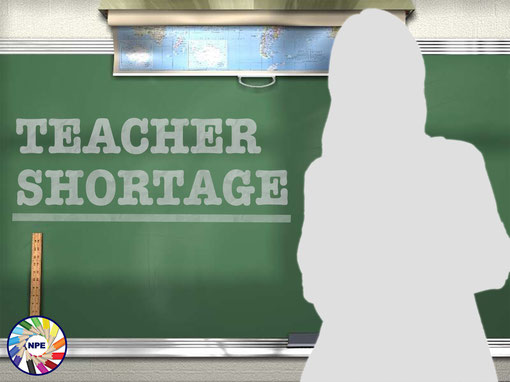
 
originally published on his blog: http://www.mitchellrobinson.net/2015/11/20/who-s-narrating-the-teacher-shortage-narrative/
Photo credit: http://www.networkforpubliceducation.org/2015/08/newsletter-teacher-shortage-ny-times-got-it-wrong/
 
Photo credit: http://www.networkforpubliceducation.org/2015/08/newsletter-teacher-shortage-ny-times-got-it-wrong/


A recent column by Stephen Mucher, Director of the Master of Arts in Teaching Program at Bard College, has attracted a lot of attention from those concerned about the health and vitality of public education. And for good reason. Mr. Mucher mentions the recent history of campus protests across the country, which he says he has noticed on his visits to some of the nation's most elite universities ("M.I.T. to U.S.C., Appalachian State to Cal State, Michigan to Berkeley, Amherst to Occidental") in his attempts to recruit what he refers to as "brilliant, dedicated, inspired young people who are ready and willing to serve" to Bard's Master of Arts in Teaching program. His conclusion is that these students are still engaged, politically aware, and want to make a difference in our nation's future ("until recently, many flocked to Teach For America"), but "they do not want to become teachers."


Why?


Without offering any actual evidence, Mr. Mucher suggests that prospective teachers have been scared off from applying to his program by much of the agenda of the corporate reform movement: increasing accountability demands placed on teachers, using student test scores to determine teachers' effectiveness ratings, and "the way teachers are blamed for much broader social problems." Now, no one who has spent any time in a classroom over the past several years would disagree that these are all real problems, and have combined to create a profession that feels under attack and held to unrealistic expectations even as states and the federal government continue a systematic disinvestment in public education. However, I would suggest that at least part of Mr. Mucher's failure to find what he is looking for may be because he is he is basing his search strategy on a faulty premise--and perhaps more importantly, because he's looking in the wrong places.


Better Rhetoric
A careful reading of Mr. Mucher's essay reveals an emphasis on the same, tired old reformer rhetoric: that teachers are "the problem" in public education ("But finding candidates to fill this role, especially good candidates, may be more difficult than policymakers are willing to admit"), and that these problems can be solved only if we can improve the quality of the teaching workforce ("America’s public schools need better teachers"). In an effort to bolster his assertions, Mr. Mucher nods to a recent survey suggesting that the teacher shortage is a significant problem, and identifying a set of principles designed to attract more young persons to the profession. [Curiously, these principles are eerily similar to the ones released earlier this week by the #TeachStrong initiative: "Better pre-service preparation, scholarships, loan forgiveness, higher salaries, professional mentorship, in-service training, and more time for collaborative work."]


With all due respect to Mr. Mulcher, it's time to put a stop to this lazy rhetoric, and stop blaming teachers for the problems that have been caused by the very reform agenda that forms the underpinning for his essay. Teachers are not the problem--teachers are the solution.


The "problems" in public education won't be solved by promoting the rhetoric that simply luring the "best and brightest" students from America's most elite colleges and universities to teaching will somehow fix the systemic defunding and privatization of our schools and the de-professionalization of the teaching profession. If anything, this strategy has contributed to the destabilization of the teaching force through programs such as Teach for America and The New Teacher Project--both of which, ironically enough, are partners for the #TeachStrong initiative.


Public education will only be "fixed" by admitting that whatever problems do exist in the schools have only been worsened by the damages done by the corporate reformers. Is there a "teacher shortage" in certain areas and in specific subject areas? Of course. But this shortage has been a "manufactured" one, and won't be solved simply by increasing the numbers of new entrants to the profession. We must first address the root causes of the shortage--poor working conditions, inadequate compensation structures, a lack of administrative and community support for teachers and schools, and invalid and unreliable teacher evaluation systems that are driving the most talented and experienced teachers out of the classroom.


Looking for Teachers in All the Wrong Places...

If Mr. Mulcher is really interested in finding more and "better" teachers I would also suggest that, instead of copying the approach of Teach for America and other alternative route to certification programs, he start by looking for young people who actually want to be career teachers--not just those with the highest GPAs or the gaudiest resumes.


I also find it curious that while the principles mentioned by Mr. Mulcher in his essay for improving the quality of the teaching force include recommendations for "better inservice preparation...in-service training, and more time for collaborative work," the marketing materials for the Bard MAT Program, which is designed to be completed in 14-24 months, appear to emphasize brevity and convenience more heavily than depth or breadth of content or experience. The irony here is remarkable.


The students I have the privilege of working with at Michigan State University are not only proficient in the skills, knowledge and dispositions needed for success as early career teachers, they are aware of the "big picture" surrounding public education, and are committed to making a difference. These students are deeply committed to becoming not just teachers, but to becoming teacher leaders. They recognize the inequities that currently exist in too many schools and communities, and are excited to enter a profession that desperately needs their energy and passion. My students understand that they are entering a profession that requires significant preparation, and have dedicated themselves to a comprehensive and thorough course of study that includes theory, practice and authentic field experiences over an extended period of time. 


While Mr. Mulcher seems alarmed at the recent protests on college campuses, I see these protests as signs that today's students are increasingly aware of the inequities that exist in our society, and are ready to do something about these problems. Where Mr. Mulcher sees college activism as a sign that students are less interested in joining the teaching force, I see these events as indications that college students are ready to join those of us who have committed our professional lives to making a difference in our public schools and communities.


It is our job to stand up to the reform agenda, and make public education a place that is again worthy of the passion, dedication and spirit of our newest colleagues. We need them, and they need us. 

Friday, November 20, 2015

I am a Public School Teacher. Give Me All the Refugees You’ve Got!

syrian_refugee_schools


Come into my classroom any day of the week and you’ll see refugees.

That little Iraqi boy slumped over a book written in Arabic while the rest of the class reads the same story in English. Those twin girls blinking back memories of the Bosnian War as they try to underline possessive nouns on an English worksheet. That brown-skinned boy compulsively rocking back-and-forth in his seat fighting back tears wondering when his dad is going to come home from prison.

Every day, every hour, every minute our public schools are places of refuge for children seeking asylum, fugitives, emigres, exiles, the lost, the displaced, dear hearts seeking a kind word and a caring glance.

Some may shudder or sneer at the prospect of giving shelter to people in need, but that is the reality in our public schools. In the lives of many, many children we provide the only stability, the only safety, the only love they get all day.

And, yes, I do mean love. I love my students. Each and every one of them. Sometimes they are far from lovable. Sometimes they look at me with distrust. They bristle at assignments. They jump when redirected. But those are the ones I try to love the most, because they are the ones most in need.

I told a friend once that I had a student who had escaped from Iraq. His parents had collaborated with the U.S. military and received death threats for their efforts. So he and his family fled to my hometown so far away from his humid desert heartland.

I told her how difficult it was trying to communicate with a student who spoke hardly any English. I complained about budget cuts that made it next to impossible to get an English Language Learner (ELL) instructor to help me more than once a week. And her response was, “Do you feel safe teaching this kid?”

Do I feel safe? The question had never occurred to me. Why wouldn’t I feel safe? I don’t expect ISIS to track him down across the Atlantic Ocean to my class. Nor do I expect this sweet little guy is going to do anything to me except practice his English.

In one of my first classrooms, I had a dozen refugees from Yugoslavia. They had escaped from Slobadan Milosevic’s ethnic cleansing. Yet you’d never know unless they told you. They were some of the most well-behaved, thoughtful, intelligent children I’ve had the pleasure to teach. They were always smiling, so happy to be here. They approached every assignment with a seriousness well beyond their years.

But sometimes you’d see a shadow cross their faces. Rarely you’d hear them whispering among themselves. I was so new I didn’t know any better but to come down on them. But later they told me what they had been talking about, what they had been thinking about – how Henry V’s military campaign brought back memories. They taught me that day. Every year I learn so much from my children.

My high poverty school doesn’t get a lot of refugees from overseas these days. But we’re overwhelmed with exiles from our own neighborhood. I can’t tell you how many children I’ve had in class who start off the year at one house and then move to another. I can’t tell you how many come to school bruised and beaten. I can’t tell you how many ask a moment of my time between classes, during my planning period or after school just to talk.

Last week one of my students walked up to me and said, “I’m having a nervous breakdown.”

Class had just been dismissed. I had a desk filled to the ceiling with ungraded essays. I still had to make copies for tomorrow’s parent-teacher conferences. I had gotten to none of it earlier because I had to cover another class during my planning period. But I pushed all of that aside and talked with my student for over an hour.

And I’m not alone. On those few days I get to leave close to on time, I see other teachers doing just like me conferencing and tutoring kids after school.

It was a hard conversation. I had to show him he was worth something. I had to make him feel that he was important to other people, that people cared about him. I hope I was successful. He left with a handshake and a smile.

He may not be from far away climes, but he’s a refugee, too. He’s seeking a safe place, a willing ear, a kind word.

So you’ll forgive me if I sigh impatiently when some in the media and in the government complain about the United States accepting more refugees. What a bunch of cowards!

They act as if it’s a burden. They couldn’t be farther from the truth. It’s a privilege.

When I see that iconic picture of three-year-old Syrian boy Aylan Kurdi drowned in Turkey as his family tried to escape the conflict, I find it impossible that anyone could actually refuse these people help. Just imagine! There are a host of others just like this family seeking asylum and we can give it! We have a chance to raise them up, to provide them a place to live, to shelter them from the storm. What an honor! What a privilege! What a chance to be a beacon of light on a day of dark skies!

I’m an American middle class white male. My life hasn’t been trouble free, but I know that I’ve won the lottery of circumstances. Through none of my own doing, I sit atop the social ladder. It is my responsibility to offer a helping hand in every way I can to those on the lower rungs. It is my joy to be able to do it.

It’s what I do everyday at school. When I trudge to my car in the evening dark, I’m exhausted to the marrow of my bones. But I wouldn’t have it any other way.

It’s not uncommon for a student or two to see me on the way to my car, shout out my name with glee and give me an impromptu hug. At the end of the day, I know I’ve made a difference. I love being a teacher.

So if we’re considering letting in more refugees, don’t worry about me. Send them all my way. I’ll take all you’ve got. That’s what public schools do.

Thursday, November 19, 2015

To My School Board
By: Julianna Krueger Dauble, WA BAT


Tonight I am compelled to give you a slice of reality from a classroom teacher who stands in solidarity with our classified employees working without a contract since the school year began.
We have some big behavior issues at my school. Repeatedly the district tells us paraeducators are not a solution and won’t be hired for these children but there is no other forseeable way within the restraints of our system to help our kids.
We’ve been told no one in the district is prepared to deal with the trauma our kids come with. Classroom teachers need another adult in their classrooms for learning to happen. There is just no way around that fact.
Everyone, and I mean EVERYONE is doing ALL THEY CAN in my building. It isn’t enough. We need more educators. Certificated and classified.
Yet without fair pay for our classified staff we won’t attract anyone and the many open positions will remain unfilled.
The word workload gets thrown around a lot. I thought I’d outline some of my workload from past years that has since been replaced by the work of implementing Common Core. Further, these things I want to tell you about were done for kids BEFORE so many of them came with toxic stress caused by trauma and before our counselor was cut. These things were accomplished before years of state budget cuts, before high turnover of district level support staff, and before the overwhelming pacing guides were required of us. Before mandated assessments were so far out of reach for our struggling students and before students and teachers felt like failures even when we are working as hard as any human can.
These things I did before project based learning was thrown out and scripted lessons took their place;
Before our paraeducators weren’t stretched to their physical and emotional limits and back when the district provided paraeducators when student needs warranted them, here’s what I used to be able to do for my students:
We went on 4 Field trips a year to tour the wastewater treatment plant, Seattle Symphony, stream survey and ecology learning on Tiger Mountain, and planting trees to restore salmon spawning habitat on Lake Sammamish.
We used to have time for a worm bin for lunchroom compost.
We raised baby salmon and released them in the creek near school.
Green Teams of 5th graders helped with recycling school wide.
I used to have weekends with my family and was home before 8 pm most nights.
Parent conferences were about the whole child, they were not just pouring over the multitude of data points that now describes the standardized student.
We planned integrated learning units with guest speakers culminating the work.
We had museums provide temporary exhibits to our classes for hands on cultural learning.
We scheduled art as a lesson.
We had time to eat lunch.
We had paraeducators in our rooms supporting teaching and learning.


Now, I am not asking to go back in time, there were serious problems before (that persist today) but I speak for so many educators who are afraid or are so overworked they are too tired to speak out.
We are tired of asking 'why is this so hard?'
Here’s why:
Kids need caring supported environments with caring supported caretakers.
I challenge anyone in the public school system to refute that we, teachers and classified staff work miracles.
Daily.
But we alone are not enough.
Again, why is this so hard?
I purport that it is a simple mathematical ratio.
Student:Educator
We do not have adequate support staff nor enough trained teachers. We need caring adults who have the time, space, and resources to run schools for the 21st century.
That is, schools with wraparound services for families.
Schools with art at their foundation.
Schools with truly positive behavior systems.
Schools with experts who recognize and heal trauma.
Schools with teams of teachers encouraged to share their expertise and increase job satisfaction.
Schools with ample opportunities for educators to learn what their students need.
Schools that provide TIME for collaboration that is at least quadruple what we now have in our contracted year.
Schools which provide training the teachers ask for.
Schools with relevant books/materials & authentic space for innovation.
Schools with adequate light and heat.
Schools with tech usage that leads to solving real world problems.
Schools with layers of support for student safety.
Schools with flexible curriculum adaptive to families' interests.
Schools with transparent and democratic decision-making.
Schools where all employees are paid a living wage.
Schools where staff don’t have to work second jobs to live near their workplace.
Schools where employees are respected.
Schools where students who are aggressive or violent have services that match their needs.
Schools where science is considered core curriculum and valued as such.
Schools with an emergency preparedness plan that is realistic and supported with training and resources AND ENOUGH STAFF TO PROTECT KIDS.
Please understand that the ratio of student to educator is NOT adequate. We desperately need more adults in our rooms, our hallways, our playgrounds, our crosswalks, our clinics.
Please pay our classified employees what they need to live. Without a living wage we will continue to stumble through each school year praying for survival and inching closer to burnout. Fair pay and good faith bargaining is a first step in truly fixing what ails our education system.
HERE'S WHAT WE WON'T FORGET

By:  Jessica McNair, Opt Out CNY


The onslaught is coming, parents, and we must unite and remain steadfast.
From now until the tests in April, you will hear statements urging you to
opt back in from every organization you had hoped would be an ally.  We
know that Commissioner Elia would give anything to convince you to opt back
in.  Our Governor would like nothing more than for all of us to stop
bringing down his poll numbers.  I predict NYSUT, the state teachers union,
will urge you to take the tests even though its membership voted to support
test refusal.  Of course, since we heard so many beg last year, we know
that there will be dozens of local and BOCES Superintendents encouraging
you to take the tests for reasons that are less than good.  The NYS School
Boards Association, the NYS PTA, and the NYS Council of School
Superintendents are likely to beg you to "opt in" as well.

So tonight I ask you to please take a moment to reflect upon why it is you
support the opt out movement.

Is it because your child is so much more than a test score?   Maybe it's
because there is no more science class, or recess been cut because there
just "isn't time" for play.  Is your school about to be closed or forced
into receivership because test scores deem it as a failure?  Are you tired
of the horrendous EngageNY materials?  Do the developmentally inappropriate
Common Core Learning Standards steal the curiosity and joy out of
learning?  Perhaps you support your child's teacher(s) and school and you
know that they deserve respect and support in all that they do for our kids
as opposed to being forced to work in a test & punish culture.  Do you
demand more than the drill & kill teach to the test environment?  Are you
sick of copious amounts of work being sent home because there just isn't
enough time to cram everything in before the test?  Maybe you are concerned
about your child's privacy and data mining.  Do you feel the tests are
inappropriate, too long and absolutely useless to you as a parent?

Whatever your reason, SHARE WHY YOU OPT OUT in the comments below and
commit to standing resolute in your choice to refuse the 2016 tests because
HERE'S WHAT WE WON'T FORGET: NOT ONE of those people/organizations that
will beg you to opt back in has adequately addressed the concerns you
have.  Not one of them has stood shoulder to shoulder with you and taken
the time to advocate for a better learning experience for ALL of our
children.  Not one has looked you in the eye and listened to your concerns
with sincerity.  Last year they ignored you and hoped you'd go away-and you
responded with record opt out numbers.  This year they will turn their
backs on you and your children... AND YOU WILL RESPOND WITH RECORD BREAKING
OPT OUT NUMBERS!

You made history with your 2015 opt out.  The entire nation continues to
look to the Empire State in awe of your commitment to children and public
schools.  That commitment is about to be tested and I'm asking you to
remain STEADFAST.  #GreatOptOutNY

The Plan is Coming Together...

By:  Dr. Mitchell Robinson

Originally posted on his blog  http://www.mitchellrobinson.net/2015/11/18/the-plan-is-coming-together/
Careful readers have noticed a flurry of reformster activity over the past week or so, highlighted by two big announcements. First was the rollout of #TeachStrong, an education improvement scheme allegedly dedicated "to modernizing and elevating the teaching profession," and involving a murderer's row of reformer groups, like Teach for America, the Relay Graduate School of Education and the National Center for Teacher Quality. Never mind that none of these groups are actually interested in either modernizing or elevating anything, and are instead working to hasten the privatization of public education, and turning P-12 schools and college teacher education programs into profit centers. [As an aside, why is it that when the reformers name a new group they simply throw a bunch of words together that sound like they are good, but infuse them with the exact opposite of what those words mean (i.e., TFA is not about teaching for the good of America in any way; the RGS bears absolutely no resemblance to a real graduate school; and, the NCTQ wouldn't recognize a quality teacher preparation program if it actually set foot on a college campus--which it doesn't actually do in its attempts to evaluate teacher prep programs. So there's that...).]

Announcement #2 came today with the unveiling of a massive, $34 million grant bonanza from the Bill and Melinda Gates Foundation that is designed to...stop me if you've heard this one before..."improve teacher-preparation programs’ overall effectiveness." This one looks for all the world like a college-targeted follow up to Mr. Gates' failed efforts to improve teacher quality, which has taken over a decade and billions of dollars. You've got to hand it to Bill and Melinda--they are persistent. Even in the face of overwhelming evidence that their reforms have not moved the needle on teacher quality, test scores, class size, small schools or student learning, they just don't give up.

This new project involves a rather motley crew of organizations, including TeacherSquared (which includes a slew of what are charitably referred to as "nontraditional preparation programs," such as our old friends from the Relay Graduate School of Education), a consortium of 6 Southern universities, the Massachusetts Department of Education, and the National Center for Teacher Residencies.

But perhaps the most curious partner in the Gates-funded consortium is TeachingWorks, a think-tank out of the University of Michigan, led by Dr. Deborah Loewenberg Ball, Dean of the UM School of Education. TeachingWorks has been brought on board to serve "as a clearinghouse for the other grantees to share best practices, provide technical support to each center, and supply teacher performance assessments." It's the last part of that description that provides the clue as to what this flurry of activity may really be all about.

As I wrote about here, TeachingWorks has been partnering with ETS (the Educational Testing Service in Princeton, NJ) on the development of NOTE, a new competitor to edTPA, the high-stakes student teacher evaluation system from Pearson, Inc. NOTE is noteworthy (get it?) for its use of avatars and a virtual reality setting to provide an up-or-out "teacher performance assessment" for student teachers. Go back and read that last sentence again...I'll wait...yup, you read that correctly. ETS is creating a high-stakes student teacher test that they will sell to teacher preparation programs and students that makes teacher candidates pretend to teach avatars--fake students--in order to be judged worthy of becoming teachers.

Cue background music...Narrator's voice: "If only we could develop a system of preparing future teachers that involved prospective educators, under the supervision of actual master teachers, as they taught real, live children in real schools. And if only we could provide these young teachers with support and guidance during their internships in the schools by having college personnel observe them on a regular basis, and holding weekly student teacher seminars back on campus to help them process and make sense of their practice as novice teachers...well, wouldn't that be a really great way to help welcome our newest colleagues to the profession in a nurturing, realistic and supportive fashion? Wouldn't it? Wouldn't it?"

Connecting the dots here, it's becoming clear that the real goal behind all of these grants, projects and initiatives is to establish a "college to classroom" pipeline controlled, designed and delivered entirely by the reform industry...
  • from teacher preparation program admission (TeachStrong's Recruitment principle)
  • to teacher preparation programs (TeachStrong's Teacher Prep principle)
  • to teacher candidate performance assessments and licensure requirements (ETS and TeachingWorks' NOTE and TeachStrong's Licensure principle)
  • to compensation and reward structures (TeachStrong's More Pay principle)
  • to new teacher mentoring and induction (TeachStrong's New Teacher Support principle)
  • to tenure provisions (TeachStrong's Meaningful Tenure principle)
  • to professional development delivery systems (TeachStrong's Professional Development principle)
  • to graduate school programs (Relay Graduate School's involvement in both initiatives is telling)
  • to "teacher leader" ladders (TeachStrong's Career Pathways principle).
We are finally seeing Mr. Gates' "end game" fully fleshed out here. Not content to tinker with education as his personal plaything any longer, Mr. Gates has now turned his foundation's full attention to how his immense wealth and power can be used to take total control over the entire enterprise of education in our country. And based on the most current policy research being done on the impact of philanthropy in education reform, we can expect that the results will not be pretty:

The pendulum of philanthropic strategy may have moved too far in response to the Annenberg Challenge. Where funders saw too much adaptation to local circumstances with Annenberg, they have responded with an overemphasis on national models and replicating a common strategy across multiple districts. Where funders saw too much geographic dispersion of resources with Annenberg, they have responded with significant coordinated investments in certain districts where Blacks and Latinos find themselves disempowered by outside interests. Where funders saw too many attempts to cooperate and collaborate with traditional school districts, they have responded with a strate- gy that financially weakens some urban districts, and may be damaging the educational services provided to children who remain in traditional public schools.
A new course correction by foundations should take seriously three major lessons of the recent period of national replication strategies and charter school expansion. First, schools are not only a service to be provided—they are community institutions. Whether charter organizations or local school boards operate them, schools are not fast food franchises that can open and close when market pressures changes, without causing substantial dis- ruptions to children, families, and neighborhoods...

Second, power matters, particularly when decision makers and funders are disconnected from the people impacted by racial, ethnic, and class divisions. When power and resources are so starkly off-balance between outside funders and local residents, funders need to check their hubris at the door—they do not have all the answers, and they do not really know the experiences of students, teachers, and parents in the district. Hiring consultants to conduct listening tours is not the answer to bridging this gap. Listening is not the same as empowering, and funders should seriously consider how they could reduce the power gap between themselves and the communities they seek to support.

Third, the public sector is faltering in many urban areas—cities and school districts face long-term structural challenges to match revenues with expenditures. Education remains an overwhelmingly public sector enterprise—the vast majority of students are served by traditional public schools, alongside the growing ranks of public charter schools. The bottom line for students in all schools is that more funds need to reach students more effectively; addressing this challenge in public school districts may help a larger share of students in the long run.

Sarah Reckhow, "Beyond Blueprints: Questioning the Replication Model in Education Philanthropy", Symposium: The New Philanthropy: What Do We Know Now? Society, December 2015, Volume 52, Issue 6, pp. 552-558.

We have now glimpsed what Bill Gates' envisions as the future of teacher preparation in our nation. It's up to all of us to respond, clearly and forcefully.

Wednesday, November 18, 2015

It’s Not That Bad”


When a normally conscientious student lets the end of the quarter arrive with a failing (or barely passing) average because of missing work, it doesn’t take a lot of insight to realize that something is wrong.  I had two such students in my room today, doing after-the-last-minute make-up work.

I could easily have told both of them that it was too late–the deadline had come and gone and they had missed it.  In fact, I wouldn’t have needed to tell them because neither of them had asked.   The reason they ended up in my room today was because I told both of them that their grades were unacceptable and that they needed to come to my room today after school to fix this.

One of them had started on Friday to make up the test he had missed because of a string of absences.  But when I asked him about the lab (and corresponding lab report) that he also owed, and told him that the quarter was ending and that he had to make up the lab that day, he had a stress reaction that was bad enough that he needed to go to the nurse.  When he got back, I told him that I wasn’t in the habit of torturing my students, and that he needed to come in Monday (today) after school instead.

The other student had been silently ignoring the problem.  When I saw her in the cafeteria today, I asked her if she had any of the missing work to give to me.  When she answered in the negative, I told her that she also needed to come to my room today to finish.

Here are some snippets of conversation from the 90 minutes after school today:

While student #1 was working on the lab experiment, I gave student #2 enough help to be able to take and pass the quiz that she had missed.  In the process, I asked her whether she was struggling in any of her other classes.  She looked away and replied, “Let’s just concentrate on physics.”

I responded, “What’s important to me right now is you, not physics.  But we can stick to physics, at least for now.”

Later, as she had joined Student #1 working on the lab experiment, she said to me “I’m sorry I didn’t make this up sooner.  I tried, but I just couldn’t.”

“This sounds a lot like symptoms of depression.”

“Oh, no.  I was really depressed before.  This is not nearly that bad.”

“Depression is one of those things that you can never decide that you’re free from.  It hides around corners waiting to pounce on you.  It’s really dangerous to wait until it gets bad to do something about it.  If you do that, there’s too much of a chance that things could get bad again.  It’s much easier to counteract it if you catch it early.”

“I’ll be OK.”

“Probably.  But all the same, I’m going to drag you in here if you’re in danger of falling behind again.”

“No teacher has ever done that for me before.”

“Then it’s about time one of us did.  Would it help if I check with you about your other classes too, and drag you in if you need a little help keeping up with them?”

“I’d like that.”

Later, as they were working on the lab, I mentioned to Student #1, “I’m glad this is making more sense now.  I’m hoping we can keep up with the make-up work a little sooner this quarter.  I don’t want to see you fall behind and struggle so much.”

“It’s OK.  I’ll work harder this quarter.”

“That’s a dangerous thing to say.  I’m sure you didn’t consciously decide to not work hard this quarter.  And now, if you can’t manage to work harder next quarter, you’ve set yourself up to be mad at yourself.  When you turn that anger inward on yourself, it can amplify any depression that’s already starting to set in and send you into a downward spiral.  Instead of promising to work harder, I want you to promise that you’ll watch more closely for signs of depression trying to gain a foothold, and that you’ll ask for help if you need it.  I’m going to be watching you closely–both of you actually (indicating Student #2)–and I’ll intervene if it looks like either of you needs it.”


I have a little extra grading to do this evening, but it’s worth it.
"Please, listen to a refugee"
by Nusrat, a member of BATs since the beginning


As a Muslim whose family was granted asylum in USA, let me tell you, the asylum seekers and the refugees do not just waltz in and are handed a green card and a Big Mac! It is a long drawn out process. The Syrian refugees are not just turning up at US shores. They are being thoroughly vetted in camps in Jordan and Turkey. I recently volunteered at the refugee resettling agency and most of the refugees had to wait more than 2 years to get a refugee status in USA. The refugees are asked to provide proof - actual documents - to prove their identity and their stories. This even before they go for an interview. The list of documents is exhaustive, the documents are checked for authenticity, so are the stories before one is called for an interview or a series of interviews. Not everybody is granted a refugee status as United States only accepts a certain number of refugees. Even when they arrive here the refugees are in contact with government agencies and have to comply with certain requirements, they cannot just disappear. So with all due respect, all this hysteria is just political grandstanding. It is not welcoming people because of their religion.
Where were all these teachers after Sandy Hook massacre, demanding that all white males be thoroughly vetted before being employed in schools or even visit a school? Do people concerned about Syrian refugees ask the movie theaters to be extra vigilant about white male patrons? Why do I not see a clamoring for a ban or extra scrutiny of Norwegian males after the Oslo massacre? I hope people who are against admitting Syrian refugees are also extra vigilant about EU nationals, as you know all the terrorists so far identified have been EU born and raised. Even if it eventually comes out that one of the terrorists was Syrian, it tells us more about the broken system in place for helping the desperate people than it tells us anything about Syrian refugees. Volunteers on the ground have been asking the European governments to provide more assistance and setting up refugee processing centers in Turkey and Jordan so that Europe can avoid the refugee crisis happening right now, and provide fleeing Syrians a safe passage. I write as a person of Muslim faith who is angry and afraid at the same time. Angry that I, my faith, and Syrian refugee's Muslim faith are being used by the coward politicians to score some points with their voter base.
I am angry that Syrians are seen as one mass. Just because maybe one of the refugees may have used his status to visit carnage upon Paris, then it must be that all of them should suffer, as one Syrian is same as the next. I am afraid because the voices of hate, Islamophobia, and xenophobia are being brought center stage, amplified by the politicians and echoed by many Americans. There have already been hate crimes committed against Muslims in the wake of Paris attacks, and I do worry about what comes next.
I came to USA because I lost my father to the same hate that many Syrians are fleeing. I came here because we were being killed in our places of worship, on our way to work, and in our houses. I admire this country for welcoming me and providing me with a safe place to love and live. I do miss my home. I would have never left my country if I knew I was welcome there. Nobody leaves their homes, walks thousands of miles, crosses a sea unless the dangerous, lonely, and painful journey is safer than the place they once used to call home.
Please, listen to a refugee. See their journey and desperation, and understand they are fleeing the same terror which is making some Americans discard the values they so cherish. Do not let your fear dictate your actions and your choices. As educators, we teach our students to share, to be kind to each other. We try everyday to make our classrooms a welcoming place for all our students. As educators we hope that we are helping our students grow as compassionate and kind human beings. We try everyday to make our schools bully free. The Syrian refugees are fleeing the biggest and meanest bullies on the block. We as educators can not turn our backs on the bullied, otherwise what kind of example are we setting for our students?
If you can, talk to a refugee. Read their stories. Go to your local refugee resetting agencies and volunteer. You will come to realize that refugees are looking for a safe place, just like all of us.
“you have to understand,
that no one puts their children in a boat
unless the water is safer than the land
no one burns their palms
under trains
beneath carriages
no one spends days and nights in the stomach of a truck
feeding on newspaper unless the miles travelled
means something more than journey.
no one crawls under fences
no one wants to be beaten
pitied."
“Home” by Warsan Shir