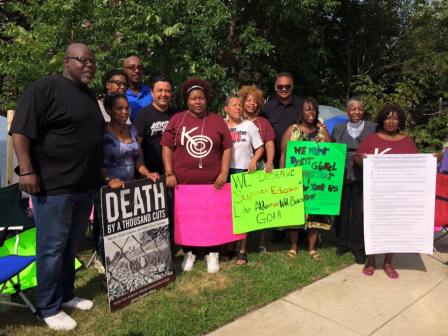
This is for every teacher who refuses to be blamed for the failure of our society to erase poverty and inequality, and refuses to accept assessments, tests and evaluations imposed by those who have contempt for real teaching and learning.
Contact:Gus Morales, President Holyoke Teachers Association,GusMoralesHTA@gmail.com
State Issues Charge Against Holyoke Public Schools for Firing Union Leader
The state Department of Labor Relations (DLR) has found “probable cause” to believe that the Holyoke Public Schools illegally fired Holyoke Teachers Association (HTA) President Gus Morales because of his activism as a union leader.
The DLR will hold a hearing on the complaint, which stems from a charge filed by the HTA on June 25. The DLR complaint is similar to a grand jury indictment; the upcoming hearing will have many of the characteristics of a trial, with witnesses and cross-examination.
“Because I speak out against policies that I see as bad for our students and bad for our educators, I have been targeted for two straight years,” said Morales, whose employment contract with the Holyoke Public Schools was not renewed at the end of the school year.
Morales, who does not have professional teaching status, was similarly dismissed at the end the 2013-14 school year after his election to lead the HTA. Then, as now, the DLR issued a complaint that found reason to believe that Morales was illegally terminated for his union activism.
In that case, following the initial DLR complaint, the Holyoke Public Schools agreed with the HTA and Morales to return Morales to the classroom in November. Shortly thereafter, the state Department of Elementary and Secondary Education announced a planned review of Holyoke Public Schools and its intentions to recommend that the district be placed under the control of a state-appointed receiver.
Morales and the HTA were vocal opponents of the takeover, which was imposed in April despite widespread objections from the community and several of its elected leaders.
“It is an outrage that an educator and leader such as Gus Morales, who has spoken out for the students and the Holyoke community, is being targeted for dismissal,” said MTA President Barbara Madeloni. “The MTA will not tolerate attacks on educators, especially when the attack is meant to cause fear among those who challenge the deeply flawed accountability system used to punish educators, students and communities. Gus has the courage to address the real issues affecting Holyoke — such as economic and racial injustice — and the MTA supports him and the HTA in holding the state accountable for providing resources that the community can use to combat these problems.”
Throughout stakeholder meetings to craft a “turnaround” plan for Holyoke Public Schools, Morales and others from the HTA raised concerns about the influence of standardized tests, the need to provide social services to students living in poverty, inadequate programs for students on special education plans, the lack of ethnic diversity in the teaching ranks and other issues that they felt that the receiver needs to address.
“Before I became vocal about the problems I see in our schools, I received very good evaluations. But once I spoke out, my evaluations turned negative,” Morales said. “The real story here is how the current evaluation process lets administrators target and eventually terminate educators who challenge their authority.”
Another academic year is upon us, and students, parents and teachers are approaching the beginning of another school year in the "accountability era" with a mix of excitement, anticipation and apprehension. As we ready ourselves for another year in our classrooms, what do we see around us?
We have schools that have already been open for weeks, others about to begin, and still others that won't begin classes for several weeks...
We have small rural schoolhouses with children in mixed-grade groupings, sprawling suburban schools with Ivy League-worthy campuses and facilities, and historic urban schools in our nation's biggest cities...
We have schools with students who have a plethora of learning styles, gifts and challenges, schools with students who speak languages from across the globe, and schools that reflect the richness and diversity of the communities that they represent...
We have public schools, private schools, magnet schools, charter schools, independent schools, religious schools, home schools, online and virtual schools, and "schools of choice"...
We have schools that offer a traditional curriculum, schools that provide a veritable buffet of AP classes and other advanced offerings, schools with IB curricula, and school consortia that offer vocational education in various areas of interest...
We have schools that operate on quarters, semesters, trimesters, year-round and other even more arcane scheduling options...
We have schools organized into districts, by counties, and into "corporations;" schools in which the teachers are members of unions, and schools in states where unions do not exist...
There is nothing about these schools--or our students--that is standardized. Schools are not fast-food franchises, engineered for consistency and similarity of "customer experience." The differences in our schools, and among our students, are to be savored, treasured and celebrated, not targeted as "issues", or "problems" to be solved, or "variables" to be accounted for in the construction of a standardized exam. The diversity in our schools is not a "bug", it's a feature.
The goal in education is not for every 4th grade student in the US to be learning the same thing at the same time--"If it's October 17, it must be time to sing "The Itsy Bitsy Spider!"
The goal is for each student to become more fully human, to develop her or his individual strengths, talents and skills in the ways that make sense for each child, and to instill an unquenchable thirst for learning, exploring and questioning the world around them.
Education is not simply about constructing efficient delivery systems for the transfer of information--books and computers can do that. Education is about the building of relationships--between students and teachers, and among learners themselves. And schools, in all of their messy, noisy, confusing chaos, do this spectacularly well.
And yet we keep hearing the same mantra from non-educators that the only way to "keep the schools and teachers accountable" is to leave no child untested. Every reform initiative seemingly ups the ante yet again with more tests, longer tests and harder tests, as if inserting more thermometers will somehow cook the meat better and faster.
The reformers are fond of lecturing us that "the only way we will know how our children are doing in school" is to gather copious amounts of "data" through the administration of an endless array of "end of course," final, summative, high-stakes, rigorous, standardized tests. These reformers seem oblivious to the fact that teachers and parents already know a lot about our students and children:
we go to parent nights
we attend open houses
we go to concerts, plays and science fairs
we drop them off and pick them up from soccer games, piano lessons, dance classes, art galleries, and museums
we communicate with their teachers, by email, phone and face-to-face
we volunteer in their classrooms, marching band parent groups, chorus and orchestra booster clubs, and athletic support groups
we chaperone trips with their elementary classes, music ensembles and sports teams, riding buses for hours and hanging out in muddy zoos and nature centers, cold, rainy stadiums, and drafty auditoriums
And, as parents and teachers, we talk to our children and one another. We ask questions about our children and their work in school; are they paying attention? behaving appropriately? doing their best? "getting it"? A standardized test tells us none of those things--it only provides a snapshot of the movie of our children's lives as learners.
So, as we begin another school year, let's keep the focus on the differences in our schools, and among our children, and resist the reformers' urging to standardize their experiences, their learning, and their evaluation. Rather than trying tonationalizeour standards, let's work toindividualizeour standards--with nuance, "feel", and the understanding that each child has a unique background, understandings and abilities. And let's celebrate the uniqueness of each and every one of our children, teachers, schools and communities.
Standardize that.
We Are All on the Lunatic Fringe – The Centerless Battle Against Corporate Education Reform
It was one of the strangest meetings I’ve ever had with a state legislator.
When we described how the definition of school accountability
has changed from holding lawmakers accountable to holding teachers
accountable, he talked about the sad scapegoating of the profession.
Why? Because it interested him. “Jane Eyre”? Not so much.
And he admitted that in today’s environment where nothing is counted a
success unless it generates a high test score, he would have been lost
and probably would have dropped out.
Which brings me to the third strangest thing – Miller isn’t playing
partisan politics. As a Democrat, he isn’t blaming everything on the
Republicans.
“This is a bipartisan issue,” he said. There’s no reason why both
parties can’t agree on what needs to be done to help our schools.
So why doesn’t the legislature do more?
Ignorance. “There’s a low level of analysis of bills down there (in Harrisburg).” Local government usually does a better job.
There’s a lot of good will in the capital, he says. “Most legislators
aren’t trying to cause a problem.” They want to try to achieve
something, but if those experiments fail, the consequences are dramatic,
long lasting and hard to correct.
“He was always polite to me, “ Miller says. “He just didn’t talk.” He wasn’t approachable.
By contrast, Gov. Tom Wolf
comes to you. Miller recalls walking in to his own Harrisburg office
and Wolf was sitting there waiting for him because he had something he
wanted to talk about. Wolf is well liked, even among Republicans. They might not agree with the new Democratic governor, but they have to admit he has the best interests of the state at heart.
Perhaps its Miller’s infinite good will that’s propelled the Democrat with only two years in state office to the House Education Committee.
Republicans have dominated state education policy for years. They
still do. But in Miller we have someone who actually has a say in one of
the most critical areas in the state. And he knows what he’s talking
about, takes time to meet with real live educators and sympathizes with
our cause.
Which brings me to perhaps the strangest aspect of the whole meeting –
Miller’s analysis why more isn’t being done to combat the testing
industry.
“The groundswell isn’t there,” he said. “You’re still the fringe.”
He praised teachers unions like the Pennsylvania State Education Association (PSEA) for being excellent advocates. He said lawmakers get all their emails, but the emphasis seems to be maintaining pension benefits. He understood why this is so, but the issues we were talking about didn’t seem to register on most legislators radar.
Heck! If we’re all dangling on the outer edge, who’s in the middle? Where’s the mainstream?
Perhaps its just a matter of perception. Maybe the other side just has better public relations.
If so, it’s up to us to spread the word until all of us
counterculture anti-standardization and anti-privatization folks are
seen for where we really are – at the axis of real school reform.
Thank you to Meagan O’Toole for setting up the meeting. Thank
you, Ben Lander, Yvette Robinson Logan, Mary Cay Rojtas-Milliner, Susan
Olsen, and Roslyn Stulga for speaking out for your students and
profession. And most of all thank you, Rep. Miller, for meeting with
classroom teachers to talk about what’s going on in our state’s public
schools and actually listening to our stories and advice.
Bernie Sanders Explains Puzzling Education Vote – It’s Because Accountability
Photo: Alex Garland
When teachers asked, Bernie Sanders answered.
Why, Bernie? Why did you vote this summer against everything you seem to stand for on education policy?
In education circles, it’s a buzzword meaning opposite things to opposite people. And determined in opposite ways.
Ask a representative of the standardized testing industry, and more than likely he’ll tell you accountability means making sure public schools actually teach students – especially the poor and minorities. And the only way to determine this is through repeated, rigid, standardized assessments. Let’s call that TEACHER ACCOUNTABILITY.
On the other hand, determining LAWMAKER ACCOUNTABILITY is easy. Just compare school budgets.
Greater than and less than. You’ll find that none of our lawmakers
provide equitable funding. Rich kids in wealthy districts get Cadillac
funding while poor and minority kids in impoverished districts get
bicycle funding. Strangely, this is never discussed.
Moreover, none of this relies on opinion. All it takes is empirical evidence to see the truth. Lawmakers
are not accountable at all. Teachers are accountable for too much and
judged by unscientific and untrustworthy methods.
Unfortunately, few politicians have fully figured this out yet. Even you, Bernie.
However, under President George W. Bush and throughout the Obama years, it’s become about punishing teachers and schools for low standardized test scores – TEACHER ACCOUNTABILITY.
And the champions of TEACHER ACCOUNTABILITY this summer have been primarily Democrats including liberal lions like Elizabeth Warren and Sanders.
That’s why a group of respected education professionals and union leaders (including myself) wrote an open letter to Sanders asking him to please explain, himself.
We aren’t exactly a hostile crowd. We like a bunch of things that
Sanders represents in his presidential campaign. We want to support him,
but we need to know why he voted to keep the worst aspects of the
current law.
And Bernie answered! Or his staff did.
I’ll reproduce the entire letter
we received from staffer Phil Fiermonte below this blog. But first I
want to focus on Bernie’s specific reasons for voting in favor of the
Murphy Amendment:
As you mentioned, Senator Murphy introduced an amendment
on the Senate floor that would have required states to hold schools
accountable for the academic performance of low-income, minority and
disabled students. Senator Sanders voted for this amendment because he
believes states must do more to protect every student’s right to a
quality education, and that from a civil right’s perspective, the
federal government has an important role to play in protecting
low-income, minority and disabled children. As you pointed out, the
mechanism this amendment would have used to identify struggling schools
resembles the failed policies of No Child Left Behind. This was a
significant concern to the Senator, and one that he shared with the
sponsors of the amendment.
Senator Sanders cast his vote on this amendment to express his
disapproval with aspects of the bill that were insisted upon by Chairman
Alexander and Senate Republicans and that do not reflect the best
interests of vulnerable populations, or a progressive view on the
distribution of education resources. He has made clear to Chairman
Alexander, Ranking Member Murray, and Senate Leadership that his vote
was not an endorsement of the accountability mechanism included in the
amendment, but rather as a statement of his intent that other measures
must be put in place to protect low-income, minority and disabled
students.
So Sanders voted for the Murphy Amendment for these reasons:
He was mad that there is nothing about LAWMAKER ACCOUNTABILITY in the ESEA.
He believes in TEACHER ACCOUNTABILITY – at least in part. He thinks the federal government needs to make sure teachers and schools are actually educating kids, BUT he doesn’t believe standardized tests are the best way of determining this.
However, I don’t see how voting for an amendment you don’t believe in
is going to make a point about something entirely unrelated. How would
voting for the Murphy Amendment get us LAWMAKER ACCOUNTABILITY?
The Amendment had nothing to do with that. There are places for it in
the ESEA but this amendment was focused almost entirely on TEACHER ACCOUNTABILITY.
Was Sanders trying to convince Republicans to add LAWMAKER ACCOUNTABILITY elsewhere in the bill by voting against them on TEACHER ACCOUNTABILITY here? That seems a stretch. Both parties appear to love TEACHER ACCOUNTABILITY,
but during this ESEA process the Republicans have been more concerned
with stripping the federal government of its power over education. It’s
not that they don’t like TEACHER ACCOUNTABILITY, they just want to leave it up to the states.
Are there really schools in our country that don’t even TRY
to educate their students? Really!? Are there hospitals that don’t try
to heal their patients? Are there defense attorneys who don’t try to
defend their clients? Are their airlines that don’t even try to get
passengers to their destinations?
It’s absurd. Certainly if there were such places, we should do
something about them, but the fact that our education policies are
obsessed with something that almost never happens is asinine. It’s like
going to Ireland and spending the majority of your vacation budget
looking for a leprechaun! (At least, this doesn’t happen in non-cyber, non-charter, not-for-profit traditional public schools. But I digress…)
Then we get to Bernie’s suggestion that he’s against using
standardized tests to measure if schools are functioning properly. At
least here he is justified. But how will voting for the exact thing
you’re against get you what you want? It boggles the mind. I want Pizza,
that’s why I’m voting for chicken. Huh!?
However, Sanders is responsible for an innovation in the ESEA along just these lines. He proposed a 7-state pilot program that would allow TEACHER ACCOUNTABILITY
to be determined on more holistic methods than test scores. Schools
could use multiple measures such as student portfolios, classroom
projects, or other means to be determined by the states.
This could be a step forward. But even under the best of
circumstances, it is limited to a maximum of 7 states. It’s not a long
term solution. The majority of the country could still be stuck with
test and punish.
So we’re left with some good news and bad news.
GOOD NEWS: Bernie actually took teachers open letter
seriously enough to have a staffer answer it. That’s something. I’m
sure there are plenty of presidential candidates who wouldn’t even do
that much. GOOD NEWS: Bernie has some thoughtful ideas on
education. His pilot program holds – limited – promise. He understands
that the measures usually prescribed to determine TEACHER ACCOUNTABILITY are bogus.
GOOD NEWS: Bernie acknowledges that LAWMAKER ACCOUNTABILITY is important and says he’d like to address it.
BAD NEWS: He doesn’t mind focusing on TEACHER ACCOUNTABILITY when there is very little need for it. Moreover, TEACHER ACCOUNTABILITY without LAWMAKER ACCOUNTABILITY
is actually harmful. Imagine if NASCAR fired a driver because the Pit
Crew didn’t gas up the car. If schools have inadequate money and
resources, putting a gun to all the teachers heads isn’t going to help.
BAD NEWS: Some of his answers don’t make sense.
BAD NEWS: He isn’t addressing us personally. Will it take teachers storming his campaign speeches and swiping the microphone before he does more than limited reforms and pays us lip service? It’s one thing to say #BlackLivesMatter. It’s another to make sure our black and brown kids get an equitable education.
The following letter was sent to Arthur Goldstein, one of the teachers who signed the original open letter to Bernie Sanders:
Sen. Sanders views on the Every Child Achieves Act,
standardized testing, and school accountability Rand Wilson Add to
contacts 4:59 PM Keep this message at the top of your inbox To: Arthur
Goldstein Cc: Philip Fiermonte, Cwa Cohen laborforbernie2016@gmail.com
Dear Brother Goldstein:
Senator Sanders has asked me to respond to your email, and share his
views on the Every Child Achieves Act, standardized testing, and school
accountability.
As you know, Senator Sanders has long opposed the blame-and-shame
approach to school accountability embodied in No Child Left Behind. He
voted against No Child Left Behind in 2001 because he believed then, as
he does now, that the legislation’s narrow focus on standardized test
scores ignores a broad range of factors that determine how well a school
is meeting the needs of its students. Since the passage of this
legislation, we have seen the devastating impact that high stakes
standardized testing has had on schools all over the country. In the
Senator’s home state of Vermont, nearly every school is identified as
“failing,” and is threatened with increasingly proscriptive
federally-determined interventions.
No Child Left Behind’s narrow focus on standardized test scores has
tragically led to a significant culture shift in our nation’s schools.
An obsession with testing and test preparation has taken over in
countless school districts in America, and educators are being forced to
dedicate hours of class time getting students ready for exams rather
than teaching them new material, or strengthening essential skills and
qualities like critical thinking, teamwork, and problem solving. And the
worst thing is that students from low-income, urban school districts
spend more time in test preparation than students from the suburbs.
These hours and hours of test preparation have no educational value, and
the fact that poor and minority students are disproportionately
subjected to test prep at the expense of lesson time is a huge problem
that must be addressed.
Last month, the senate passed the Every Child Achieves Act, which
would fundamentally reform No Child Left Behind, and end its system of
high stakes testing and draconian interventions. Senator Sanders
supports this legislation, and believes it represents a very important
step forward.
As a member of the Senate Committee on Health, Education, Labor and
Pensions, the Senator had an opportunity to shape this legislation at
every stage of its development. For example, he was one of the leading
advocates on committee for the inclusion of a “multiple measure”
accountability system that allowed states to include factors other than
test scores when determining a school’s effectiveness.
In addition, he worked to provide states with significant flexibility
when it comes to assessment. This legislation includes a provision
written by Senator Sanders that would create a groundbreaking
alternative assessment pilot program which would allow states to
implement alternatives to standardized testing. If the legislation
passes, these new assessments would eventually reduce the number of
statewide tests children are forced to take, while providing educators
with timely information on student performance.
However, this legislation is far from perfect, and there are several
aspects of the Every Child Achieves Act that have caused the Senator
great concern. For example, there is no requirement that states focus
resources or attention on schools that are meeting the needs of middle
class children, but not meeting the needs of minority, low-income and
disabled children. In addition, the Senator is concerned that the bill
does nothing to address resource equity, and was deeply disappointed
when an amendment offered by Senators Kirk, Baldwin, Reed and Brown to
address resource equity failed on the Senate floor.
As you mentioned, Senator Murphy introduced an amendment on the
Senate floor that would have required states to hold schools accountable
for the academic performance of low-income, minority and disabled
students. Senator Sanders voted for this amendment because he believes
states must do more to protect every student’s right to a quality
education, and that from a civil right’s perspective, the federal
government has an important role to play in protecting low-income,
minority and disabled children. As you pointed out, the mechanism this
amendment would have used to identify struggling schools resembles the
failed policies of No Child Left Behind. This was a significant concern
to the Senator, and one that he shared with the sponsors of the
amendment.
Senator Sanders cast his vote on this amendment to express his
disapproval with aspects of the bill that were insisted upon by Chairman
Alexander and Senate Republicans and that do not reflect the best
interests of vulnerable populations, or a progressive view on the
distribution of education resources. He has made clear to Chairman
Alexander, Ranking Member Murray, and Senate Leadership that his vote
was not an endorsement of the accountability mechanism included in the
amendment, but rather as a statement of his intent that other measures
must be put in place to protect low-income, minority and disabled
students.
As congressional leaders move toward the next step in consideration
of this bill – negotiating differences with the House – Senator Sanders
has urged the future leaders of the conference committee to include
protections for low-income, minority and disabled students, and to do so
in a way that addresses the needs of the whole child. We must ensure
low-income, minority and disabled children have the same access to
educational resources that their wealthy suburban peers have. In
addition, we must ensure that struggling students have access to
adequate supports including health, mental health and nutrition services
and after school programs that help level the playing field.
For many years, educators across the country have been the loudest,
strongest voices against the corporatization of our nation’s education
system and for the increased funding and wraparound services that will
make a difference for our children. This is a fight that Senator Sanders
has been waging at the national level for 25 years, and one that he
will continue to pursue.
Sincerely.
Phil Fiermonte
Bernie 2016
NOTE:This article also was published in the LA Progressive.
Parent Power Can Crush the Testocracy – and the Government is Scared Witless
“We need to change accountability for schools to be more holistic. My greatest frustration is that I can’t do it fast enough.”
–Pedro Rivera, Pennsylvania’s Education Secretary
Parents, you can.
It doesn’t matter where you live. It doesn’t matter what laws are on
the books. It doesn’t matter if your state is controlled by Democrats,
Republicans or some combination thereof.
No government – not federal, state or local – can trample your
parental rights. If you don’t want your child to be evaluated based on
standardized tests, your child doesn’t have to be. And if a majority of parents nationwide make this decision, the era of standardized testing comes to an end. Period.
It has already begun.
Across the nation last school year, parents decided to opt their
children out of standardized testing in historic numbers. The government
noticed and functionaries from New York to California and all places in
between are scrambling to deal with it.
In the Empire State one in five students didn’t take federally mandated standardized tests. State education commissioner Mary Ellen Elia responded yesterday by threatening sanctions against schools
this year with high opt out numbers. In short, if in the coming year
too many kids don’t take the test in a given school, the state will
withhold funding.
It’s a desperate move. If the public doesn’t like what its duly
elected officials and their functionaries are doing, those same
officials and functionaries are vowing to punish the public. But wait.
Don’t those people work for the public? Isn’t it their job to do our
will? It’s not our job to do theirs.
The message was received a bit better in U.S. Congress where the Elementary and Secondary Education Act
(ESEA) is being reauthorized. Two drafts of the law that governs K-12
public schools were approved – one in the House and one in the Senate.
And both specifically allow parents to opt their children out of
standardized testing. But can schools be punished for it?
The House version says no. The Senate version says it’s up to each state legislature.
These bills are being combined before being presented to President
Obama for his signature. If he doesn’t veto the result, one might assume
that at worst the issue will become each state’s prerogative.
But you’d be wrong. The state has as much business deciding this matter as does the fed – which is none. This is a parental rights issue. No one has the right to blackmail parents to fall in line with any government education policy. It’s the other way around.
In my own state of Pennsylvania, opt out numbers this year were not
as dramatic as in New York, but they still sent a message to state
government.
The number of students opted out of state tests tripled in 2015,
according to data from the Pennsylvania Department of Education. PSSA
math opt-outs rose to 3,270 students from 1,064 in 2014. PSSA English
language arts opt-outs rose to 3,245 from 1,068. Those are the largest
jumps in the nine years of available data.
And it’s not only parents who are concerned. Teachers continue to speak out against high stakes standardized tests.
Thousands of teachers have told State Education Secretary Pedro Rivera
that school accountability needs to be less about test scores and more
about reading levels, attendance, school climate, and other measures, he
said. They have concerns about graduation requirements and the state’s
current system of evaluating schools.
It’s not like these criticism are new. Education experts have been
voicing them since at least 1906 when the New York State Department of
Education advised the legislature as follows:
“It is a very great and more serious evil to
sacrifice systematic instruction and a comprehensive view of the subject
for the scrappy and unrelated knowledge gained by students who are
persistently drilled in the mere answering of questions issued by the
Education Department or other governing bodies.”
-Sharon L. Nichols and David Berliner, Collateral Damage: How High Stakes Testing Corrupts America’s Schools, 2007
Corporate education reformers complain that testing is necessary to
hold schools accountable. However, the results are not trustworthy,
according to the Pennsylvania Department of Education, itself! In 2011
and now again in 2015, officials are cautioning against using test
scores to compare student achievement from year-to-year.
“The 2015 assessment should not and cannot be compared to the 2014
and 2013 assessment,” Rivera said. “It’s apples and oranges. Schools are
still working on aligning curriculum to standards. They’re still
catching up to teaching what we’re assessing.”
Each year students and teachers are told to hit a moving target, which was the reason also cited for caution four years ago.
While Rivera laments the issue and his inability to change anything
soon within the government bureaucracy, parents are not thus encumbered.
All you have to do to save your child from being part of this outdated and destructive system is opt out.
But don’t stop there.
Talk to other parents. Talk to classroom teachers. Organize
informational get-togethers. Go to the PTA and school board meetings.
Get others to join you.
And if the government threatens to withhold funding, lawyers are waiting in the wings to start the class action suits.
Withholding taxpayer money expressly put aside to educate children
because those same taxpayers disagree with government education policy!?
Just try us!
Governments are tools but we hold the handles. If enough of us act
this year, there will be no testing next year. Functionaries can
threaten and foam at the mouth, but we are their collective boss. If
they won’t do what we want them to do, we have the power to boot them
out.
A multi-billion dollar industry has sprung up around high stakes
standardized testing. Lobbying dollars flow from their profit margins
into the pockets of our politicians. But we are more powerful.
Because you can’t serve your corporate masters if you are voted out of office.
Black Schools Matter – Chicago Protesters Go on Hunger Strike to Save Their Last Neighborhood School
Somewhere in Chicago tonight, Mayor Rahm Emanuel may be sitting down to his favorite desert – warm pecan pie with vanilla ice cream.
Across the city in the South Side neighborhood of Bronzeville, 11
parents, teachers and community members aren’t eating so well. Their
meal – a few sips of coconut water to keep their strength up.
If the Emanuel administration has its way, this mostly black community will have to choose between
sending their children to a failing charter school or a failing public
school run by a private company – all while the neighborhood’s historic Walter H. Dyett High School is closed.
Nat King Cole, Dinah Washington, Red Fox and Bo Diddley are all alumni of Dyett.
Why close such a vibrant connection to the community’s proud past?
It’s the same excuse lawmakers used
in 1988 to take away local control from Chicago residents throughout
the city. Most Americans have the right to vote for the people who run
their local public schools. But not in Chicago, Philadelphia, New
Orleans or many other places dark complected people live. The poorer the
people and the darker their skin, the more likely the state will swipe
away their right to self government on the excuse that their neglected and underfunded schools are “failing.”
Chicago, the third largest district in the country, is a prime example of this kind of disaster capitalism.
While schools in wealthier neighborhoods had all the amenities, Dyett students had no honors or AP classes and no art or music. Even physical education classes had to be taken on-line.
No wonder test scores were low! These children didn’t have nearly the same resources as other richer, whiter kids.
In 2008, there was a 30% increase in students graduating. The improvement was so spectacular it was even recognized by then Mayor Richard Daley and Chicago Schools CEO Arne Duncan (soon to be U.S. Secretary of Education).
Likewise, in 2009, a community program helped decrease out of school suspensions by 40%. However, by the time Emanuel took office, this wasn’t enough for the
city’s Board of Education – all of whom are appointed by the mayor.
The South Side community has been fighting to change the board’s
decision for years. About 7 months ago, it seemed to have some success.
Eleven community members chained themselves to a statue of George Washington
outside Emanuel’s office demanding the board reconsider. It did. But
once the protesters removed themselves, the board decided to take bids
on how to keep the school open.
Three plans were submitted – two to privatize and one to keep it an open enrollment public school.
That last plan submitted by the community, itself, would transform the facility into the Dyett Global Leadership and Green Technology High School. This would be a district run school for up to 600 students mostly from the Bronzeville area.
The plans to charterize the school have strengths and weaknesses, but
the biggest problem with both privatization schemes is they disconnect
the new school from the community and its history.
If either charter school plan is enacted, Bronzeville children may or
may not be able to attend it. They could apply, but the entire student
body will be selected by lottery. So it’s a roll of the dice whether
they could go to their neighborhood school.
Community children not selected would be sent to Phillips Academy
– a public school being run by a private management team. Phillips has a
worse academic record than Dyett did in it’s darkest days. In 2012,
less than 1% of Phillips students passed the state math test and just 8%
passed the reading test.
The best solution seems to be the plan created by and for the Bronzeville community to keep a public school in place. But when a public hearing was abruptly cancelled this month, they suspected the worst – the board was trying to sidestep a democratic vote.
That’s when community members started the hunger strike.
Protesters vow not to eat unless there is an emergency meeting on Dyett and a final vote taken.
The activists say they’re starting to feel tired
and a bit light headed but severe hunger has not set in yet. They are
getting daily checkups from a nurse to ensure they’re healthy enough to
continue.
Meanwhile, where is the national media?
The Rev. Jesse Jackson visited the hunger strikers Tuesday and vowed to join them in their quest for justice. But even this hasn’t brought national attention.
How typical! While black schools are closed and black communities gutted, White America yawns and the band plays on.
If you would like to help, you can call Mayor Rahm Emanuel at
(312) 744-3307 and Alderman Will Burns at (773) 536-8103 and ask them to
support the Dyett Global Leadership and Green Technology High School.
You can also tweet in solidarity to the hunger strikers using the hashtags #SaveDyett, #WeAreDyett and #FightForDyett. Finally, you’re invited to email the protesters at info@reclaimourschools.org and let them know you stand with them and would like updates on their progress.
Rebecca Friedrichs, the main plaintiff behind Friedrichs v California Teachers Association et al has not been working alone. She has been a strong proponent of National Employee Freedom Week (NEFW).
While the list behind the coalition of NEFW does not sound like the “who's who” of corporate educational reform, the size of this organization is disconcerting. All but eight states have organizations that support this cause which advocates for privatization of public education and destruction of unions. It is important to know who the players are. The two national founding partners behind this endeavor are the Nevada Policy Research Institute (NPRI) and the Association of American Educators (AAE). A person may question why NPRI is involved with such an endeavor, but keep in mind that this endeavor will not only hurt education, it will influence other unions. Las Vegas Casinos are a huge union industry. The devastation of unions for this city would be very beneficial to casino investors while being very harmful to the workers. This is evidenced in Atlantic City by Carl Icahn's recent replacement of pensions and benefits with 401K plans and insurance under the Affordable Care Act.
When you look at the Board of Directors for NPRI it is glaringly evident that this organization is stacked heavily with people that would seem to have a heavy personal interest in any union busting agenda. There is no voice representing middle or lower class citizens on this board. The list of Board members views as people that are directing policy, affecting thousands, while benefitting themselves.
Judi Cresanta - Founder
creator of Nevada's first Free Market Think Tank (NPRI)
Ranson Webster – Chairman
Evergreen Capital LLC – invests in internet start ups and biotech projects
Nancy Croom – Vice-Chair
past involvement with golf and resort development, real estate broker
At first glance, a person can see the business connections of this organization and see how following this agenda of union busting could personally benefit them. Digging deeper, other ties can be found. According to Sourcewatch, a center for Media and Democracy that tracks ties to ALEC there is a link between NPRI and the ALEC-connected Franklin Center for Government and Public Integrity. Sourcewatch has this organization listed for its funding of reporters across the country that are known for reporting with a conservative bias. Expand the lens on NPRI to see that the organization is part of a larger group, the State Policy Network (SPN). The website for SPN touts school choice programs right on the homepage. The State Policy Network has created Heritage Foundation-like groups at the state level and has been exposed by the Center for Media and Democracy of being a main driving force of the ALEC agenda.
The Association of American Educators states on their homepage that is the largest national, non-union, professional educators' organization, advancing the profession by offering a modern approach to teacher representation and educational advocacy, as well as promoting professionalism, collaboration, and excellence without a partisan agenda. When you look at the staff list the last part of a partisan agenda comes into questions. Members on the staff have previous ties that display an agenda that can be said to have personal benefit, as well as involvement, with ALEC's political agenda.
Gary Beckner – Founder, Chairman
past – involved in a coalition of independent education associations, proponent of school
choice, involved with redefinEd a group that is pro charter, magnet and virtual schools, connections with the Bush family
past – writing, marketing, and digital media for swing-state congressional and senatorial candidates and presidential hopefuls
The Association of American Educators Foundation Board (AAEF) has its own share of members with questionable intentions. While there is a presence of teachers on the Board, there are people with ties that are not necessarily in alignment with what we feel is best for our public schools.
Gary Beckner – Founder, Chairman
(see above)
Becky Norton Dunlop – Secretary/Treasurer
Vice president of Heritage Foundation, ties to Bush family
Gene Bedley
Lift Up America – corporate training camp designed to lift leading financial managers
When looking at all of this background, the pieces begin to fall in to place. The connections to ALEC and the Koch brothers are evident. The union busting agenda is present. The corporate Charter School Movement is participating and the profit making online education providers are getting their share.
The sponsors behind Employee Freedom week strive to have anything BUT employee freedom.
*************************
What action can you take? Please send a letter to Justice Scalia - he could be the deciding vote in the case of Friedrichs vs. CTA that seeks to end unionism in this country. All of the groups you have read about here are supporting an end to unionism in America. Here is the letter you can send to Justice Scalia (tweak as you see fit)
Justice Scalia Supreme Court of the United States 1 First Street, NE Washington, DC 20543
Dear Justice Scalia:
I am writing because of the concern I have regarding a case that you will hear in the fall called Friedrichs vs. CTA. I am a public school teacher/parent ((insert your position for the letter)), and the nature of this case concerns me. The power for our teachers to unionize is an important and vital aspect of public education. I am in a teachers union/I support teachers unions (insert your position for the letter)). I see the value of unionism for our children, our schools, our community, and as an important cog in the wheel that fights for social justice.
Unionized teachers are given the power and freedom through collective bargaining to be strong advocates for children and the communities they serve. States in which there are strong unions tend to have higher state funding. In the nation, we have ten states that are non-union. Of those ten states only Virginia scores above the median. It is clear that states without teacher unions and contracts are NOT doing better. http://voices.washingtonpost.com/answer-sheet/guest-bloggers/how-states-with-no-teacher-uni.html We need and want better for all of our children. In fact many in education reform today look to the Finnish education system as the pinnacle of education. Pasi Sahlberg, the director of Finnish Ministry of Education and Culture, stated, ""Without the union, we really cannot implement anything. Its role is securing and protecting the rights of teachers. It's a very important part of the system."
In regards to the Friedrichs case, we feel that the basis for this claim is suspect. The fact that the lead plaintiff in the case, Friedrich, speaks for vouchers, against a teacher's right to due process, and against teacher pensions is beyond disturbing. As an educator in the field for over ___years I have seen vouchers pull much-needed funding from our public schools. Teacher due process gives teachers the job protections they need to advocate for children. The pension system secures teachers, who are not lavishly paid, a stable retirement. Why would any educator speak out on an agenda that seeks to destroy public education and the teaching profession? The claim is suspect in my humble opinion.
In conclusion, unions are the foundation that built this nation. They are, as Dr. Martin Luther King Jr. stated: “…the labor movement did not diminish the strength of the nation but enlarged it. By raising the living standards of millions, labor miraculously created a market for industry and lifted the whole nation to undreamed of levels of production. Those who attack labor forget these simple truths, but history remembers them.”