Friday, April 12, 2019

‘The Diary of Anne Frank’ Has Never Been More Important Than It is Today by Steven Singer

Originally posted at: https://gadflyonthewallblog.com/2019/04/11/the-diary-of-anne-frank-has-never-been-more-important-than-it-is-today/?fbclid=IwAR1PeOjXvgNQrQGkItamqdHrL27z8QkdeatmWIp77pbJ7vmgzwBubqfiEgU


The biggest mistake people make about “The Diary of Anne Frank” is to assume it’s about a little dead girl.


It’s not.


Anne Frank is not dead.


Not in 1945. Not in 2019.


Anne was a Dutch Jew hiding from the Nazis with her family and four others in a loft above her father’s former factory in Amsterdam.


The teenager is the most famous victim of the Holocaust, but her story doesn’t end when she succumbed to typhus in the Bergen-Belsen concentration camp in the closing days of WWII.


Her physical self may be gone, but her spirit remains.


In the 1990s, she was a Muslim Bosniak child killed by Christian Serbs in the former Yugoslavia.


In the 2000s, she was a Christian Darfuri in Western Sudan killed by Arab militias.


A decade ago, she was a Palestinian toddler torn to pieces on the West Bank – a victim of Israeli bombs.


And, yes, today she is a brown skinned Central American girl fleeing from violence to the United States only to be forcibly separated from her family and thrown in a cage.


Not only is Anne Frank not dead, she is more alive than most people who draw breath, whose hearts still pump blood, whose eyes shrink from the violence, prejudice and hatred all around them.


Perhaps that’s why it is so hard to teach her Diary in my 8th grade class.


It’s not a particularly difficult book.


Her prose is uncomplicated. Her ideas clear.


In fact, she jumps right off the page and into the classroom.


But that’s what makes her so difficult for me, the teacher.


Every year I help bring her to life for my students. And I suffer her loss all over again each time.


I think everyone sees something different in Anne.


My students see themselves in her. Or they see their friends or siblings.


Her problems are their problems. They, too, can feel closer to one parent than another.


They, too, can hate to be compared with a “perfect” sibling.


They, too, feel all the emotions and frustrations of growing up – the confusion, passion and hurt.


For me, though, it is different.


I don’t see Anne primarily as myself. I see her as my daughter. Or perhaps I see my daughter in her.


A precocious child hunched over a book scribbling away her deepest thoughts? Sounds like my precious 10-year-old drawing her comic books, or writing her stories, or acting out melodramas with her dolls and stuffed animals.


I want to take her somewhere safe, to keep her away from the Nazis, to conceal her from all the evil in the world.


After teaching the book for almost a decade and a half, it was only this year that I hit upon a new perspective. I realized that if Anne had survived, she would be almost the same age as my grandmother.


And for a moment, an image of her was almost superimposed over my Grandma Ce Ce. There she was – a physical Anne, a living person. But then it was gone.


When speaking about her to my students, I try to be extremely careful of their feelings. I make it exceedingly clear from the very beginning where her physical life ends.


She and her family are in hiding for 25 months before the Nazis find and send them to concentration camps. Only her father, Otto Frank, is left.


I don’t want any of that to be a surprise.


Yet it is.


Every time.


My classes stare back at me with shocked expressions when we reach the last page.


That can’t be the end. There has to be more.


So we read first hand accounts of Anne in the camp.


But that can’t be all, either. Can it?


So we learn about her legacy – about the Anne Frank House, the Academy Award winning film, and how her book is an international best seller.


Somehow her spirit still refuses to die.


I think it’s because she has become more than just a victim. More even than a single physical person.


We know that 6 million Jews died in the Holocaust. We know that 5 million non-Jews were also killed. But no matter how many documentaries we see, or how many pictures we look at – none of them come alive in quite the same way as Anne.


She is a face for these faceless.


She irreparably humanizes the other.


Once you read her Diary, you can’t forget that smiling little girl whose light was so suddenly snuffed out.


We can go numb at the numbers – the sheer scale of these atrocities.


But with Anne, it becomes something personal.


On Dec. 24, 1943, Anne wrote:


“I sometimes wonder if anyone will ever understand what I mean, if anyone will ever overlook my ingratitude and not worry about whether or not I’m Jewish and merely see me as a teenager badly in need of some good, plain fun.

We see you, Anne.


And because we do, we see beyond you, too.


We see you in the continuing horrors of our age.


Because your death is never in the past tense. It is always present.


Your eyes look out at us through the victims of our day, too.


And your words ring in our ears:

“What is done cannot be undone, but one can prevent it happening again.” (May 7, 1944)


We have not prevented it.


It continues.


All while the history fades.


According to a 2018 study, only 22 percent of millennials say they’ve even heard of the Holocaust.


I don’t think any of those young adults read your Diary, because my students remember you.


That’s why I’ll never stop teaching your story.


In the vain hope that by remembering you, they’ll see your eyes on the faces of all the future’s would-be victims.


In the vain hope that caring about you will help them care about the faceless strangers, the propagandized others.


In the vain hope that knowing your face will force their eyes to see – actually see – the faces of those who are demonized and dehumanized so someone will care when the boot comes down on their visage.


So that someone will stop the boot from ever coming down again.


In one of her last entries, on July 15, 1944, Anne wrote:


“I must uphold my ideals, for perhaps the time will come when I shall be able to carry them out.”


That time has come for us all.


Anne’s Diary remains to remind us – a clarion call to empathy and action.


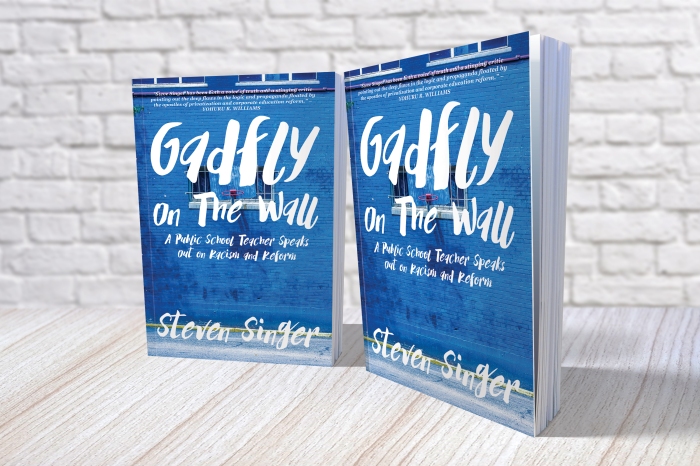
Like this post? I’ve written a book, “Gadfly on the Wall: A Public School Teacher Speaks Out on Racism and Reform,” now available from Garn Press. Ten percent of the proceeds go to theBadass Teachers Association. Check it out!
book-4

What I Learned From The Senator Kamala Harris Teacher’s Roundtable by Phil Sorensen


Last week I was contacted by the state teacher’s association president.  Being a full time teacher and a local association president, I was invited to a teacher’s roundtable Q & A with Senator Kamala Harris. I confirmed that I would attend and began imagining what this experience would be like.

I have only attended two presidential candidate rallies ever, one 30 years ago (Jesse Jackson) and one less than two weeks ago (Bernie Sanders).  I have never attended a candidate town hall or roundtable. I was excited for this new experience, but I was also well aware that I needed to be prepared to interact.

After posting about the invitation online, my good friends reminded me that the Network for Public Education has questions for candidates and candidate ranking resources on their website.  This came as a relief because I was struggling to develop thoughtful questions to ask Senator Harris.

I printed NPE’s  “Questions to Ask the Candidates” and went about selecting questions that I felt were relevant to teachers in Nevada, where I work. After reviewing the resources on the NPE website I discovered that Senator Harris had no ranking in the area of high stakes testing. With this knowledge, I selected two questions concerning testing:  

          1. Do you believe that teachers should be evaluated by student test scores?
          2. Do you believe that student test scores should be used to determine teacher salaries?

After picking my priority questions, I went through the list and selected a few others. I really didn’t know how many questions I would be able to ask or anything else about the format of the session.  I felt prepared and comfortable, though, because the issues surrounding high stakes testing are what got me into educational activism in the first place.

The day of the event arrived on Tuesday, April 2nd and I hurried to leave my school to drive to the event which was 30 minutes and a mountain pass away.  Upon arriving at the location shared with me I learned that the event was at a different school. I rushed to get to the correct place, stressing about being late. I hastily parked my truck and hurried inside, not realizing that I had left my phone behind.

As I entered the school I was directed to join the other 20 or so invitees in a classroom to wait until it was time for the roundtable discussion to start.  While we waited Senator Harris held a brief press conference that was filmed and distributed by Sinclair Broadcasting Group. When that was finished, we were invited into the school library.  By this time I had realized that I had no phone to take pictures or record with, so I pulled out my hard copy of questions and got ready to take some notes.

Senator Harris entered the room, introductions were given, and the Senator gave a stump speech highlighting her plan to increase teacher pay.  Then the questions began. The first two questions asked revealed how the Q & A was going to work. The question would be asked, followed by a response that quickly veered from the question and circled back to her teacher pay plan.  There would be no follow up question unless the next person called on asked for clarification.

Now it was my turn.  I asked about tying student test scores to teacher evaluations and teacher pay.  The response I got was about a minute long and boiled down to “we can’t get to that conversation until teachers get the resources they need … it’s myopic … it’s not a fair question … it’s actually quite simplistic.”  She dodged my question.

See the response here: https://youtu.be/xbbtE-HQpm0

As I listened to the Senator’s response, I noticed that she had both a tense tone and agitated body language.  Those cues, coupled with her response, made me feel like her pay raise deal had a cost: Test-based accountability and merit pay driven by scores.

Since I wasn’t able to follow up with another question, I was left to ponder how I may have phrased the question differently to get a definitive answer to my questions.  With hindsight being 20/20, I think that I should have payed more attention to her focus, which was her pay raise plan. Perhaps if I had asked, “Do you think it is reasonable to attach test-based accountability and merit pay as a condition to be met for your teacher raise plan?”, I may have received a specific answer to the inquiry.

Besides mine, questions that afternoon included ESP raises, early childhood and public school, supporting teacher unions, and the teacher shortage. It was not a long session, perhaps 45 minutes. The small group atmosphere would have been perfect for an organized group to support each other, following up on one or more questions.  Before the event, an attendee told me that although he thought that Senator Harris was holding this as a PR event, he felt that tough questions were fair game. An organized group could have steered the responses toward more revealing answers.

Because I had left my phone behind, my plan to audio and or video the event had fallen apart.  I did my best to take notes during the event so I could share it in our networks. I had enough information, coupled with an AP article, to post about it that evening.  In the post I mentioned that I was unable to record the event. One of the attendees who I am connected with had captured my question and response on video. So I was able to pass along a much better description of Senator Harris’ answer to my question.

My take away is that presidential candidate Senator Kamala Harris does not have a full understanding of issues affecting public education.  I also feel that she hasn’t discounted neoliberal leanings toward using financial compensation as a lever for teachers to accept test-based accountability practices.

In regard to logistics, clear directions to the location, travel timelines that allow for delays, planning for audio/video documentation, and a coordinated group of people supporting common questions are all methods that public education activists can utilize to direct public meetings to provide clearer information about candidate stances on issues.  With the election season only beginning, my hopes in sharing these lessons learned is that collectively we can have many successes in candidate forums.

I hope that this has been informative and an experience for all of us to learn from as we continue our activism in support of public education.

In Solidarity,
Phil Sorensen


Monday, April 1, 2019

Don’t Treat Schools Like Competitive Businesses by David Negaard

Originally posted at: https://www.civilbeat.org/2019/03/dont-treat-schools-like-competitive-businesses/?fbclid=IwAR0COMqiueZzgJf8UNZBdYU5WpcYnS24UzhunPQxoIRIUpJYBWxLtUMf2MU

Once more for the people in the back: Schools aren’t businesses, kids aren’t product, employers aren’t schools’ customers or clients, and standardized tests aren’t quality control. It is not schools’ primary function to produce (compliant, obedient) employees for the titans of industry, but rather self-actualized citizens who think critically and effectively and can create a better future for themselves and for all of us.
NOTE: pick the correct link
The purpose of public schools is to elevate all students. All public schools have the same basic goal and do not and should not compete with one another for resources, for students, for anything. Neither should public school students compete with one another for opportunities or status.
Whether schools or students, when they compete, there are winners and losers, and that is contrary to the premise of public education. Neither schools nor students should be subject to Darwinian “survival of the fittest”  pressures. Competition (fostered by so-called “school choice” and “accountability” initiatives) pits would-be allies — schools, principals, teachers, even students — against one another and “may the odds be ever in your favor.”
Recently, HawaiiKidsCAN, a branch of venture capital-funded “50CAN: The 50-State Campaign for Achievement Now,” published a critique (“analysis”) of Hawaii public schools based on 50CAN’s “four dimensions of a healthy and dynamic learning system.” Among the “lenses” they use to judge (“evaluate”) HawaiÊ»i public schools, the competition lens is the most problematic.
In free market capitalism, competition is “good” (for those at the top of the food chain). In education, collaboration is essential, and a competitive model works against its central principles of equity and justice. When resources are allocated not on the basis of need but rather on the basis of “achievement,” the lion’s share goes to the lions (who need it least) rather than the lambs (who need it desperately).
Ala Wai Elementary school 4th graders kids students.
Schools exist to educate and elevate all students.
Cory Lum/Civil Beat
Examples may help.
A student whose parents work multiple jobs and still struggle to make ends meet — a student without a sense of stability and security at home, who may not be well nourished or well rested — needs as much or more from school than a student whose home life is stable and secure.
The playing field is not level, and competition inevitably favors the privileged, but public education shouldn’t. Or a school in a wealthy neighborhood, with many generous public-private partnerships (the problems with public-private partnerships call for a separate article), competes for state resources with a remote rural school.
Again, the playing field is not level, and the school with the greatest needs is least likely to “win” them in competition.
This is not “The Hunger Games.” Hawaii keiki deserve better.
This false, business-influenced model for education, based on scarcity and competition and evolutionary pressure, only perpetuates and widens the gap between the haves and the have-nots.
Public schools are tasked with narrowing that gap. Public policy should instead reduce scarcity (adequately fund schools!) to meet the varying needs of both vulnerable and privileged kids, and foster collaboration — not competition — among public schools.
Collaboration and funding are key for Schools Our Keiki Deserve, not competition and scarcity.
Community Voices aims to encourage broad discussion on many topics of community interest. It’s kind of a cross between Letters to the Editor and op-eds. This is your space to talk about important issues or interesting people who are making a difference in our world. Columns generally run about 800 words (yes, they can be shorter or longer) and we need a photo of the author and a bio. We welcome video commentary and other multimedia formats. Send to news@civilbeat.org. The opinions and information expressed in Community Voices are solely those of the authors and not Civil Beat.

About the Author

Planned Ignorance by Grumpy Old Teacher

Originally posted at: https://grumpyoldteacher.com/2019/03/30/planned-ignorance/?fbclid=IwAR1uQGxFwkro_hF8CA1buyfItLG76Q0ccjshM0W92cZpvBmooq8s27fbKyE


Every teacher will realize the pun.
Planned ignoring is a classroom management technique to extinguish undesirable student behaviors. No matter the misbehavior, the teacher ignores the child. Do not acknowledge what they are doing because the child really wants the teacher’s attention. Once the child replaces the misbehavior with a desirable behavior, the teacher then lavishes attention upon them to reinforce how the child should behave in the classroom.
“The most unqualified nominee for Secretary of Education in the history of the Department.”
Planned ignorance is the only way GOT can interpret the astonishing performance of Secretary Devos in Congressional hearings regarding her attempt (for a third year) to eliminate a grant to the Special Olympics.
The ignorance of the woman and her I-can’t-be-bothered attitude is not accidental. Since the disastrous confirmation hearing, in which she had to admit she knew nothing about federal education requirements for the disabled, she has made no progress in educating herself.
More than the Special Olympics is on the chopping block. If the Trump recommendations go into effect, the impact on local schools will be devastating, for example, the elimination of Full Service Schools. Fortunately, regardless of which party holds the White House or Congress, Congress almost always ignores White House budget recommendations.
Planned ignorance. Check this out when Madame Secretary actually said that larger class sizes were a good thing:
Um, uh, ed freedom, uh, sure there’s research, um, can I google it?
President Trump threw the Secretary under the bus when he repudiated the deletion of the Special Olympics grant. While not a focus of this post, it is interesting that Trump is not beyond the pressure of public opinion, which was resoundingly negative.
Planned ignorance. Devos has an agenda to pursue (with the blessing of Trump) and that is to direct federal money to charter schools and private school vouchers. To find that money, she must eliminate everything else.
She uses her ignorance as her defense. When backed into a corner, she responds that, given a written request, she’ll look into and respond.
Planned ignorance. After two years in Washington, why has she not studied how Congress works so she can look competent in hearings?
(Okay, I’m reaching here, but the parody of John Kerry was irresistible.)
She suggested that the cut was intended to spark increased support for Special Olympics funding.
It has to be planned. This kind of attack on the well-being of all citizens of a society doesn’t happen by accident. To feign no knowledge … planned ignorance.
Devos has tried for three years to eliminate Special Olympics funding and many other things so the money can be diverted to charter schools.
Once again, she has failed.
In a famous quote (which apparently she stole from Ted Turner), she said, “Money is how we keep score.”
Get out your record book, Betsy. You have 18 million losses to enter into your record.
Her god of Mammon is not pleased.

Sell Your Soul to the Testocracy: Kamala Harris’s Faustian Teacher Raises by Steven Singer

Originally posted at: https://gadflyonthewallblog.com/2019/03/28/sell-your-soul-to-the-testocracy-kamala-harriss-faustian-teacher-raises/?fbclid=IwAR3aozgdXOMpBIsHag_pAYfOTF7wEHhtKyChkWHdWclO9LjE_VM6eP9m_DU

 
I love the idea of Kamala Harris’ plan to give teachers a pay raise.
 
But once we get past ideas, it’s way more troubling.

The California Senator and Democratic Presidential hopeful is proposing a $13,500 pay increase for the average teacher, with the exact number based on the size of each state’s pay gap.
 
That’s $315 billion more over a decade through federal matching funds, which amounts to a 23 percent salary increase for most educators.

Yes, please!
 
I could certainly use a raise.
 
But as Joe Moore said, “You can’t trust a promise someone makes while they’re drunk, in love, hungry, or running for office.”
 
And Harris IS running for office.

With this policy she’s wooing the national teachers unions and filling the neoliberal seat left by Hillary Clinton in 2016.
 
I love my union, but its leadership is like a college kid during spring break – ready to jump into bed with anyone who says the right words.
 
Arne Duncan likes it.
 
 
Obama’s first Education Secretary. The guy who thought Hurricane Katrina was the best thing to happen to New Orleans because it allowed the government to close the public schools and replace them with charter schools.
The man who held federal grant money hostage unless schools enacted his unproven and disastrous corporate driven education reforms.
 
 
The man who encouraged pushing out teachers of color who had four year education degrees in favor of mostly white Teach for America temps with a few weeks crash course training.
 
 
The man who encouraged a rapid increase in high stakes standardized testing, narrowed curriculum, let class sizes balloon and decreased authentic lessons.

“Radical idea: pay the professionals we entrust to teach, nurture and mentor our children a better salary!”


Screen Shot 2019-03-27 at 7.53.10 PM
 
How to reconcile the two?

 
I draw your attention to what he said on a recent book tour:


“If we were willing to invest in high-quality early childhood education, if we’re willing to pay great teachers and great principals significantly more, the benefits to our society, the benefits to our economy, the benefits to our democracy I think would be extraordinary…
[But] Money is never enough. So you’ll never hear me say, it’s only about money. For me it’s always about your high expectations as well as high support. And we have to hold ourselves accountable for great results. When schools aren’t working, we have to be willing to challenge the status quo. So investment is part of it, but high expectations have to go with that, and we have to hold ourselves accountable as educators for results, absolutely.”

 
So for Duncan this plan is entirely consistent with corporate education reform.
 
 
In fact, it makes sense as a continuation of those policies.


When privatization cheerleaders like Duncan talk about “high quality teachers” and “accountability” what they really mean are strings attached.


In this case, they probably mean merit pay – giving bonuses to teachers whose students get high test scores.


It’s a terrible idea because it encourages bad behavior from teachers, administrators and districts, which in turn hurts kids.

 
Having all your teachers fight over the rich white kids who get the highest test scores doesn’t help the struggling students. It just means fewer educators will want to teach the underprivileged because they can’t take the financial hit that comes with it.
 
 
The result is test prep all day, every day.

 
I want a raise, but not if it means I have to bastardize my own profession down to that!
 
 
And it’s not just Duncan who loves this idea.


“It could be transformative in terms of how we think about elevating and modernizing the teaching profession and the federal role in doing so,” Brown said.


CAP is a neoliberal think tank that worked closely with the Obama and Clinton administrations. And Brown is also the co-author of “The Progressive Case for Charter Schools”.
 
 
Any plan to raise teacher salary that is consistent with increased privatization is inherently suspect. 
 
 
You can’t champion authentic public schools and public school teachers while also pushing for more institutions run without the same transparency, democratic government, and enrollment standards. If you think schools should be able to cherrypick which students to accept, they should be run by appointed bureaucrats, and it’s fine to cut student services while pocketing the profits, you aren’t a friend of public education.


In an article she co-wrote published by CAP called “Fact Sheet: Yes, Increase the Salaries of All Teachers,” she made it clear that merit pay is a good idea.


She wrote:


“…there is still debate surrounding whether all teachers need a raise, or if it is enough to make changes for a select group of teachers through differentiated or merit-based pay. While differentiated and merit-based pay can help alleviate some specific teacher shortages, such as those in subjects or schools that are high-needs, they are not a substitute for higher base pay.”


Ultimately, Brown comes out in favor of an across the board salary increase for teachers, but in her view merit pay is part of that solution.


As education blogger Peter Greene points out, the language used in Harris’ proposal is right from the neoliberal playbook. It is full of the same euphemisms and code words that have signaled school privatization, high stakes testing and merit pay.
 
 
Consider this gem:


“Every child deserves a world-class education, regardless of their ZIP code. Of all in-school factors that impact their success, there’s nothing more important than our teachers.”

 
“World class education” and  “regardless of ZIP code” mean charter schools galore. And the only “success” these folks are interested in is high test scores.
 

Or this:
 

“Our plan will include a multi-billion dollar investment in programs that help elevate the teaching profession and support principals and other school leaders. This includes high-quality teacher and principal residencies early-career induction programs that pair new teachers with mentors and master teachers, career ladder models that allow for advancement opportunities for teacher leaders, and “Grow Your Own” programs that help increase teacher diversity.”


Greene says that the term “Career ladders” is a red flag because it usually denotes career stagnation. It’s code for adding more duties and responsibilities on teachers without actually furthering their careers.


If I’m honest, these are all red flags.
 

As much as I want a raise, I’m doubtful Harris’ plan would actually accomplish much other than selling my soul to the testocracy.
 
 
Ultimately that’s what this is – a Faustian bargain.

 
We need to invest in greater per pupil spending and let that translate into higher teacher salaries.

 
We need equitable and sustainable funding formulas that aren’t tied to testing or that don’t open the door for privatization.


And most of all, we need an understanding of the real challenges in education and not a piece of parchment where teachers are supposed to sign in blood.


Like this post? I’ve written a book, “Gadfly on the Wall: A Public School Teacher Speaks Out on Racism and Reform,” now available from Garn Press. Ten percent of the proceeds go to the Badass Teachers Association. Check it out!
book-1