Saturday, September 9, 2017

A Teacher’s Dilemma: Take a Stand Against Testing or Keep Abusing Children by Steven Singer

Originally posted at: https://gadflyonthewallblog.wordpress.com/2017/09/08/a-teachers-dilemma-take-a-stand-against-testing-or-keep-abusing-children/

What am I?

Seriously. What is it I do for a living?

When I wake up to go to work in the morning, am I preparing to be a teacher or a test proctor?

Am I engaged in the practice of nurturing young minds or am I a tool of the establishment?

Should I be held accountable to the dozens of students in my classroom, their parents and the community – or to my administrators, the bureaucrats and moneyed interests ordering us around?

I ask these questions not as a rhetorical device. I really don’t know the answers. Because the solution begins with me.

Today was not a banner day in my classroom, and I can honestly say it was not my fault.

I had to give my 7th grade students the Classroom Diagnostic Tools assessment in Reading/Lit for grades 6-high school.

If you’re not familiar with the CDT, this is an optional test offered by Data Recognition Corporation for students in Pennsylvania’s public schools. It’s a way to assess student learning to predict whether they’ll pass there annual federally mandated standardized tests (also created by Data Recognition Corp. in the Keystone State). In addition, it offers example questions of the type that students struggled to answer correctly on the diagnostic.

It’s very helpful if you want to print out a buttload of test prep, give it to students and then read the paper quietly at your desk – something I never do.

For the second straight year, I’ve been forced to give it to my students three times annually – twice before the Pennsylvania System of School Assessment (PSSA) tests and once after.

I am not a fan.

Students hate it. It does not return valuable data. And it takes precious time that I could be using to actually teach something.

When I told my kids they were going to have to take the assessment this morning, one girl said, “I hate the CDTs. It stands for I Can’t Do This.”

Another girl had a more visceral reaction. When she saw the letters “CDT” on the board, she literally began rolling around on the floor and groaning.

These are the kinds of students I have – victims of generational poverty, malnutrition, childhood trauma, violence, drug abuse and systemic racism and prejudice. Strong-arming them into another standardized test isn’t doing them any favors.

Compare their reaction this morning to yesterday’s lesson.

We had just finished a unit on plot using Dr. Seuss stories and cartoons to illustrate complex concepts like exposition, conflict, rising action, climax, resolution, theme, etc.

I made a competitive review game through a program called Kahoot, and kids were out of their seats, jumping around, squealing with delight as they demonstrated their knowledge of what they’d learned. It got so loud one of the principals came running over from the office to make sure things weren’t getting out of hand. But what he found were students so engaged by the work they could barely contain themselves.

Heck! I even gave them a test of my own creation right afterward. There were no groans. There were no protests.

They sat at their seats like grown adults, concentrated and answered the questions to the best of their abilities.

Compare that with today’s assessment.

Behaviors off the hook. Sullen looks. Demands to use the restroom, go to their lockers, visit the nurse – ANYTHING but be here in class and do this test.

Why the difference?

Because they knew what was expected on MY test, and they knew they could meet my expectations. I was there for the lesson. I made the test. I would grade it. I have a relationship with these kids and they know I will assess them fairly.

But not on this standardized CDT nonsense!

Data Recognition Corp isn’t there for the lesson. It has no rapport with students. Kids don’t know what the expectations are and don’t think they can meet them. And they have no sense that this multi-billion dollar corporation will grade them fairly for their efforts.

So they act out.

They throw wads of paper or airdrop pictures to each others’ iPads.

And here I am in front of this room of unruly children forced to have to defend the bullcrap garbage that I’m being coerced to do to them.

I want to apologize. I want to tell them this is not my idea. And after a while, I even DID that. But it’s no use.

It matters little whether the executioner does his job with reluctance or not. He’s still here to end your life. And I was still cast in the role of ending their education for the day and replacing it with “proof” that they aren’t good enough.

When the test was over, so many children showed me their scores with hurt faces.

“Mr. Singer, I really tried!” one boy said.

“This is rigged!” another said.

And what am I supposed to say to that? Should I explain how they’re right – how standardized tests have always been culturally and economically biased? Why would they care!? What kind of teacher would that make me!?


What use am I?

What purpose do I serve enforcing policies I know to be detrimental?

I went through five years of college to become a teacher – not a prison guard. But on days like today that’s what I am. I’ve devoted over a decade of my life to nourishing children, not ordering them all to march in line single file.

But here I am, a paid thug who browbeats and coerces innocents into doing things they don’t want to do for purposes that won’t benefit them and will in fact be used against them.

I wonder what the school board would say if I had the guts to stand in front of them at a public meeting and tell them.

I guess I’ll just have to keep wondering because the last time I tried to address that august body without an explicit invitation, I was told I wasn’t allowed to do so since I don’t live in the district where I teach.

But sometimes I question whether the elected representatives of my district even understand what I’m being bulldozed into doing in their name.

Do you know I am abusing your children? I am crushing their creativity, their self-respect, their curiosity. Is that really what you want of me? Is that what you hired me for?

Don’t get me wrong.

It’s not really anything new. I’ve been doing this for almost 15 years. It’s just harder every year.

I heap on justifications – you have to do the bad stuff so you can do the good stuff. You have to enforce the testing so you can do authentic teaching.

And every year the mandates get more restrictive, the teaching gets a little less and the testing a bit more.

Meanwhile, politicians pretend like they’re doing something to fix it. Gov. Tom Wolf (whom I generally like) cuts off a few days from the PSSA tests this year. But he keeps the recommendation that we take the CDTs. He keeps the entire test-and-punish framework in place. Like most Democrats, he’s willing to twiddle around the edges but has no guts to do away with what’s wrong and replace it with what’s right.

Meanwhile, parents in my state are generally clueless.

You have some strong advocates here and there. Some moms and dads who understand what’s going on. But most are either oblivious, too busy putting food on the table, in jail or dead.

I used to send home a letter to parents reminding them of their right to opt out of standardized tests. It almost got me fired.

And for my efforts, I think maybe one or two parents over five years actually took me up on it.

I go to my local union and tell them my concerns. They nod and ask for more information and then quietly forget it.

Meanwhile, the national unions are behind the testocracy 100%. They’ll wag their fingers and complain about testing, but they’re too busy making sure the teaching profession even exists tomorrow to stop for small potatoes like bad practices.

I feel so alone here.

I’m pulling my hair out and the only response I get is from the choir (Hallelujah!) and the corporate education reformers (How dare you!?).

The majority stays silent. And complicit.

I’m just not sure I can do it anymore.

I’ve thought about calling in sick whenever I have to give a standardized test. It would be a lot of days, but I could do it.

That might be safe, but it would be cowardly.

I’d just be saving myself the pain and humiliation of giving the tests. My students would still be forced to take them.

So what do I do?

I write.

I write blogs like this one.

I pound out my cares and reservations, put them in a virtual bottle and set it adrift on the seas of the Internet.

It’s a constant gamble.

Someday someone may read them who can end my career.

Or maybe someone with the power to make a difference will read them.

Maybe that’s you.

Maybe it’s all of us.

I don’t know.

I have no solutions today. Just shame and regrets.

A dilemma that I cannot solve.

XQ Live – Desperate School Choice Rebrand After Trump Touched It

By Steven Singer


IMG_8016
What do you do when your corporate brand has become repugnant to consumers?
You REBRAND, of course! And that’s exactly what uber-rich widow, Laurene Powell Jobs, paid a boatload of celebrities to do last night all over your TV.
The program was called XQ Superschools Live, and it took over four major networks.
It’s ironic really. Using an almost 100 year old medium to push “schools of the future.” They tweeted and Facebooked all over it, but the focus was on the old boob tube.
Why? Because the audience they wanted wasn’t so much the young. They wanted the old – those deep pocketed investors who might be startled by all the flash and bombast and ask their grandkids if this was “cool.”
It was the most pathetic display of desperation I have ever seen in my life.
If there is any justice, Tom Hanks, Yo-Yo Ma, Samuel L. Jackson, Jennifer Hudson and Common will have to spend the rest of their lives to regain even a fraction of street cred.

IMG_8017

They were nothing but a series of singing and dancing sell outs. This was a modern day minstrel show. A bunch of highly paid shills pretending to represent the common folk.
I’m talking raised fists at the end of dance numbers meant to evoke all the power of authentic activists like Black Lives Matter without really having any grassroots support or message.
To be honest, my overwhelming response was pity.
Did anyone really think this was going to connect with an audience?
And speaking of that audience, if you had no idea who XQ or corporate education reform was, you probably watched the screen in bemused confusion. What the heck was this crap? It was platitudes about improving high schools broken up by song and dance numbers. It made the MTV Video Music Awards seem like a college dissertation.
Yet, to the initiated, you could see the subtle nods to privatization and charter schools, the shade thrown on traditional public schools.
Rethink high school?
Sure! Let’s do that! Let’s rethink inequitably funding it. Let’s rethink high stakes standardized testing. Let’s rethink Common Core, stealing local control, teacher autonomy and a host of the kinds of top down bull crap XQ tried obscure while selling  an issue of Tiger Beat.
So now that it’s over, what have we learned?
1) Corporate education reformers are THAT desperate to distance themselves from Donald Trump.
His wholehearted endorsement of their agenda has done them serious life threatening damage. He has exposed their racist, privileged, corporatist policies for exactly what they are. No amount of celebrities will replace that in the public consciousness.
2) Rich people cannot set education policy.
Steve Jobs widow may be a very nice lady. But she has no freaking clue about public education. Nor is she honest enough to engage actual classroom teachers in the discussion to find out.
Instead of relying on the billionaires of the world, we should tax them. Then we can afford to fully fund our schools and let the people actually in the classroom decide what’s best for the students in their care. Let parents decide. Let school boards decide. Not a privileged tech philanthrocapitalist.
3) Celebrities will do anything for money.
The things these Hollywood elite prostitutes did last night to sell snake oil would make porn stars blush. I will never look at any of these people the same. Some of them I knew were true believers because of other projects. Heck! As much as I love Common’s new album, he does rap about Corey Booker – so warning there. Viola Davis is an amazing actress but she was in the parent trigger propaganda film “Won’t Back Down.”
Being famous doesn’t mean you know a damn thing. We recognize their faces. We associate them with past roles and characters we loved. We think their political stands are authentic when they are often just a pose. We’ve got to stop respecting these people just because they’re celebrities.
What will the long-term effect of last night’s propaganda be?
I don’t know.
I seriously doubt anyone really bought that. But you know what they say – no one ever went broke betting on the stupidity of the public.
And that’s what this was – a high stakes wager on American gullibility.

Wednesday, September 6, 2017

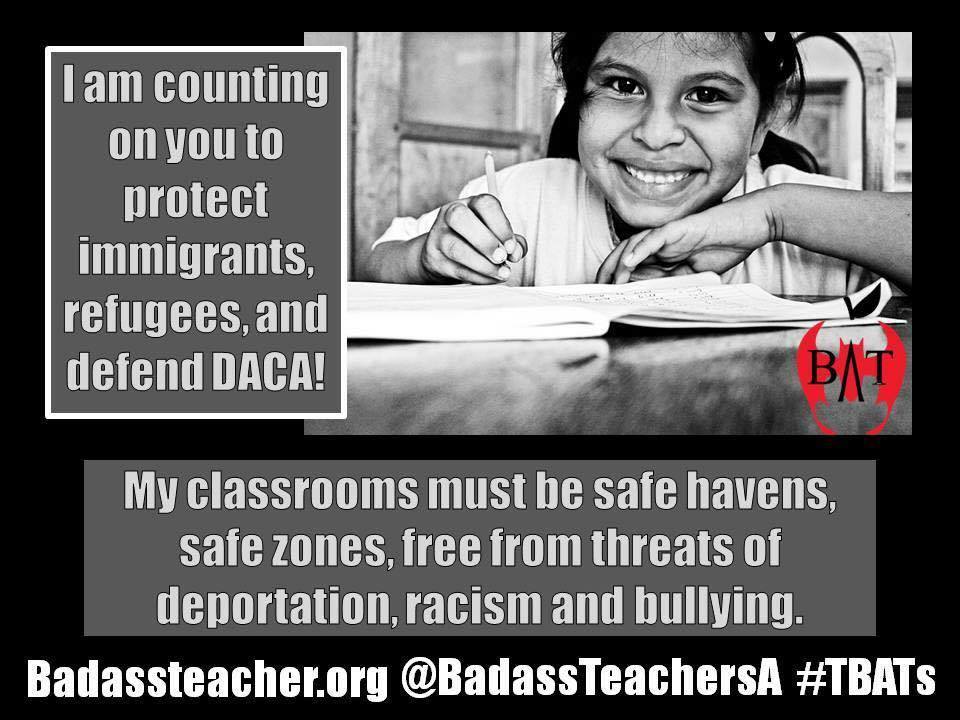
The Badass Teachers Association Board of Directors Statement on DACA

The Board of Directors of Badass Teachers Association, a grassroots national education activist organization,  strongly condemns President Trump's announcement to rescind DACA (Deferred Action for Childhood Arrivals).  To quote former Pres. Barack Obama it is “cruel” and “self-defeating.” Trump continues to define his administration as one that supports racism, hatred, and bigotry.  We want to be clear – The Board of Directors of The Badass Teachers Association will call on every educator, parent, student, and community member in our network to stand up, and speak out, against the hatred that the Trump administration continues to support.  


"Some may shudder or sneer at the prospect of giving shelter to people in need, but that is the reality in our public schools. In the lives of many, many children we provide the only stability, the only safety, the only love they get all day. So you’ll forgive me if I sigh impatiently when some in the media and in the government complain about the United States accepting more refugees. What a bunch of cowards! They act as if it’s a burden. They couldn’t be farther from the truth. It’s a privilege." ~Steven Singer, Co-Director BATs Blogging/Research

“Ending DACA will tear at the fabric of the lives of too many of our neighbors, our friends, our students, and our family members. The deconstruction of our communities is an intentional step towards once again putting forth white nationalist policies that harm our most marginalized community members.” ~Melissa Tomlinson, Asst. Executive Director BATs

“Most of my students for the last 22 years were kids who had dreams of helping their families by using their initiative and education to move forward. Many were helped by teachers who helped them get into colleges and universities by helping them overcome the bureaucratic and financial obstacles so many tried to put in their path. When people start to remember that these kids ARE our future, they'll see how futile the fear-based obscenity is of removing extant laws that keep these kids from their potential.”  ~Sue Goncarovs, Co-Director BATs Meme Team

“It is unconscionable to me that anyone could think that ripping away the hopes, dreams and opportunities of children who grew up in this country and were educated in our schools could possibly be the best thing for anyone. Ending DACA will not only rob children of their dreams, it will rob our society of the investment we have made in the talent and future potential of these children.”   ~Tina Andres, Co-Director BATs Action Team

“We heard that there will be "a big heart" for Dreamers who have come out of the shadows under DACA. These are young people who have done nothing wrong and literally everything right. They trusted in the promise that if they applied for DACA, turning over their personal information to the government, they would be protected. No "big heart" would end the program and tear them away from their families, friends, and the only country many of them have ever known. We need to honor the trust these young people have placed in our country, their country. And we need an end to discriminatory immigration policies.”  ~Kathleen Hagans Jeskey, Co-Director BATs State Administrators

“Terminating DACA is an unreasonable and unjustified move that accomplishes nothing good while destroying the only avenue that thousands of young boys and girls had to achieve a personal goal and to become productive members of this society. From a political or social perspectives, this presidential decision is wrong and bad at once. The only hope is to find in the rest of the political elite, the strength and the political will to oppose this inhumane measure.” ~ Sergio Flores, BAT Board of Director Member

“Many of my pre-service teachers are now living in a world of uncertainty. They believed under DACA they could pursue their dream of becoming teachers but now they must live in fear that their work permits will be revoked. We need more teachers and this attack on DACA will hurt our ability to recruit and prepare young people to join this profession.” ~ Dr. Denisha Jones, BATs Board of Directors

We call on all members of our global community to stand up and protect our DACA youth. These are young people who have come here from all over the world as children: from North and South America, Asia, Europe, Africa, and Australia. Many have no memory of their country of origin and do not speak the language spoken there. We call upon educators to stand up to an administration that is seeking to take OUR children away from us. We call upon educators to stand up and take steps to make your schools a safe haven for all children.

                       ####


For more information on DACA and Immigration please read and share these articles.

5 facts about illegal immigration in the U.S.  http://www.pewresearch.org/fact-tank/2017/04/27/5-facts-about-illegal-immigration-in-the-u-s/?fref=gc&dti=1016612275038970


Demographics of Immigrants in the United States illegally  https://immigration.procon.org/view.resource.php?resourceID=000845

European Immigrants in the United States  http://www.migrationpolicy.org/article/european-immigrants-united-states?fref=gc&dti=1016612275038970

Here’s the Reality About Illegal Immigrants in the United States https://www.nytimes.com/interactive/2017/03/06/us/politics/undocumented-illegal-immigrants.html?mcubz=0&_r=0

Think your immigrant ancestors came here legally? Think again | Opinion http://www.nj.com/opinion/index.ssf/2015/11/think_your_immigrant_ancestors_came_legally_think.html

Deferred Action for Childhood Arrivals (DACA) Data Tools  http://www.migrationpolicy.org/programs/data-hub/deferred-action-childhood-arrivals-daca-profiles

Irish in Chicago in ‘shock and fear’ after Trump’s election https://www.irishtimes.com/life-and-style/abroad/irish-in-chicago-in-shock-and-fear-after-trump-s-election-1.2870437

Immigration Facts: Deferred Action for Childhood Arrivals (DACA)  https://www.brookings.edu/research/immigration-facts-deferred-action-for-childhood-arrivals-daca/


Tuesday, September 5, 2017

Personalized Learning Is Data Collection And Less Human Contact by Bernie Keller


At a closing school I worked at, I discovered the school was spending $500 per student for an online learning course. At 300-400 students, that’s $150,000-200,000! Now multiply that by all of the schools throughout the city using online learning. The way I count, that’s tens of millions or hundreds of millions of dollars from a city that claims it is strapped for cash. Not only is online learning not a best practices , tried and true learning method, but in its best case scenario, in order for online learning “to work”, the learner must be disciplined, committed to learning, mature, responsible and motivated –characteristics students, by and large, do not possess, This tells me that online learning is not a wise investment. Not only is it not cost effective, given the people using it, it cannot be successful.

The mayor of New York City says there is no money to hire teachers or school aides. How many teachers would tens of millions of dollars provide? How many books? Paraprofessionals? Social workers? Guidance Counselors?

I really cannot understand the unbridled enthusiasm for online learning. Maybe if it were used as an enrichment to augment what has been taught in class, or as a way to “audit” a class which a student would have passed except for his/her failure to meet the attendance requirement it would make sense, but as it is now, it just doesn’t make a whole lot of sense to me.

Everybody talks about the 21st century and how we all have to become technologically adept if we are to survive. Think about this for a minute. At a recent professional development session, the facilitator told us that the Smartboard, the piece of equipment no classroom can be without in any school if learning is to take place, that costs between $5,000 and $10,000 each, is now obsolete. It’s one thing to have a $75 book become obsolete after two or three years- a $10,000 piece of equipment becoming obsolete in two to three years doesn’t work for me. Think about it. That means that in order for schools “to work”, to educate our children technologically they’d have to be re-tooled every two years!! Can I make a suggestion? Let’s get books and if and when new information becomes available, let’s use online technology to address that!! Not only will it save millions of dollars, but it will provide information we want the students to have.

Online learning, Smartboards, technology are not panaceas. They will not work just because they are technology, like waving some magic wand. There is no shortcut to learning- the learner still has to invest time, effort, dedication and motivation is success is going to occur. Maybe you know something I don’t know, but I can’t think of any technology that has these characteristics or that can work for any user who is devoid of these characteristics.

Can you?

Monday, September 4, 2017

Living and Teaching In This Age of Anxiety and Threat by Ira Rabois

Originally posted at: http://irarabois.com/teaching-age-anxiety-threat/

How do you teach when so many people feel and are threatened and the federal government is controlled by people who do not have your well-being in mind? How would growing up in this age, with this minority-elected President, influence your children? If you’re a parent, you might be thinking about this question too often. If you’re a child in a public school, a person of color, a recent immigrant, an LGBT, Muslim or a Jewish person, female, a person who believes in civil rights, a free press, or a democrat—the list of who might be threatened is almost endless. How do you teach?

What children will primarily learn from today’s political situation is more dependent on the understanding, creativity, and empathy shown by a teacher’s response, by all of our responses, than by the situation itself. Your response educates the child in what is possible, in what it means to be a human being. A person becomes a bully, not a clown or a desperate person, not only by his or her actions but how they respond to how they are perceived. Your response is your freedom. Schools can begin with programs against bullying and increasing the understanding and practice of empathy; teach social-emotional skills.

In November of 2015, I wrote a blog about facing terror. In a way, what I said then is relevant now. I asked: “How do you talk with your children, or if you are a teacher, with your students, about… any acts of terror and violence, [or the new administration] or whenever something dreadful happens and you feel frightened or pissed off?  You might feel numb, scared, mute. You might want to cry out for revenge, or cry out to stop the killing. All understandable. All emotion is understandable. But what do you do with it? And how do you teach your children or students about it?”

“This is a complex question and I think answering it needs to be part of the discussion in families and in the curriculum. There are at least two directions this can take. One is teaching children how to face emergencies. The other dimension is helping students learn about the situation and learn about the attacks, what led to them and what might be done to prevent further violence.”

“First, I suggest starting by feeling and hearing what is going on in yourself. You have to be honest and willing to face uncomfortable feelings and look deeply into your own ways of thinking. To get out of the way of a thrown object you have to first see it. Then you need to hear from students. What do you feel? What responses to the violence have you heard or seen? [Or what do you feel about the administration?] By listening, you say to yourself and your students, ‘you are strong enough to face this and I care enough to listen.’ You teach empathy and emotional awareness.”

Ask students: How can you feel more comfortable and less anxious here, in the classroom? Work together with students to make explicit what you and the students need in order to create a supportive, caring atmosphere—that is within your power. Ask the children open-ended questions followed with more explicit ones. For example, What does caring look like to you? Is being kind important? What about being heard? What about feeling the discussion is relevant to your life?

If you can, lead the students in imaginative inquiry practices using questions based on student responses. For example, if they pick out kindness as one characteristic of a supportive classroom, ask them to close their eyes and answer in their own mind the following questions: What does ‘kindness’ mean to you? What words come to mind when you hear the word ‘kindness’? What does it look like? How do you feel when someone is kind to you? Who could you be kind to today and how would you do it? Then ask them to record and then share with the class what came to mind.

Once you share what you and the students think about kindness or caring, and what is necessary to create the supportive community children say they need, pledge to each other that you will do all you can to act accordingly.

The next lesson is on facing adversity. Ask students: How do you face what is difficult? Deconstruct what happens when you feel stressed, threatened, or anxious. If you notice the sensations of fear and anxiety before they get too strong, you can act in ways that utilize their energy without them dominating you. You learn from them and let them go. You can’t always control what arises in your life, or mind, but you can determine your response.

Ask: What happens to your breathing when stressed? When stressed, your breathing gets more shallow and quick. When you notice this, deliberately take one–three longer, deeper breaths before you consider what actions to take.

What about your thoughts? We often turn away from what is uncomfortable and treat it as abnormal, or wrong. If you respond to feelings of discomfort, or of being challenged as if no normal life would be touched by them, you greet such sensations with fear and anxiety. G. K. Chesterton said, “An adventure is only an inconvenience rightly considered.” A challenge is just normal life.

The more aware you are of your own mental and emotional processes, the more freedom you have in your actions and the more readily you learn. To teach this, you could have mindful moments in your classroom, where you ask students to close their eyes for a moment, allow themselves to be aware of their breathing, and take a longer, deeper breath. Or start a class with a moment of silence. Or, if you practice mindfulness, start the day with a mindfulness practice. Always practice on your own before you do it with students. If you haven’t already done so, study how to lead students in such practices.

Say to students: Sit back in your chairs with your backs relatively straight and at ease, and either close your eyes partly or fully, or let them rest on a blank surface in front of you. Can you feel your breath? Feel yourself take a gentle breath in. Then feel it go out. Do that again; focus on your breathing in—and then breathing out. No hurry.

Then ask students to: notice any sensations that arise. Do it as you would if you were on the shore of a stream and were seeing and hearing the sounds of the water, noticing any stones in the bed of the stream. Notice where the sensations are, how they begin and end. They are like the water flowing and bends in the course of the stream. You might focus on your shoulders. Simply notice your shoulders rise as you breathe in. And relax, settle down, as you breathe out. Then go to another place in the body. Notice how you body expands as you breathe in, and lets go, settles down as you breathe out. Notice also any thoughts. They are part of the water flowing. If your mind drifts away, or you lose focus on the breath, simply notice it. When you notice something, it means you are found. Right now, you are aware. Take joy in that. Just notice what arises with the inhalation, and let it go with the exhalation.

Take another, deep breath, open your eyes, and return your awareness to the classroom. Ask them to: look round and notice how you feel now. And then write in a journal or share how the experience was for them. Did they relax?

You could ask students: What actions can you take to change the nation to be a better place or to help others? By taking action, students feel empowered.

If physical exercise isn’t part of the school day or your day, add it somehow. It grounds you. Fear closes you off, divides you. When you engage both the mind and body, you feel whole, more patient, confident and you think more clearly. Take a walk in the woods, study history and social justice movements and go deeply into the question of “Who are we humans?” I’d discuss with students, “What does it mean to be a citizen in a democracy?” I’d add media literacy to the curriculum so students learn to spot bias. And compassion: we need to dig deeply into what compassion is, for ourselves and for others. But these topics are for another day.

What are you doing, if you’re a teacher, to help your students? If you’re a parent, to help your children? If you’re in a relationship, to help your partner? If you’re feeling anxious yourself—what are you doing to help you face adversity with as clear a mind as you can bring to the task?

Change the Dynamic 2017-18 : An Invitation to Principals and Administrators Across the Country to Save our Education System by Cheryl Binkley


I taught in public schools for about 18 years, and have been retired about a year.  Across those 18 years,
I taught in three different schools for 6 different principals, 7 different supervising Assistant Principals, 4 different Assistant Superintendents, and 3 different Superintendents. I also have participated in several national and state level teacher groups that provide some insight into wider geographies.

Most of my Administrators were good people, hardworking, and smart, but also were fraught by things currently plaguing the job, such as:

1. Administrators, like teachers, feel professionally vulnerable.  As a result, they largely go along with what their superiors tell them, even when they know the practice, policy, or regulation is not best for the school, and will not solve the issues the policy claim to address.  Sometimes they quietly ignore, circumvent, or ameliorate the damage of those requirements, but seldom do they go to bat and openly challenge or contest them.

2. Administrators are, like teachers, caught in the double bind of having their evaluations tied to false testing-based measures that can destroy or make their careers without having real relevance to the quality of their job performance.  This makes their jobs highly uncomfortable, even as  they know in their heart of hearts that the “standards” currently used to measure their students, teachers, and themselves are invalid measures.

3. Even Superintendents often feel their hands are tied by political choices made beyond their control, like federal regulations, state policies, accreditation requirements, and funding formulas at all levels.

4. Most struggled at first to reclaim their professional center and fully develop their managerial abilities after the “Leadership Masters” they are required to take in preparation for the job and the bureaucratic gauntlet they had to run to get the position, and like teachers, their job spans and careers are getting shorter.

5. Out of necessity, more of the Administrative decisions they make for the schools are based on financial choices than on instructional choices; including who will teach the children in their schools, and which programs are offered. There is Never enough money to meet all needs.

6. Few Administrators are able to follow the labyrinth and time consuming processes of meetings, observations, and data collections now required (usually due to federal and state regulations)  for evaluating the overload of teachers they supervise.

7. They wish the job they struggle to do were as fulfilling as they had hoped and dreamed. They too want to make a positive difference in the communities they serve, yet often find that sense of accomplishment elusive. Their workload, like teachers, is heavier than it should be, and made so by the massive changes their schools have faced, and the student disciplinary part of their jobs is hard, even when they are very good at it. 

What might bring a sense of fulfillment and a real sense of accomplished leadership back to the daily challenges Administrators face? How might you be the navigators who safely and effectively steer our schools through the quantum change and complex questions of the 21st Century?

And, Why is a retired teacher writing to the nation's principals and administrators now, and what can an old teacher have to say to those still trying to steer the schools in our communities?  Perhaps it is to finally say what your still working faculties cannot, and to ask for your help.

These are a few of the things we need:

1. Please ask yourself what are the most important things for your schools to do, not for the federal government, not for the state government, not even for the local school board or the business community at any of those levels.  Let this be your guiding question:
What are the most important things to do for the children in your care?

2. Ask yourself if each policy or stance is really good for your school and community, and ask questions of policy makers. Challenge decisions that you know are questionable.  For instance, many districts these days are spending vast sums on testing and the technologies that promise better test scores rather than on creative interactive teaching and learning. There are many areas in which districts, states and USDOE are pushing you and your colleagues to accept poor practices that drain your school’s resources and morale with crushing workloads.  Be willing to ask, which data is actually useful to learning, and which is expensive shelfware or merely valuable adlist for vendors. Accept your own knowledge and skills as superior in your field to those of entrepreneurs, moguls, politicians, and bureaucrats.

3. Ask teachers questions– about their favorite units, their most effective practices, and the programs that have made the largest differences for your students.  Listen– to the good stuff. Choose those programs and practices, not what the Edupreneurs with company funded studies tell you is best. Join forces with your teachers. The push for some time has been for administrators to not think like teachers, or view teachers as their colleagues. Throw that out. Teachers are not mastodons. Most are highly capable and dedicated to their field and students. They can both follow and create algorithms.   View them as your fellow professionals and encourage the rest of your administrative staff to do the same. Ask them for their help in your mission– and mean it.

4. Ask your parents about their hopes and dreams for their children and community, and share your aspirations for their children.  Let them know that you need their help in providing the kind of school they want, not just in cookies and homeroom, but in advocacy and vocal support in the community. Help the teachers and parents collaborate more openly and more often.  They will be your advocates and your champions, and you will be theirs.

It may seem presumptuous for a retired teacher to tell you these things– and I only do so because we teachers cannot reclaim and renew our schools alone.  We need your participation and engaged facilitation.  Until our Principals and Superintendents are as strongly activist in both protecting and renewing our schools as teachers and parents have been becoming, we can all only be partially successful.

The forces that would privatize our schools and take them from the communities they serve to turn a profit are powerful and well-funded.  We cannot fully meet the challenge without your voices and activism.

If I am underestimating the activism of you or your colleagues in general, accept my apology, but from the perspective of many teachers, Administrators' defense of our schools, teachers, and students has not been as visible or vocal as needed across these sorely trying years of “reform.” We have been hoping and waiting for your profession-wide vocal defense of our schools in vain.

Whatever you decide to do, we need you now— to approach this year 2017-18 with an open hand to your faculties, staffs, parents, and students, with an awareness of how hard we are working together to keep and renew our schools.

Help us, Help you, Help our students and save our schools.